Reviewed · MOUNT ETNA TOURS
Volcanological excursion of the wild and less touristy side of the Etna volcano
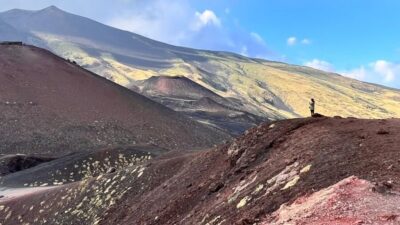
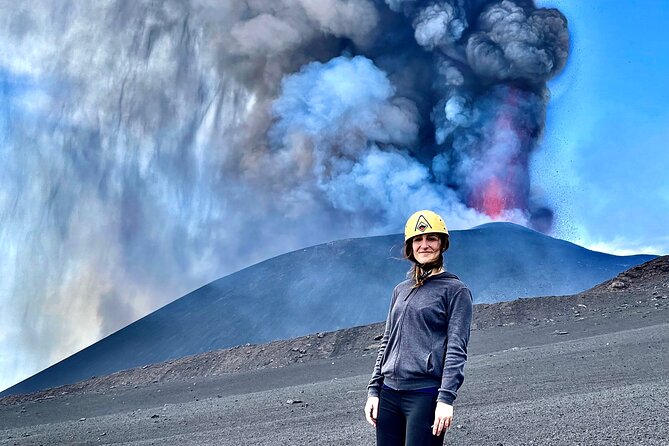
Etna’s north side feels like a different volcano from the busy southern slopes. From Piano Provenzana, you ride an authorized 4×4 through pine forest and the raw lava fields of the 2002 eruption, then walk among older craters, lava tubes, ash, and pioneer plants with a certified volcanological guide. On clear days, the views reach from Catania and Syracuse to Calabria and the Aeolian Islands.
I like the quiet setting and the strong science behind the outing. Guides such as Pepe, Poldo, Linda, and Domenico explain what you are seeing without turning the walk into a lecture, and the supplied boots, poles, helmet, warm jacket, and extra socks make a serious mountain route easier to manage. The main drawback is cost confusion: the listed price is $71.20, but the 4×4 transfer from 1,800 meters requires an additional €50 per person on the spot.
Key points to know before you go
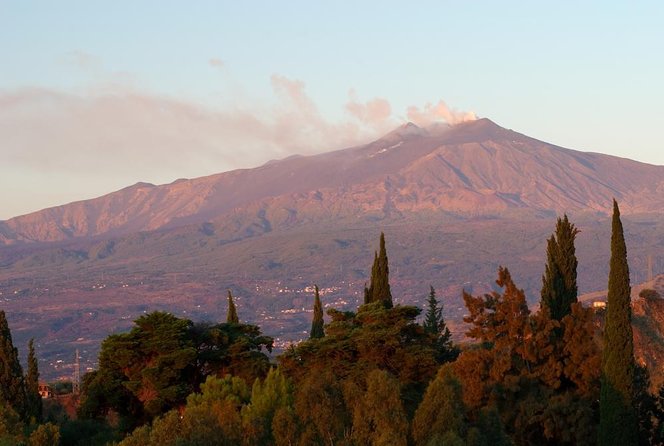
- The north side is Etna’s quieter face: Piano Provenzana sees fewer visitors than the southern station and offers a more natural setting.
- The 2002 eruption is central to the route: You pass destroyed facilities, fresh lava, eruptive fractures, and a partly buried hotel roof.
- The walking is real mountain trekking: Expect about 7 kilometers over loose volcanic soil, ash, and crater edges.
- The guide makes the difference: Pepe, Poldo, Linda, and Domenico are named guides praised for clear explanations and fluent language skills.
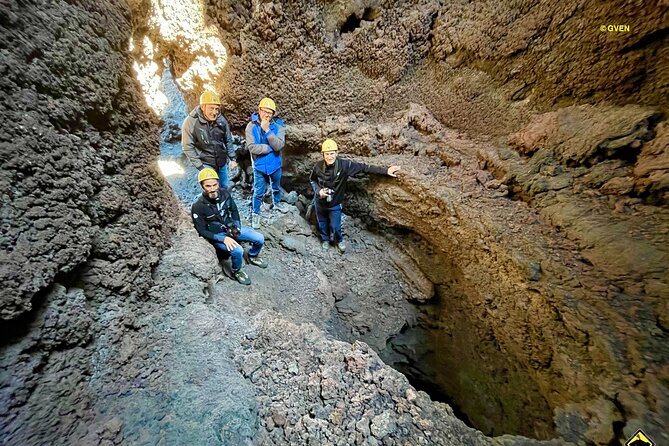
- Equipment is supplied: Boots, trekking poles, helmets, warm jackets, extra socks, and a spare backpack are included, though you still need a windbreaker.
- Weather controls the day: Thunderstorms or unsafe conditions can lead to a new date or a full refund.
Why Etna’s north side feels more authentic
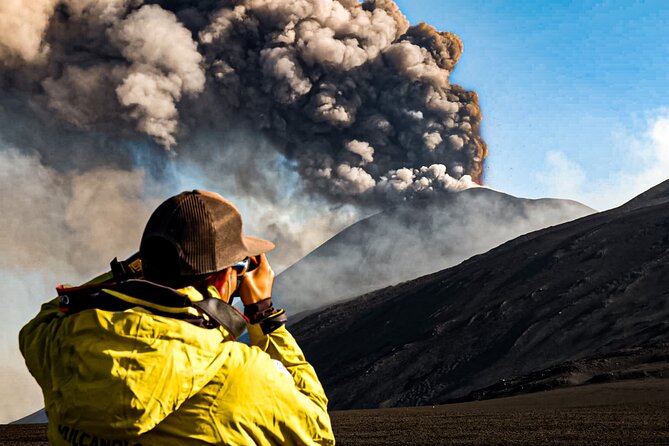
Most first-time visitors approach Mount Etna from the south. That side has the larger tourist infrastructure and can feel crowded. This excursion starts at Piano Provenzana on the north slope, reached by paved public road from Linguaglossa.
At 1,800 meters, Piano Provenzana is a small mountain station bordered by pine woods and black lava. Cafés, bars, souvenir shops, restrooms, and water refill points make it a useful place to prepare. In winter it operates as a ski station. In warmer months it becomes a base for guided hikes and authorized 4×4 trips.
The October 27, 2002 eruption changed this place forever. Lava destroyed the earlier restaurants, hotels, ski lifts, and trails. The remains are not polished museum pieces. They sit partly buried in the lava field, including the roof of an old hotel. That stark reminder gives the first part of the trip a human scale: you are not just looking at old volcanic rock, but at a mountain that can erase a tourist center in a matter of hours.
Parking is in blue-lined spaces and costs €5 for a full weekday or €8 on Sundays and public holidays. You meet the guide at the Chiosco Bar Mareneve di Ferraro, on Via Provenzana. The scheduled start is 7:45 am, so plan to arrive early enough to park, use the restroom, collect equipment, and adjust your footwear without rushing.
More ways up Etna:
- Catania: Mount Etna Morning or Sunset Day Trip with Tasting
★ 4.8 · 4,028 reviews - Mount Etna: Guided Volcano Summit Hiking Tour with Cable Car
★ 4.7 · 3,784 reviews - Catania: Sunset Jeep Tour of Mount Etna and Lava Flow Caves
★ 4.8 · 2,113 reviews
The 4×4 climb through the 2002 lava fields
After a short briefing, the group boards an authorized 4×4 vehicle. Private cars can reach Piano Provenzana, but they cannot continue up the restricted volcanic road. From this point, the route is limited to approved vehicles and licensed guides.
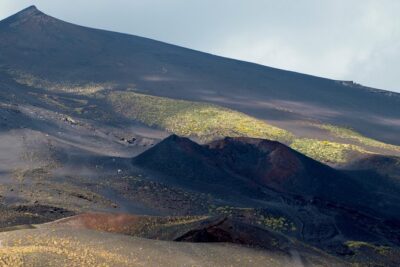
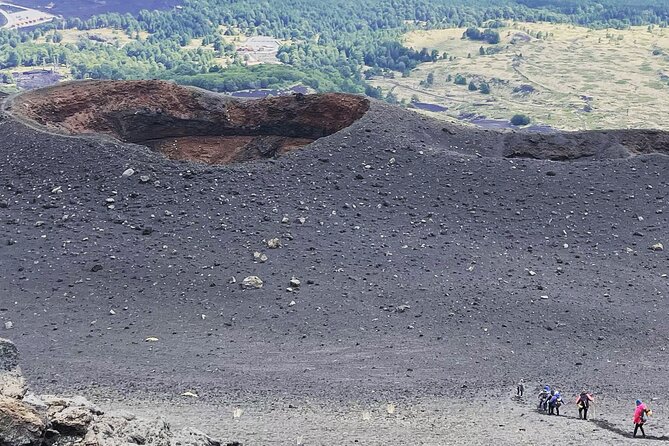
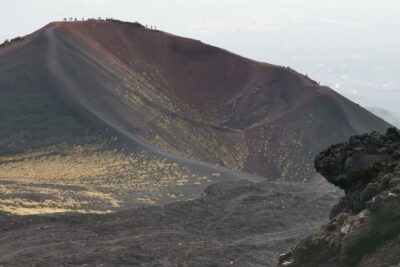
The road climbs through forest first. The trees soften the setting for a while, then the route opens onto broad lava fields. You pass black ridges, deep craters, eruptive cracks, and flows from different eruptions. The contrast is one of the best parts of the outing: green woodland gives way to a gray, brown, and charcoal world with very little shelter.
Your guide explains the volcano as you go. You learn how lava moved, where fractures opened, how monitoring stations track activity, and how plants slowly begin to colonize new rock. Small pioneer plants may look insignificant, but they show how life returns to ground that once reached extreme heat.
The vehicle reaches the Etna Nord Volcanological Observatory near Piano delle Concazze at about 2,860 meters. Some descriptions place the highest point of the route closer to 3,000 meters, depending on conditions and access restrictions. If the summit area is closed, the authorized route does not take you to the summit craters. You can still see steam rising from them above the upper slopes.
The ride itself is part of the attraction, but it is not a luxury transfer. Expect an off-road mountain journey rather than a smooth coach ride. If you are prone to motion sickness, sit where you are most comfortable and bring any personal remedy you normally use. The provided equipment helps with the cold and rough ground, but a windbreaker is not included, so bring one.
Walking among craters from 1614 to 2002
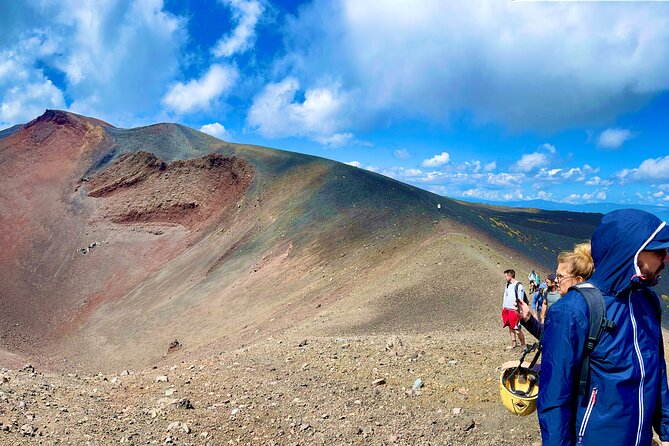
The walking section is the heart of the excursion. The full route is about 7 kilometers, with ascent, crater edges, loose ash, and uneven volcanic ground. Some people describe it as easy to moderate, but the operator asks for good physical fitness, and that is the safer way to view it.
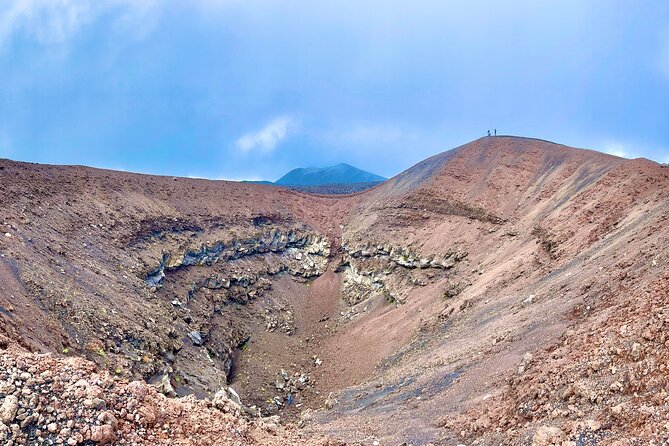
You visit craters and lava features linked to eruptions from 2002, 1911, 1923, 1874, 1879, 1809, 1646, 1614, and 1624. This sequence gives you a useful lesson in Etna’s long activity. Instead of seeing one dramatic crater and moving on, you walk through layers of volcanic change spread across centuries.
The terrain can be unstable. Volcanic soil is often loose underfoot, and the crater edges require care. Trekking poles are supplied for balance, while proper boots protect your feet from sharp rock and ash. Helmets are also provided. You should still watch every step, especially when moving near crater rims or descending through sandy channels.
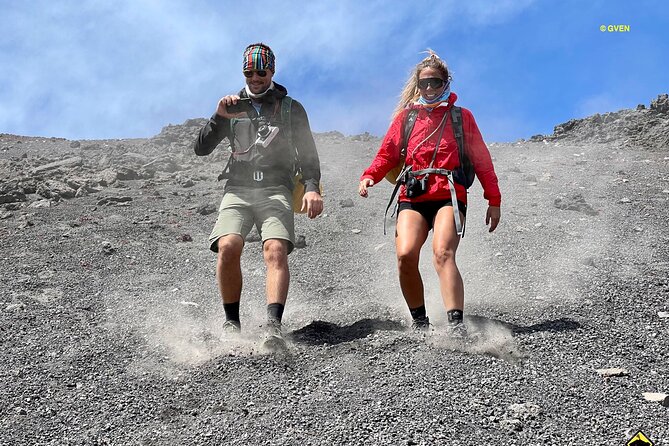
The descent is often the most memorable part. Loose volcanic sand allows you to move quickly, almost sliding downhill, though it can also make your legs work hard. One part of the route follows a sandy channel before returning toward forest and Piano Provenzana. Good boots matter here, and long trousers are sensible even though they are not listed as required equipment.
There is no shade across the upper volcanic plateau. A hat, sunscreen, and plenty of water are important, particularly in June and other warm periods. The air can feel cool at altitude while the sun remains strong. Volcanic gases and ash may also bother your eyes, and contact lenses are discouraged.
The views from Piano delle Concazze
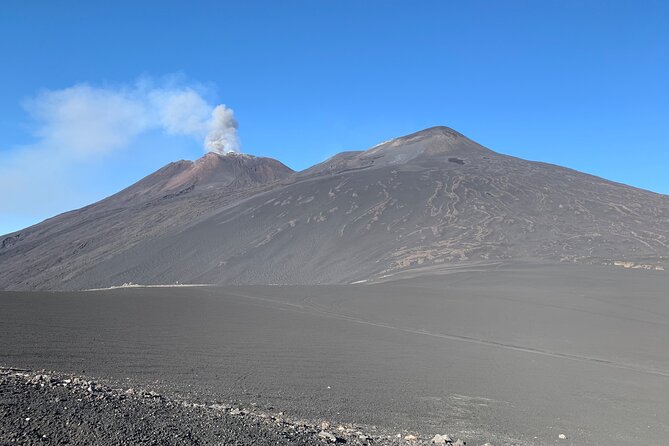
At the high point, the reward is not only the craters beneath your boots. On a clear day, the view opens across much of eastern Sicily. You may see Catania and Syracuse along the coast, the Nebrodi and Peloritani Mountains, the Madonie, Calabria, and the Aeolian Islands.
Clouds can roll across the upper slopes without warning. That is normal on Etna, not a sign that the day has failed. You might have clear views at one moment and a veil of cloud the next. The summit craters may continue to steam above you, reminding you that this is an active volcano rather than an extinct mountain with a dramatic past.
The north route also gives you a quieter viewpoint. There may be stretches when your group has the upper area largely to itself. That calm is valuable. You can hear the guide, study the lava, and stop for photographs without the constant movement found at a larger tourist station.
Do not judge the experience only by visibility. The close details are strong even on a partly cloudy day: layered lava, old crater walls, monitoring equipment, ash channels, fault lines, and hardy plants growing in fresh rock. The setting rewards attention more than a quick photograph.
A few more Sicily days worth weighing up
- Etna Morning Trip
★ 4.5 · 1,241 reviews - Syracuse: Boat Trip of Ortigia Island and Sea Caves
★ 4.7 · 937 reviews - Tour of the island of Ortigia and exploration of sea caves with baths.
★ 5.0 · 668 reviews - Pub Crawl Palermo
★ 5.0 · 595 reviews
Guides who bring the volcano to life
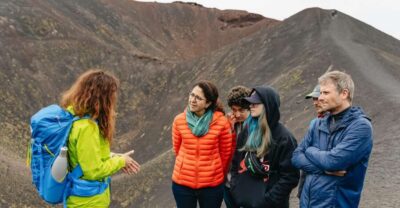
The guide is central to the quality of this experience. Pepe has been praised for clear explanations of volcanic science and for making the route approachable. Poldo has been singled out for a gripping explanation of how volcanoes work, with enough detail to interest curious adults without overwhelming the group.
Linda is described as especially strong on the volcano and surrounding area. Domenico has been noted for fluent Italian, English, and French, along with a friendly manner and a willingness to answer questions. Vincenzo is also described as a volcanologist who can guide in Italian, French, and English.
Names and assignments can change, so you should not book solely for one particular guide. The important point is that this is not simply a driver taking you to a viewpoint. The excursion is led by a licensed volcanological guide who interprets the craters, lava flows, plant life, monitoring stations, and eruption history.
The maximum group size is 20, though the actual group may be smaller. A small group makes it easier to hear explanations and ask questions. It also helps the guide check equipment and pace the walk. That matters on loose ground, where a group that spreads out too far can lose contact.
What the $71.20 price really covers
At $71.20 per person, the advertised price looks competitive for a half-day mountain outing. You receive a licensed guide, accident insurance, entry to Mount Etna, and a useful set of equipment: trekking poles, trekking shoes, helmets, a warm jacket, extra socks, and an additional backpack.
The important catch is the extra 4×4 charge. The supplied details state that €50 per person is paid on site for the authorized vehicle transfer from 1,800 meters toward the upper route, with access references to the 2,800 and 2,500-meter sections. Confirm the exact payment arrangement before you go, since this fee significantly changes the final cost.
You also pay for parking, and transport from your accommodation is not included. That makes this best suited to people with their own rental car or a private vehicle. Piano Provenzana is reachable by paved road, but the excursion does not collect you from your hotel.
For the full package, the value comes from access and interpretation. You are not paying just for a ride uphill. You are getting a guided route into an area where private cars cannot continue, plus safety equipment and a guide trained to explain an active volcano. It is good value if you want to walk across several volcanic zones rather than stop at a single scenic point. It is less attractive if you want a short viewpoint visit with little walking.
Fitness, altitude, and practical preparation
The excursion is suitable for children over six, but the age rule should not be mistaken for an easy family stroll. The route includes altitude, uneven ground, crater edges, and a total walk of roughly 7 kilometers. Children need to walk confidently on loose volcanic soil and follow instructions near unstable ground.
The operator discourages the activity for people with cardiovascular disease, breathing problems, hypertension, or other significant health concerns. You should be honest with the guides about your condition. Altitude, cold, exertion, and volcanic gases can all affect how you feel.
Wear comfortable layers, bring a windbreaker, carry water, and use sun protection. A hat is useful because the upper plateau has no shade. Avoid contact lenses, since ash and volcanic gases can irritate your eyes. The supplied boots and warm jacket help, but they do not replace sensible clothing.
The early start is practical. Morning conditions can be calmer, and you have more time to complete the route before weather changes. Still, mountain weather is never guaranteed. If thunderstorms or other poor conditions make the activity unsafe, the provider offers another date or a full refund.
The route may cause dizziness for people sensitive to heights or crater edges. If you feel unwell, tell the guide immediately rather than trying to keep up. This is a guided volcanic route, not a test of endurance.
Who should book this Etna excursion
I would choose this trip if you want the quieter, more natural side of Etna and you are interested in how eruptions shape a mountain over time. It suits hikers who enjoy a physical walk, amateur geologists, photographers, and anyone who finds the remains of the 2002 eruption as compelling as the views.
It is also a strong choice if you have already seen crowded tourist areas and want a less developed setting. The north side combines forest, old lava, fresh lava, craters, fault lines, and wide views in one half-day outing.
I would think twice if you dislike loose ground, altitude, cold, or long walks. This is not the right choice for someone who wants to stay in a vehicle or make only a short stop near the visitor facilities. The additional €50 vehicle fee should also be part of your decision.
Cancellation is free up to 24 hours before the 7:45 am start. Inside that window, refunds are not available, except when the operator cancels for poor weather or because the minimum group size is not met.
Should you book it?
Book this excursion if you want to understand Etna by walking across its eruption zones, not simply looking at the volcano from below. The north side is quieter, the route is varied, and the guides add real meaning to the craters, lava, plants, and ruined facilities.
Skip it if you want a cheap, effortless scenic ride or if the extra 4×4 charge pushes the final price beyond your budget. For a fit visitor who brings water, layers, sun protection, and a sensible attitude toward mountain conditions, this is one of the more rewarding ways to meet Etna on its own rough terms.
FAQ
Where does the Etna north-side excursion start?
It starts at Chiosco Bar Mareneve di Ferraro, Etna Nord, Piano Provenzana, Via Provenzana, 95015 Linguaglossa CT, Italy. The scheduled start time is 7:45 am.
How long does the experience last?
The excursion lasts about 4 hours and 30 minutes and ends back at the meeting point in Piano Provenzana.
Is the 4×4 vehicle included in the advertised price?
The supplied details list an additional €50 per person paid on site for the authorized 4×4 sections from 1,800 meters toward the upper route. Confirm the exact arrangement before departure.
What equipment is provided?
The tour provides trekking poles, trekking shoes, helmets, a warm jacket, extra socks, and an additional backpack. You need to bring your own windbreaker.
How physically demanding is the walk?
The route covers about 7 kilometers and includes crater edges, high altitude, loose volcanic soil, ash, and sandy descents. A moderate to good level of fitness is required.
What happens if bad weather cancels the excursion?
If poor weather makes the activity unsafe, you can choose another date or receive a full refund. Free cancellation is also available when you cancel at least 24 hours before the start time.
Just added around Sicily
- Zafferana Etnea:Honey extraction workshop and honey tasting★ 4.7 · 3 reviews
- From Trapani: Favignana and Levanzo Yacht Tour with Stops★ 5.0 · 4 reviews
- Mt Etna: Winter Trekking Tour with Optional Catania Transfer★ 4.7 · 13 reviews
- Wine tour with wine tasting★ 4.7 · 18 reviews
- Sicilian Soul: Winery Tour, Wine & Food Tasting in Catania★ 5.0 · 4 reviews
- Wine tasting in Catania Historic center★ 4.4 · 15 reviews
- Valley Of The Temples By E-Bike With Picnic Included★ 4.7 · 7 reviews
- Valley of the Temples and Villa Romana Multi-Language Tour★ 4.8 · 5 reviews
Mount Etna Tours, compared.
Mount Etna Morning or Sunset Day Trip with Tasting
Read our review →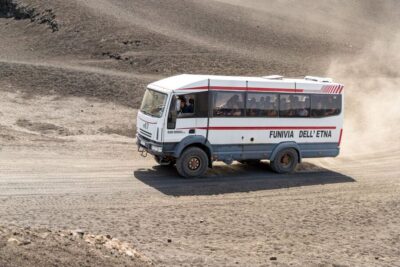
Guided Volcano Summit Hiking Tour with Cable Car
Read our review →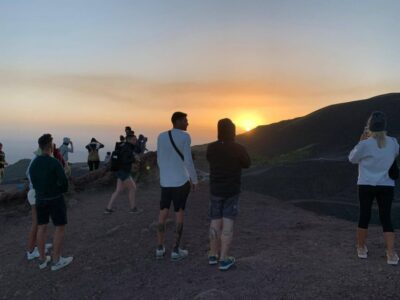
Sunset Jeep Tour of Mount Etna and Lava Flow Caves
Read our review →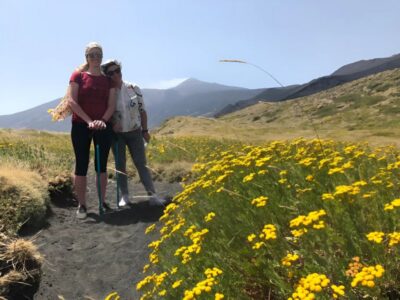
Etna and Alcantara Gorges Full-Day Tour with Lunch
Read our review →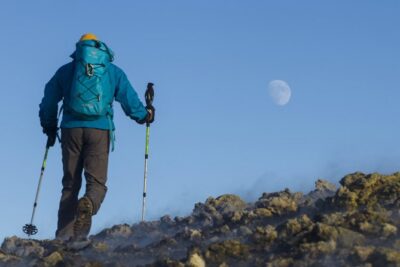
Mount Etna Trekking Trip off the Tourist Path
Read our review →