
Reviewed · HISTORICAL TOURS
Syracuse: Ortigia Deep Dive Cultural Tour (max 6 Guests)
Ortigia is compact, layered, and best understood on foot. This 90-minute cultural walk links Greek ruins, grand squares, Syracuse Cathedral, and the mythical Arethusa Spring, with a guide explaining what you are seeing rather than leaving you to guess.
I like the small six-person limit, which should make it easier to ask questions, and I like the flexible start time. Guide Enrica is described as energetic, friendly, and able to answer questions with ease. The main consideration is that the tour moves quickly, and entry to the Temple of Athena inside the cathedral costs extra.
Key points to know
- Starts at the Temple of Apollo: You begin with one of Ortigia’s oldest and most important Greek remains.
- Ends at Arethusa Spring: The route crosses the historic center and finishes beside a famous freshwater spring by the sea.
- Small group of up to six: This is a more personal format than a standard city walk.
- History or gastronomy focus: The tour can be adjusted around historical sights or food-related interests.
- Flexible meeting time: You can request a time that fits your schedule.
- Temple of Athena entry is optional: The cathedral visit is not included in the tour price.
Why this short Ortigia walk works
Ortigia is the old heart of Syracuse, a place where Greek temples, medieval streets, Baroque facades, and everyday Sicilian life sit close together. A self-guided stroll can show you the sights, but it may not explain why a cathedral contains a Greek temple or how a spring became tied to an ancient myth.
That is the value of this experience. You get a guide’s explanation at five carefully chosen stops, with time to ask questions along the way. The route is short enough to fit into a busy day, yet broad enough to give you a useful first reading of the island.
The group size matters. With no more than six people, you should have a better chance of hearing clearly and getting an answer when something catches your attention. The available feedback specifically praises Enrica’s friendly manner, energy, and ability to bring Ortigia’s past to life. If she leads your walk, expect an involved conversation rather than a speech delivered over a crowd.
The flexible timing is another practical strength. You can choose a meeting time that works around lunch, a museum visit, or an evening reservation. The experience is offered in English, and confirmation arrives when you book.
The tradeoff is depth versus length. Ninety minutes is enough for an orientation and a focused introduction, not a full archaeological study of Syracuse. You will also need to pay separately if you choose to enter the Temple of Athena inside the cathedral.
More Historical Tours in Sicily:
- Palermo: Street Food and History Walking Tour
★ 4.9 · 1,294 reviews - Palermo: UNESCO World Heritage Sites Guided Walking Tour
★ 4.8 · 548 reviews - Palermo: Walking Tour of Historic Markets and Monuments
★ 4.9 · 478 reviews
Starting with the Temple of Apollo
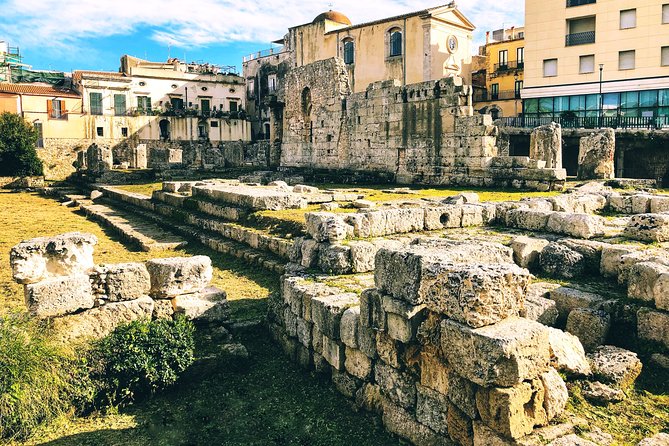
The walk begins at the Temple of Apollo, known in Italian as the Tempio di Apollo. This is an ideal starting point because it immediately places you in the Greek chapter of Syracuse.
The guide explains the temple’s date, placing it in the early sixth century BC. That simple fact gives you a useful sense of scale: Ortigia is not merely a picturesque old town with later churches and palaces. Its story reaches back more than two thousand years.
You should expect about 15 minutes here. Admission to the temple site is free, so there is no extra ticket to arrange for this first stop. The guide’s role is especially useful at a ruin like this, where a few remaining stones can be difficult to read without context.
Look for the chance to ask questions at this point. If you want to understand Greek building traditions, Syracuse’s place in the ancient Mediterranean, or how the site fits into the rest of Ortigia, this is a good moment to speak up. The small group should make that easier.
The temple is an outdoor stop, so wear sensible shoes and plan for changing weather. The tour requires good weather, and poor conditions can lead to a different date or a full refund.
Reading Piazza Archimede and Diana’s Fountain
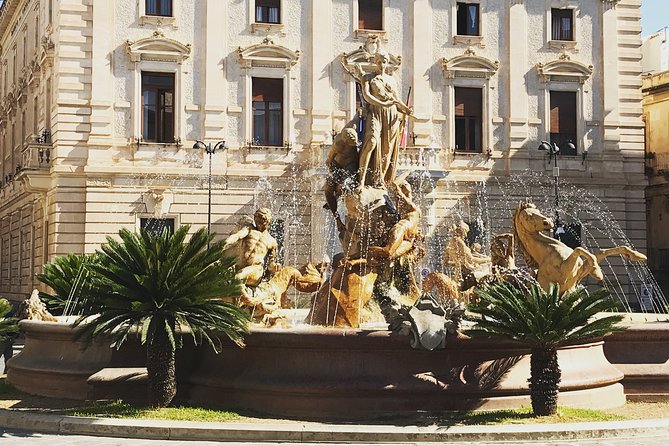
From the Temple of Apollo, the route continues to Piazza Archimede. The square is named for Archimedes, the famous mathematician associated with Syracuse, and its center is marked by the Fountain of Diana.
You spend about 10 minutes here, with the guide explaining the historic buildings around the square. This is not simply a pause for photographs. The surrounding facades help show how Ortigia changed over time, as Greek foundations gave way to later civic and religious buildings.
A guided explanation is helpful in a square like this because the eye tends to jump from one attractive facade to another. You can ask which buildings matter, what periods they represent, and how the square fits into the city’s story.
The short stop also keeps the walk moving. You will not spend half an hour on one building, but you will gain enough information to recognize the main features when you return on your own. I see this as a useful first pass for anyone staying in Syracuse for more than a day.
Piazza Duomo’s grand civic setting
Piazza Duomo is likely to be the visual high point of the route. The square is lined with important historic buildings, and the guide explains the structures around it rather than treating the piazza as a single photo stop.
Allow about 10 minutes for this part of the walk. That is enough to take in the arrangement of the square and hear the main points, though anyone fascinated by architecture may wish for more time afterward.
This is also where the tour’s compact design becomes clear. You are not being led through every side street in Ortigia. Instead, the route chooses a few locations that show how the city’s religious and civic life developed around major public spaces.
If you enjoy asking questions, Piazza Duomo is a good place to do so. The guide can connect the buildings you see with the Greek remains introduced at the first stop. That link is one of the walk’s main strengths: the past is presented as a series of layers, not as isolated monuments.
A few more Sicily days worth weighing up
- Etna Morning Trip
★ 4.5 · 1,241 reviews - Syracuse: Boat Trip of Ortigia Island and Sea Caves
★ 4.7 · 937 reviews - Tour of the island of Ortigia and exploration of sea caves with baths.
★ 5.0 · 668 reviews - Pub Crawl Palermo
★ 5.0 · 595 reviews
Seeing the Temple of Athena inside Syracuse Cathedral
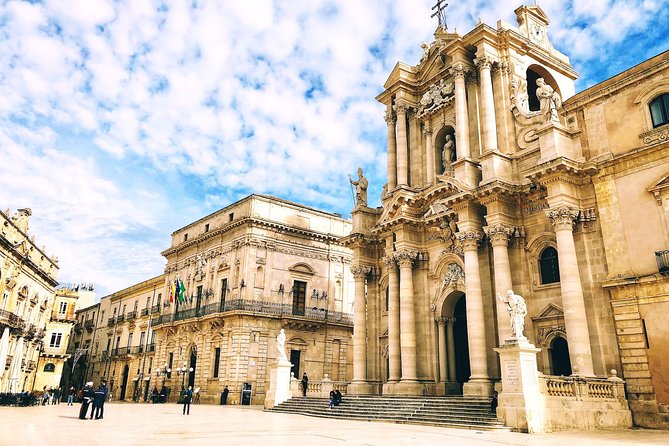
The Temple of Athena is explained from the outside and, if you choose, from the inside. It is incorporated into Syracuse Cathedral, making this the clearest example of ancient and later Syracuse occupying the same structure.
The guided explanation here lasts about 15 minutes. The cathedral entry is optional and is not included in the tour. That distinction matters when you are comparing the experience with other walking tours. You can take part in the outdoor explanation without paying an additional admission fee, then decide if you want to enter.
I like having that choice. Some people want a quick orientation and prefer to continue walking. Others will want to see the interior and understand how the Temple of Athena became part of the cathedral. If this site is a priority for you, allow a little flexibility in your schedule and check the admission cost when booking or on arrival.
Dress smart casual. That is the stated dress code, and it is a sensible rule for a route that includes a cathedral. Comfortable footwear still matters, since this is a walking experience through historic streets.
Finishing at the Arethusa Spring
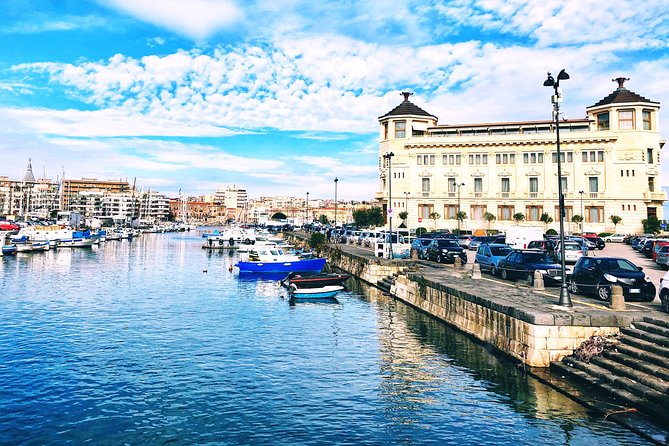
The final stop is the Arethusa Spring, reached at Largo Aretusa. The guide spends about seven minutes explaining the spring and its mythological importance.
Arethusa gives the walk a fitting ending. After Greek temples and grand public buildings, you finish with a natural feature tied to the stories of the ancient world. The stop is brief, but it provides a change of pace and a memorable image of Ortigia.
The end point is also practical. You finish at a clearly identified location rather than returning to the starting point. That can work well if you want to continue exploring, stop for a meal, or make your own way elsewhere in Syracuse.
Because the tour ends here, think about what you want to do next before you start. The activity does not include a return transfer, and the supplied details identify the finish as Largo Aretusa.
What the 90-minute format really gives you
The stated duration is approximately one hour and 30 minutes. The five guided stops add up to about 57 minutes, leaving time for walking between locations, introductions, questions, and any small adjustments to the route.
That makes the schedule feel realistic. You are not expected to stand at one site for the whole time, and you are not being rushed through a long list of attractions. The format gives you a compact introduction with room for conversation.
I would treat it as an orientation tour, not a complete day of sightseeing. If you want to study every church, enter every monument, or spend long periods taking photographs, you will need to continue on your own afterward.
The customizable format may help here. You can choose a history-centered outing or ask about gastronomy-themed activities. The details provided do not promise a meal or tasting, so you should confirm exactly what a food-focused version includes before booking. The important point is that the guide can shape the emphasis around your interests.
Group size, timing, and guide style
The maximum group size is six. That is small enough to feel closer to a private walk than to a standard group excursion, while still keeping the cost below that of a fully private guide in many cases. The actual price is not provided here, so judge the value by comparing it with the cost of other small-group walks in Syracuse.
The strongest reason to pay for this format is access to explanation and conversation. You are paying less for transportation or admission and more for someone to connect the sites. Since most stops have free admission, the experience is best value for people who enjoy context and questions.
The flexible meeting time is useful for real itineraries. Syracuse days often involve trains, archaeological sites, meals, and hot afternoons. A set departure can force you to rearrange everything. A chosen meeting time lets you place the walk where it fits best.
Enrica is the guide named in the available feedback. She is described as friendly, energetic, informative, and able to answer questions easily. Those qualities matter in a short tour because the guide must keep the pace moving while still making the walk feel personal.
Who should book this Ortigia experience
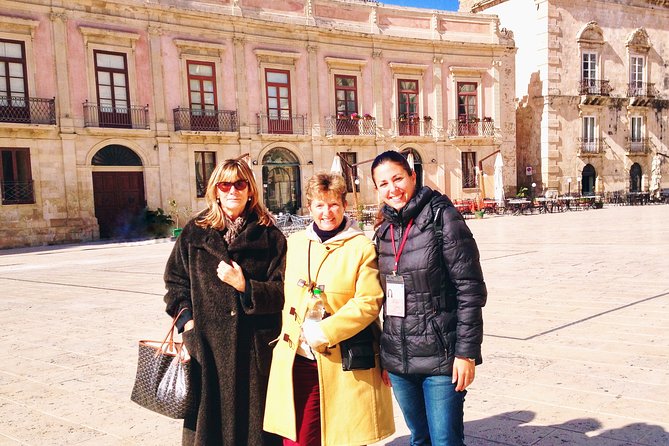
I would recommend it to a first-time visitor who wants a clear introduction to Ortigia without committing to a long walking tour. It also suits couples, families, and small groups who prefer direct contact with a guide.
It is a good fit if you:
- Want the main historic sights explained in English
- Prefer a group limited to six people
- Need a flexible meeting time
- Enjoy asking questions as you walk
- Want a choice between history and a food-related focus
- Are comfortable with an outdoor walking route of about 90 minutes
You may want something else if you need a fully private tour, extensive interior visits, or a detailed archaeological lecture. The Temple of Athena entry costs extra, and the tour does not appear to include food, tastings, or transportation.
Most people can participate, and service animals are allowed. The route is near public transportation, which makes the meeting point practical, though the supplied details do not promise full step-free access. If mobility is a concern, ask the provider about the exact street conditions before booking.
Cancellation and weather points to keep in mind
You can cancel up to 24 hours before the start time for a full refund. Changes made less than 24 hours before the experience are not accepted, and cancellations inside that period are not refunded.
Good weather is required. If poor weather causes the activity to be canceled, you are offered another date or a full refund. This is worth remembering when planning a tightly packed Syracuse visit, especially if the walk is your main introduction to Ortigia.
Should you book it?
Book this walk if you want a short, personal introduction to Ortigia with a guide who can explain the links between Greek Syracuse, later religious buildings, and the city’s public squares. The small group, flexible time, English commentary, and chance to ask questions give it a practical edge.
Skip it if you prefer to explore entirely alone or want long visits inside each monument. For most first-time visitors, though, this is a sensible way to get oriented, then return to the Temple of Athena, Piazza Duomo, or another favorite spot at your own pace.
FAQ
How long does the Ortigia cultural tour last?
The tour lasts approximately one hour and 30 minutes.
Where does the tour start?
It starts at the Temple of Apollo, also called the Apollonion, in Syracuse.
Where does the tour end?
The tour ends at Arethusa Spring at Largo Aretusa in Ortigia.
How many people can join the tour?
The group has a maximum of six travelers.
Is the tour offered in English?
Yes. The experience is offered in English.
Is admission to the Temple of Athena included?
No. Entry to the Temple of Athena inside Syracuse Cathedral is optional and requires a separate fee.
Can I choose the meeting time?
Yes. You can choose the time of day you would like to meet, subject to availability.
What happens if bad weather cancels the tour?
You will be offered a different date or a full refund if poor weather causes the experience to be canceled.
Just added around Sicily
- Zafferana Etnea:Honey extraction workshop and honey tasting★ 4.7 · 3 reviews
- From Trapani: Favignana and Levanzo Yacht Tour with Stops★ 5.0 · 4 reviews
- Mt Etna: Winter Trekking Tour with Optional Catania Transfer★ 4.7 · 13 reviews
- Wine tour with wine tasting★ 4.7 · 18 reviews
- Sicilian Soul: Winery Tour, Wine & Food Tasting in Catania★ 5.0 · 4 reviews
- Wine tasting in Catania Historic center★ 4.4 · 15 reviews
- Valley Of The Temples By E-Bike With Picnic Included★ 4.7 · 7 reviews
- Valley of the Temples and Villa Romana Multi-Language Tour★ 4.8 · 5 reviews
Historical Tours, compared.

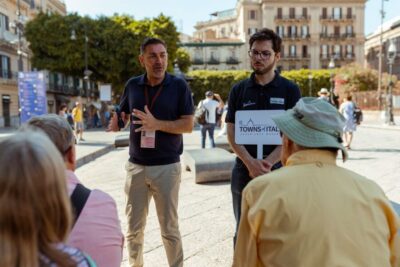
UNESCO World Heritage Sites Guided Walking Tour
Read our review →
Walking Tour and street food Tour Palermo / History and Food
Read our review →
Discover Palermo in 3 hours. Art, history, markets and street food
Read our review →
Palermo in 2 hours Main monuments and historic markets
Read our review →
Browse the lists this tour appears in