Reviewed · PRIVATE
Private Tour of Syracuse in 6 hours with Enrica De Melio
Syracuse makes its strongest first impression underground, inside the Ear of Dionysius, a huge stone quarry shaped by ancient excavation and later legend. From there, PhD archaeologist Enrica De Melio leads you through Greek and Roman Syracuse, then across to Ortigia for temples, churches, piazzas, and sea views.
I like the private format, which gives your group room to ask questions and set the pace. I also like the order of the day: Neapolis gives you the ancient setting, while Ortigia shows how Greek, Roman, medieval, and Baroque Syracuse still share the same streets. The main consideration is cost, especially for a small group, since admission tickets and transportation are extra.
Key points to know before booking
- The Ear of Dionysius comes first: See Syracuse’s famous quarry, the Cave of the Rope-makers, Greek Theatre, Altar of Hieron II, and Roman Amphitheater.
- Enrica is an archaeologist: Her explanations focus on context, dates, construction, and the stories behind each site.
- Ortigia finishes the tour: Walk from the Temple of Apollo to Duomo Square, the Cathedral of Syracuse, and Arethusa Spring.
- Your group stays private: The activity is for your party only, with a maximum of eight people.
- Budget for extras: Neapolis admission costs 17 euros per person, the cathedral costs 2 euros, and transport and lunch are not included.
- Plan ahead: The tour begins at 9:30 a.m. and is often reserved well before the visit date.
Why this Syracuse tour works so well
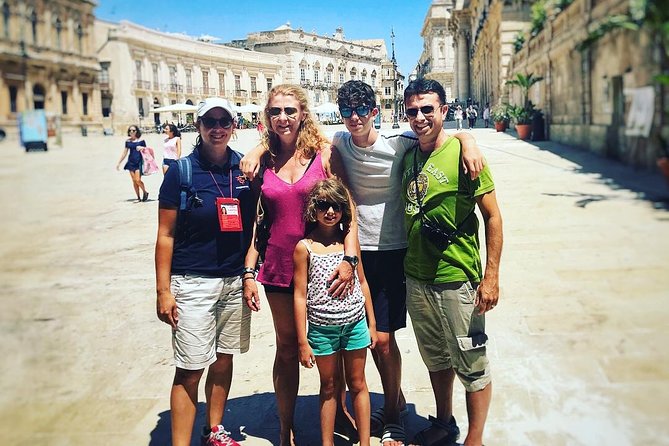
Syracuse is easier to understand when you see its two main parts together. Neapolis is the city’s great archaeological zone, with open-air monuments built for Greek drama, Roman entertainment, religious ceremony, and quarry work. Ortigia is more intimate. Its lanes lead to churches, temples, palaces, and fountains beside the water.
A standard sightseeing walk can leave these places as disconnected stops. This private tour gives Enrica time to explain how they fit together. I particularly like the chronological route through Neapolis. You start with the ancient quarries, then move to the Greek Theatre, the Altar of Hieron II, and the Roman Amphitheater. That progression helps you see how Syracuse changed over centuries.
Enrica’s background matters here. She is identified as a PhD archaeologist, and the strongest praise connected with her guiding style focuses on accuracy, clear explanations, warmth, and enthusiasm for Syracuse. That mix is useful at archaeological sites, where a pile of stones can be hard to read without a trained guide.
The private setting also changes the feel of the visit. Your family or friends can ask about a particular period, pause for clarification, or spend more time on a monument that catches your attention. You are not tied to the questions or pace of a large group.
A few more Sicily days worth weighing up
- Etna Morning Trip
★ 4.5 · 1,241 reviews - Syracuse: Boat Trip of Ortigia Island and Sea Caves
★ 4.7 · 937 reviews - Tour of the island of Ortigia and exploration of sea caves with baths.
★ 5.0 · 668 reviews
Entering Neapolis and the Ear of Dionysius
The tour begins at Parco Archeologico della Neapolis, at Via Luigi Bernabò Brea 14. The meeting time is 9:30 a.m. The park admission is not included, so budget 17 euros per person. Admission is free for anyone under 18.
The first stop is the Quarry of Paradise, known for the Ear of Dionysius. This is one of Syracuse’s most memorable sights because the place combines dramatic stonework with a story that has lasted for centuries. The quarry was cut into the limestone, and its unusual shape gave rise to the famous name.
Enrica can help you separate the physical site from the legends attached to it. That is one of the real advantages of having an archaeologist at a place like this. You get more than a quick look into a cavern. You get an explanation of how the quarry was made and why it mattered to Syracuse.
The Cave of the Rope-makers is also part of this opening section. Its name points to the practical work that took place in these excavated spaces. This is a good reminder that the archaeological park was not built as a collection of monuments for modern sightseers. It was a working part of the ancient city.
The quarries can involve uneven ground and walking outdoors, so the moderate fitness requirement is worth taking seriously. Wear sensible shoes, especially if the day is warm or the surfaces are rough.
Greek drama at the ancient theatre
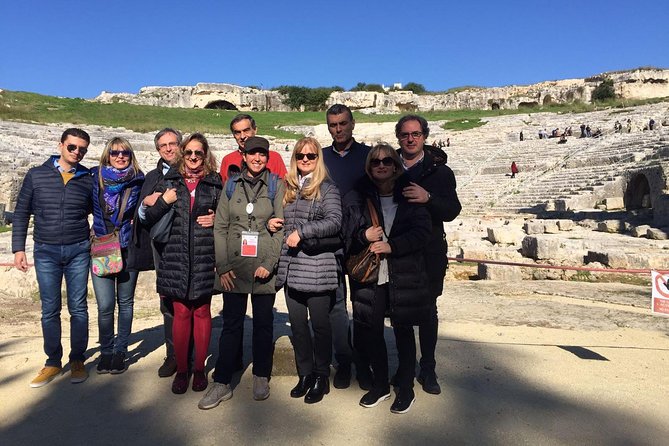
Next comes the Greek Theatre, one of the major reasons to visit Neapolis. Its broad seating area and open setting make it easier to picture Syracuse as an important Greek city, not simply a modern Sicilian town with ancient remains nearby.
A guide adds value here because the theatre is best understood as a civic space, not just a pretty ruin. Enrica’s chronological approach gives you a way to think about its construction and use within the larger story of Syracuse.
The tour description allows about 1 hour and 30 minutes for the Neapolis visit. That is enough time for a guided look at the principal monuments, though it is not the sort of schedule that encourages a long, unhurried sit at every viewpoint. If you enjoy archaeological detail, use your private format well and tell Enrica what interests you most.
The park is an open-air site, so weather affects comfort. The activity requires good weather, and a cancellation caused by poor conditions leads to either a different date or a full refund. Bring water and sun protection as sensible precautions, though lunch is not provided.
The Altar of Hieron II and Roman Amphitheater
The route continues to the Altar of Hieron II, described as the largest in the world. Even when little remains of an ancient structure, scale can make the site memorable. Enrica’s explanations help you imagine the monument’s purpose and place it within the religious life of Syracuse.
The final Neapolis stop is the Roman Amphitheater. Its presence shows the city’s later Roman chapter and gives the park a useful contrast with the Greek Theatre. You are not looking at one single period. You are moving through layers of political power, public entertainment, religion, labor, and urban change.
This is where the tour’s archaeological focus pays off most. A guide can point out why the Greek and Roman venues were built differently and what those differences tell you. The experience is less about collecting famous names and more about seeing how one city was repeatedly reshaped.
The park visit is listed as 1 hour and 30 minutes, while the full experience lasts about 5 to 6 hours. That means the day includes time beyond the two timed walking sections, but the exact use of that time is not specified. Since transportation between attractions is not included, confirm the practical plan with the provider if you need help arranging transfers.
Booked from the same base, and a completely different kind of day:
- Catania: Mount Etna Morning or Sunset Day Trip with Tasting
★ 4.8 · 4,028 reviews - Mount Etna: Guided Volcano Summit Hiking Tour with Cable Car
★ 4.7 · 3,784 reviews - Palermo: NO Mafia Walking Tour
★ 4.8 · 2,431 reviews - Palermo: Hop-on Hop-off Bus Tour 24-hour Ticket
★ 3.9 · 2,410 reviews
Crossing into Ortigia
The second half takes place on Ortigia, the small island linked to Syracuse by bridges. Ortigia feels different from Neapolis. Instead of broad archaeological grounds, you walk through streets and squares where ancient remains sit beside churches and Baroque buildings.
The guided walk is also listed as about 1 hour and 30 minutes. It ends at Arethusa Spring, at Largo Aretusa. That makes the route useful if you want to continue exploring Ortigia afterward or stop for a meal nearby. Lunch is not included, so you should plan your own break after the tour or ask Enrica for practical suggestions.
Ortigia is best enjoyed on foot. The route connects several important sights without requiring a separate sightseeing vehicle. Still, remember that transport to and from the attractions is not part of the price. You must make your own way to the Neapolis meeting point and arrange your return from the Arethusa Spring finish.
Temple of Apollo and the old heart of the island
The Temple of Apollo dates to the sixth century BC and is one of the key ancient sights on Ortigia. Its remains give you a direct link to the Greek foundation of the island.
The temple is especially useful as a starting point because it sets up the contrast that follows. You move from a Greek sanctuary to later streets and buildings shaped by many periods. Enrica can explain the changes rather than treating the temple as an isolated photo stop.
The walking route through Ortigia includes the island’s most important sights, but you should expect a city walk rather than a quiet archaeological park. Streets, squares, and public areas form part of the experience. Comfortable shoes and smart casual clothing are recommended.
Duomo Square and the Cathedral of Syracuse
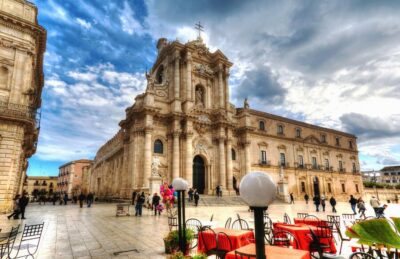
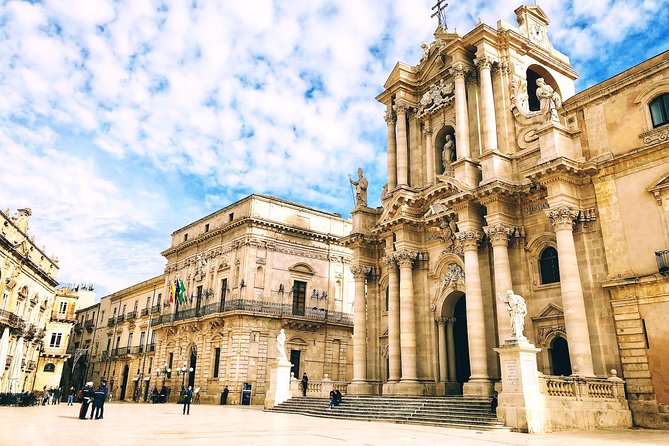
Duomo Square is the visual center of the Ortigia walk. Baroque palaces frame the square, while the Cathedral of Syracuse occupies an even older sacred site.
The cathedral incorporates the Temple of Athena, so this one building brings several chapters of Syracuse together. The ancient temple did not simply vanish when later religious buildings appeared. Its columns and earlier structure remain part of the cathedral’s story.
Entry to the cathedral costs 2 euros per person and is not included in the tour price. That is a small extra, but it is easy to overlook when comparing tour costs. If seeing the interior matters to you, bring the admission fee and allow enough time within the walking schedule.
This stop also shows why a local archaeological guide can make a difference. The square is attractive on its own, but Enrica can help you notice what is ancient, what is Baroque, and how the cathedral connects the two.
Arethusa Spring and the end of the route
The tour ends at Arethusa Spring, a freshwater spring near the water. It is one of Ortigia’s best-known landmarks and provides a natural finish after the temples, ruins, and formal square.
The end point is practical. You are left in central Ortigia rather than returned to the archaeological park. That works well if you plan to keep walking, find lunch, or spend the rest of the day on the island. It is less convenient if you need to return immediately to a cruise ship or hotel outside the center, since no return transport is included.
If your schedule depends on a ship arrival, take special care. A missed tour caused by a late or non-arriving cruise ship is not refundable. This is a private booking, but that policy still applies.
What Enrica adds to the experience
The strongest quality associated with Enrica is not simply factual knowledge. It is her combination of archaeological training, cheerful manner, patience, and personal connection to Syracuse.
Her guiding style is described as detailed and engaging, with attention to the setting as well as the monuments. She has also taken care with accessibility in other sightseeing arrangements, checking sites for a person with a physical disability. That does not guarantee that every part of this route is fully accessible, so you should discuss your needs before booking. The stated requirement is moderate physical fitness.
I also like the evidence of flexibility in her work. She has guided Ortigia and the archaeological park in different orders and across separate sessions. For your booking, the listed plan starts in Neapolis and continues to Ortigia, but a private guide is usually better suited to conversation and adjustment than a large scheduled group.
The Italian-language feedback supplied with the experience repeatedly praises her competence, sunny personality, availability, and ability to make monuments understandable. Her replies are warm and personal, which fits the impression of a guide who enjoys meeting people rather than simply reciting prepared facts.
Price, group size, and real value
The listed price is $361.11 for a private group of up to eight people. At the full eight-person limit, that works out to about $45 per person before entrance fees. For four people, it is about $90 per person, and for two, about $181 per person.
That makes the tour much better value for a family or group of friends than for a couple. The fee pays for a private archaeologist guide, not for transportation, lunch, or admission. Add 17 euros per person for Neapolis and 2 euros for the cathedral if you enter both.
I would consider the price reasonable for a group that wants serious historical explanation and a private pace. If you only want a quick look at the main monuments, the cost may feel high. If you value questions, context, and a guide focused only on your party, the private arrangement is easier to justify.
The average booking lead time is 56 days. That suggests you should not leave this until the last minute, especially if your visit falls during a busy season or your schedule is fixed by a cruise.
Who should book this tour
I would recommend it most to:
- Families and friends who can share the private group price
- People who want archaeology explained in plain language
- First-time visitors who want both Neapolis and Ortigia in one day
- Couples who prefer a personal guide and do not mind the higher per-person cost
- Visitors who enjoy walking and can manage uneven archaeological ground
- Anyone with a strong interest in Greek and Roman Syracuse
I would be more cautious if you need included transportation, a relaxed meal break, or a tour built around minimal walking. The route covers important ground, and the archaeological park is not a place for dress shoes or a hurried schedule.
Should you book the Syracuse private tour?
Book it if you want Syracuse explained by an archaeologist rather than viewed as a string of attractive ruins. The combination of the Ear of Dionysius, Greek Theatre, Altar of Hieron II, Roman Amphitheater, Temple of Apollo, Duomo Square, and Arethusa Spring gives you a strong introduction to the city.
The best value comes with a group of four to eight people. Add the admission fees, arrange your own transport, wear practical shoes, and protect the morning from ship delays. For a small private party that values clear history, personal attention, and a guide with real affection for Syracuse, this is a well-focused way to spend five to six hours.
FAQ
How long does the Syracuse private tour last?
The experience lasts approximately 5 to 6 hours. The guided visit to Neapolis is listed at about 1 hour and 30 minutes, and the guided walk through Ortigia is also about 1 hour and 30 minutes.
What time does the tour start?
The tour starts at 9:30 a.m.
Where does the tour begin?
The meeting point is Parco Archeologico della Neapolis, Via Luigi Bernabò Brea 14, 96100 Siracusa, Italy.
Where does the tour end?
The tour ends at Arethusa Spring, Largo Aretusa, in Ortigia.
Is transportation included?
No. Transportation to and from the attractions is not included.
Are entrance tickets included?
The Neapolis Archaeological Park ticket is not included. It costs 17 euros per person, with free admission for anyone under 18. The Cathedral of Syracuse ticket is also extra and costs 2 euros per person.
Is lunch included?
No. Lunch is not included.
How many people can join the private tour?
The price covers a private group of up to eight people. Only your group participates.
Is the tour suitable for someone with limited mobility?
The experience requires a moderate level of physical fitness. If you have specific accessibility needs, contact the provider before booking, since the supplied information does not confirm full accessibility for every part of the route.
Can I cancel for a refund?
Yes. You can cancel at least 24 hours before the local start time for a full refund. Cancellations or changes made less than 24 hours before the start are not refunded or accepted. If poor weather causes the tour to be canceled, you will be offered another date or a full refund.
Just added around Sicily
- Zafferana Etnea:Honey extraction workshop and honey tasting★ 4.7 · 3 reviews
- From Trapani: Favignana and Levanzo Yacht Tour with Stops★ 5.0 · 4 reviews
- Mt Etna: Winter Trekking Tour with Optional Catania Transfer★ 4.7 · 13 reviews
- Wine tour with wine tasting★ 4.7 · 18 reviews
- Sicilian Soul: Winery Tour, Wine & Food Tasting in Catania★ 5.0 · 4 reviews
- Wine tasting in Catania Historic center★ 4.4 · 15 reviews
- Valley Of The Temples By E-Bike With Picnic Included★ 4.7 · 7 reviews
- Valley of the Temples and Villa Romana Multi-Language Tour★ 4.8 · 5 reviews
Private, compared.

Private 6-Hour Tour of Three Etna Wineries with food&wine tasting
Read our review →
Godfather vs Mafia Tour & Pasta Lunch (Small Group or Private)
Read our review →
Private/Guided Godfather with appetizer and Pasta
Read our review →
Etna Countryside Food & Wine Lovers Tour (Small Group or Private)
Read our review →
Private tour of Etna and Winery Visit with Food and Wine Tasting from Taormina
Read our review →