Reviewed · SICILY TOURS
Summer Special: late afternoon tour by Palermo Wonders
Palermo’s old town makes more sense when someone connects its Arab-Norman churches, Baroque squares, grand opera house, and street markets for you. This late-afternoon walk brings those pieces together, ending near La Vucciria and the waterfront after the heat of the day has eased.
I like the small private group, which gives you more room to ask questions than a large city walk. I also like the mix of major sights and everyday Palermo, especially the market stop and the chance to see vendors at work. The possible drawback is the price: at $98, it offers strong value for a private outing, but less so if you are traveling alone or only want a quick orientation.
Key points at a glance
- Late-afternoon timing: Start at 5 pm, a useful choice in warm weather and a good fit for an evening meal afterward.
- Private group format: The outing is for your group alone and is designed around a guide with just six participants.
- Major sights in one walk: See Quattro Canti, Piazza Pretoria, the cathedral area, Martorana, Teatro Massimo, Via Vittorio Emanuele, and more.
- Santa Caterina visit included: The guided visit includes the church and its cloister, though entrance tickets are not included.
- Palazzo Butera adds something different: Allow about an hour for this modern cultural stop, with admission extra.
- Market life at La Vucciria: Finish with one of Palermo’s old street markets and its food stalls.
Why a 5 pm start works well in Palermo
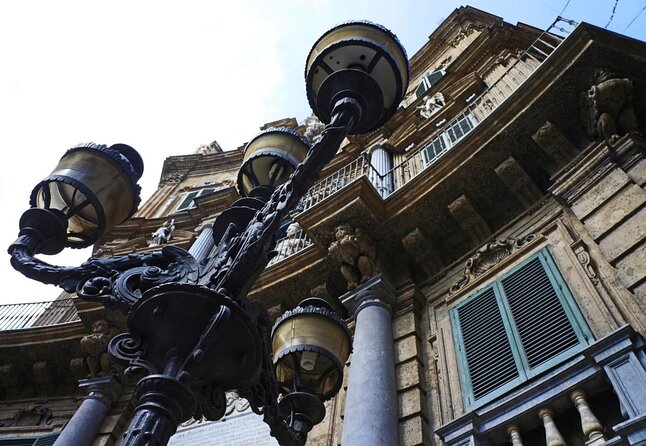
This is not a rushed checklist through Palermo’s center. The tour lasts about 2 hours and 45 minutes, and its 5 pm start gives the day a practical rhythm. You can spend the morning at the Norman Palace or the cathedral on your own, rest during the hotter part of the afternoon, then meet your guide on Via Maqueda at 5 pm.
The late start also suits Palermo’s character. The city’s streets are at their most interesting when the day is winding down, although the exact feel of the markets and food stalls can vary. The tour is described as a summer special, so the timing is clearly meant to make walking more comfortable.
You finish at Porta Felice near Foro Italico. That gives you a useful end point by the waterfront rather than returning you to the original meeting place. The start is on Via Maqueda, 199, while the walk ends at Porta Felice. Both points are near public transportation, but you should still allow time to find the meeting point before 5 pm.
A few more Sicily days worth weighing up
- Etna Morning Trip
★ 4.5 · 1,241 reviews - Syracuse: Boat Trip of Ortigia Island and Sea Caves
★ 4.7 · 937 reviews - Tour of the island of Ortigia and exploration of sea caves with baths.
★ 5.0 · 668 reviews
Quattro Canti and Piazza Pretoria set the scene
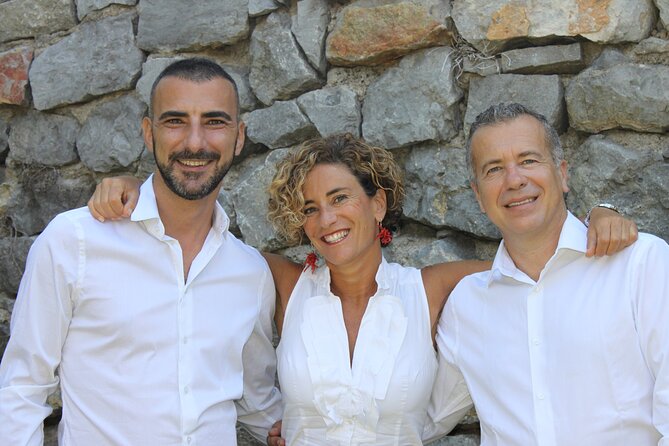
The walk begins at Quattro Canti, one of Palermo’s most striking Baroque squares. Four curved façades frame the crossing, creating a theatrical urban room at the meeting of two important streets. Your guide can help you read the layered decoration instead of treating it as just a pretty photo stop.
The scheduled visit here is about 10 minutes, so expect an introduction rather than a long architectural lecture. That is sensible. Quattro Canti is open space, and its meaning becomes clearer when paired with the nearby monuments.
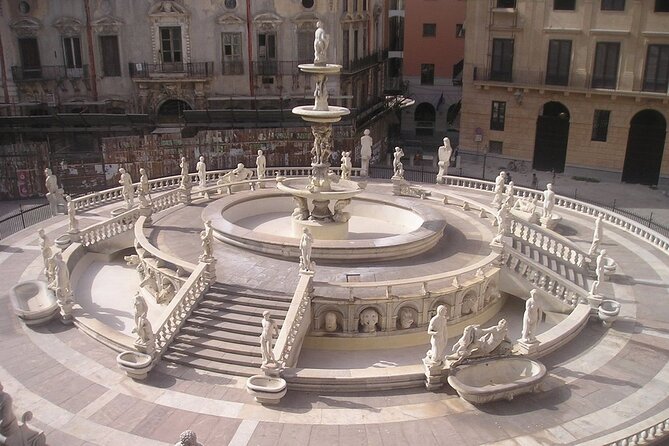
From there, you reach Piazza Pretoria, another short stop of about 10 minutes. The square is known for its large Renaissance fountain in front of City Hall. The setting brings together civic power, sculpture, and the dense old center in a compact view.
The itinerary also includes City Hall and the nearby square of the three churches. These details matter because Palermo’s center is not built around one single style. Within a short walk, you can move from Renaissance design to Baroque decoration and then to Arab-Norman forms.
Three churches and the Arab-Norman layer
One of the most useful parts of this walk is the attention given to Palermo’s mixed architectural character. You will see the famous three red domes and Arab-Norman architecture, with Santa Maria dell’Ammiraglio, also known as Martorana, listed as a possible replacement for one part of the visit.
The exact church arrangement can change, so you should not assume every interior listed will be entered in the same way. Still, the focus is clear: Palermo’s most important religious buildings are places where different cultures and periods meet.
The cathedral is also part of the central route. The stop is valuable even if the visit is mainly exterior, since the cathedral area helps you understand the scale and importance of the old city. Teatro Massimo, Palermo’s major opera house, is another headline sight included in the wider walk. These are the places that first-time visitors usually want to locate, but the guide adds context that a map cannot provide.
A small-group setting is especially helpful around churches. You can ask why a feature matters, how the building changed over time, or which interior is worth returning to later. The tour is not simply about seeing façades. It helps you decide where to spend more of your own time.
Santa Caterina offers the walk’s quietest moment
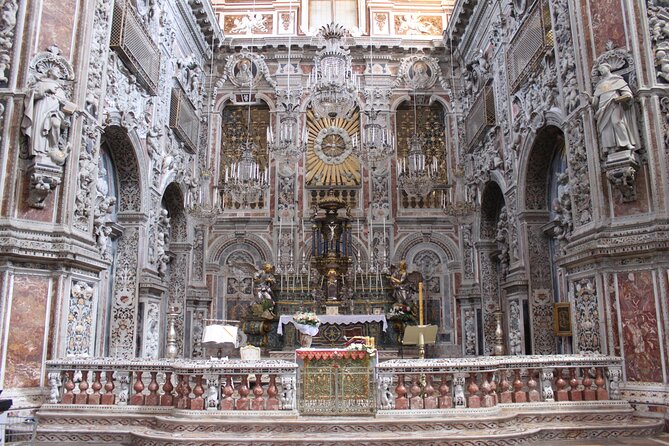
The Church and Monastery of Santa Caterina d’Alessandria provides a change of pace. The visit includes the cloister, described as a peaceful place in the middle of the city. After the traffic, squares, and busy streets, this enclosed space gives the walking route a calmer center.
The guided visit to Santa Caterina is included, but entrance tickets are not. That distinction is important when comparing the $98 price with a self-guided walk. You should plan for extra admission costs at this stop, and for other interiors where tickets are required.
The cloister is also one of the more personal parts of the route. Quattro Canti and Teatro Massimo are grand public sights. Santa Caterina feels more intimate, with architectural details that reward a slower look. If you care about church interiors and old convent spaces, this may be one of the tour’s strongest sections.
At the same time, the route does not promise a full architectural inspection of every church. You are covering a lot of Palermo in one afternoon. Think of Santa Caterina as a focused visit within a broader introduction.
Booked from the same base, and a completely different kind of day:
- Catania: Mount Etna Morning or Sunset Day Trip with Tasting
★ 4.8 · 4,028 reviews - Mount Etna: Guided Volcano Summit Hiking Tour with Cable Car
★ 4.7 · 3,784 reviews - Palermo: NO Mafia Walking Tour
★ 4.8 · 2,431 reviews - Palermo: Hop-on Hop-off Bus Tour 24-hour Ticket
★ 3.9 · 2,410 reviews
Via Vittorio Emanuele connects the old city
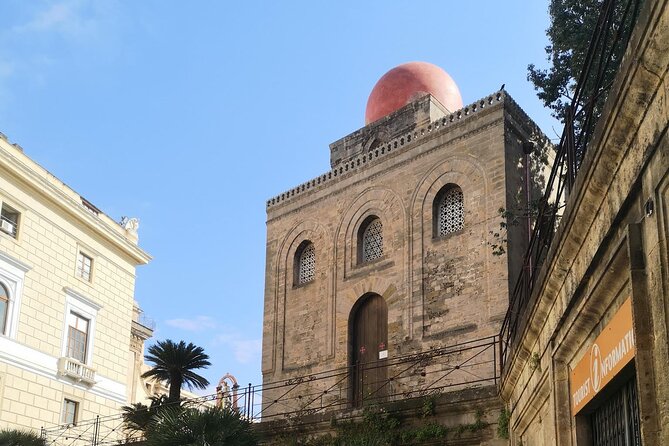
The walk continues along Via Vittorio Emanuele, identified as Palermo’s oldest street. The route spends about 30 minutes here, which gives your guide time to explain the street as more than a passage between monuments.
This is where the tour’s structure makes sense. Palermo’s major churches and squares are not isolated attractions. They sit along streets shaped by centuries of movement, commerce, government, and worship. Walking the route helps you see how the city’s center fits together.
You will also pass a picturesque Palermo square before reaching the next stops. The itinerary does not name this square, so do not book the tour expecting a specific additional landmark. Instead, treat it as part of the walk between better-defined sights.
For you, the main value of Via Vittorio Emanuele is orientation. After the tour, you should have a clearer sense of how to move between the cathedral, central squares, market areas, and waterfront. That is useful if you plan to explore Palermo on foot for another day or two.
Oratorio di San Lorenzo and the missing Caravaggio
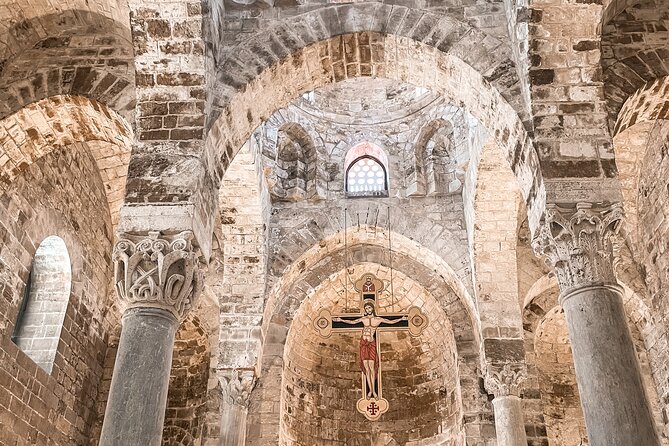
Oratorio di San Lorenzo is a short stop of about 10 minutes. Its unusual talking point is the stolen Caravaggio, a famous work that is no longer there. That absence is part of the site’s story, and it gives the guide a chance to explain why the oratory remains important even without its celebrated painting.
Admission is not included. The stop may therefore work best for you if you are interested in art, church interiors, and the stories behind Palermo’s losses, rather than only in collecting exterior photographs.
Because the scheduled time is short, ask your guide your most important question here. You may not have time for an extended visit, and the route has several other stops still ahead.
Piazza Marina and the one-hour Palazzo Butera pause
Piazza Marina brings the group toward the waterfront side of the old city. The square includes the Garibaldi Garden and offers a different kind of Palermo setting, with more open space after the narrow streets and dense blocks of the center.
The listed time here is about 10 minutes. That makes it a brief orientation stop, not a long garden visit. It is still useful as a transition before Palazzo Butera.
Palazzo Butera is the itinerary’s longest single stop, with about one hour assigned to it. It is described as one of Palermo’s most innovative places, so this section shifts the tour away from medieval and Baroque landmarks toward a more recent cultural setting.
Admission is not included, and the one-hour allocation suggests that the palace is meant to be experienced rather than merely pointed out from the street. If you enjoy contemporary cultural spaces alongside old architecture, this may be the part that makes the walk feel less predictable.
There is also a practical point here: the full program is ambitious. The route includes many outdoor sights, Santa Caterina, Oratorio di San Lorenzo, Palazzo Butera, and a market. Since the total tour time is approximately 2 hours and 45 minutes, the listed durations should be treated as guides rather than guarantees. Ask at the start how the guide plans to handle entrances and timing.
La Vucciria brings the walk back to daily life
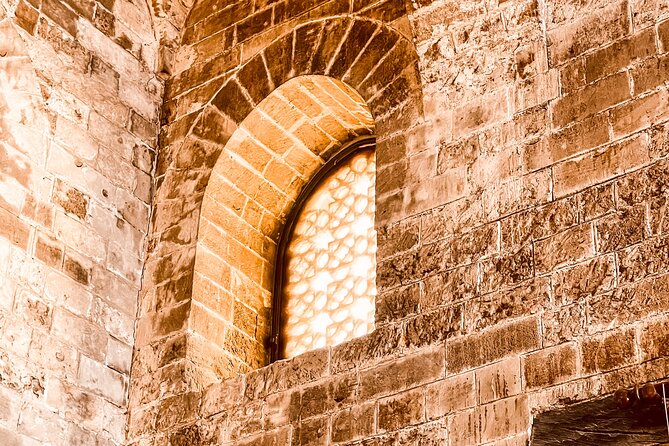
The tour ends with about 15 minutes at La Vucciria, one of Palermo’s historic street markets. This is a good choice for the final stop because it moves you from formal monuments to food, commerce, and street life.
You can see street-food vendors at work and get a sense of how Palermo’s market culture differs from a museum visit. The time is brief, so you should not expect a full market meal or a long food crawl. It is better viewed as an introduction that helps you decide if you want to return later.
Market conditions can change during the day, so the exact selection and level of activity are not guaranteed. Still, ending here gives the tour a human scale. You have spent the afternoon looking at churches, fountains, palaces, and public squares. La Vucciria reminds you that Palermo is also a city where people shop, cook, eat, and meet.
Since the tour ends at Porta Felice, you can continue toward Foro Italico after the walk. The experience does not include a meal, so plan your dinner separately.
What $98 gets you, and what it does not
The $98 price is easiest to justify if you want a private tour with a local guide and a broad introduction to Palermo. The group format matters here. With only your party taking part and a group size built around six participants, you have a better chance to ask questions, adjust the pace, and hear the guide clearly.
You are paying for the guide’s time, route planning, local explanation, and the convenience of seeing many central sights in one outing. The guide is described as an official local guide born and raised in Palermo. Mauro is specifically named in the available feedback, where his gentle manner, engaging storytelling, cultural knowledge, and family references received strong praise. Mauro may not be the guide assigned to every departure, so treat his name as a useful detail, not a guarantee.
The price does not include entrance tickets. That applies to Santa Caterina, Oratorio di San Lorenzo, Palazzo Butera, and potentially other interior visits. It also does not include food or drinks.
For a couple, family, or small group that values personal attention, $98 can be a fair buy. For a solo visitor, it is harder to justify unless you strongly prefer a private guide. If your main goal is simply to see Palermo’s streets and squares, you can cover much of the route independently for less. The paid advantage is the explanation and the efficient connection between sites.
Who should book this Palermo walk?
I would recommend it for a first visit when you want a clear introduction without spending a full day on a single museum or church. It suits people who enjoy architecture, urban history, religious art, markets, and local stories in equal measure.
It is also a good match if you prefer a small group over a large bus-style outing. The private format should make the experience more flexible and personal, although the route still has a fixed start, end, and set of major stops.
You should think twice if you dislike walking, want long interior visits, or need a tour built around a single theme. The route covers a lot, and some stops are short. It is an overview with selected visits, not a specialist art tour.
The tour requires good weather. If poor weather cancels it, you are offered another date or a full refund. You can cancel for a full refund up to 24 hours before the 5 pm start, but cancellations or changes inside that window are not refunded or accepted.
My practical verdict
Book this tour if you want Palermo to make sense quickly and you value a guide who can link famous sights with less formal city life. The strongest features are the small private group, late-afternoon timing, Santa Caterina cloister, and La Vucciria finish.
The main caution is the cost of admission tickets and the ambitious schedule. At $98, this is best for a small party sharing the experience, not for someone seeking the cheapest way to see the old town. If that tradeoff works for you, the walk gives you a useful first map of Palermo, plus enough distinctive stops to keep it from feeling like a basic monuments tour.
FAQ
Where does the tour start?
The tour starts at Via Maqueda, 199, 90133 Palermo PA, Italy.
What time does the tour begin?
The start time is 5 pm.
Where does the tour end?
The walk ends at Porta Felice, near Foro Italico Umberto I.
How long does the experience last?
The tour lasts approximately 2 hours and 45 minutes.
Is this a private tour?
Yes. Only your group participates, and the tour is designed around a guide with just six participants.
Are admission tickets included?
No. Entrance tickets are not included. The guided visit to Santa Caterina is included, but you should expect admission charges where required, including listed stops such as Santa Caterina, Oratorio di San Lorenzo, and Palazzo Butera.
Is food included?
No. The tour includes a visit to La Vucciria market, but food and drinks are not included.
Can I cancel for a full refund?
Yes. You can cancel at least 24 hours before the experience start time for a full refund. Cancellations or changes made less than 24 hours before the start are not accepted or refunded.
Just added around Sicily
- Zafferana Etnea:Honey extraction workshop and honey tasting★ 4.7 · 3 reviews
- From Trapani: Favignana and Levanzo Yacht Tour with Stops★ 5.0 · 4 reviews
- Mt Etna: Winter Trekking Tour with Optional Catania Transfer★ 4.7 · 13 reviews
- Wine tour with wine tasting★ 4.7 · 18 reviews
- Sicilian Soul: Winery Tour, Wine & Food Tasting in Catania★ 5.0 · 4 reviews
- Wine tasting in Catania Historic center★ 4.4 · 15 reviews
- Valley Of The Temples By E-Bike With Picnic Included★ 4.7 · 7 reviews
- Valley of the Temples and Villa Romana Multi-Language Tour★ 4.8 · 5 reviews
Sicily Tours, compared.
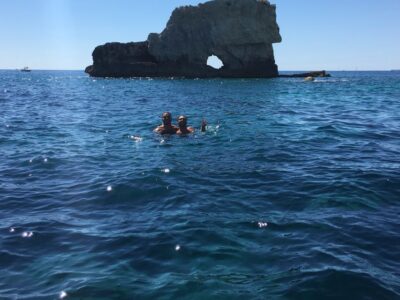
Tour of the island of Ortigia and exploration of sea caves with baths.
Read our review →
SALT TOUR-all inclusive: salt tour: Trapani, Paceco, Nubia
Read our review →
Mt. Etna nature and flavors half day Tour from Catania
Read our review →
Boat tour Giardini Naxos Taormina Isola Bella Blue Grotto
Read our review →