
Reviewed · EVENING EXPERIENCES
Ortigia guided night tour, Syracuse
Ortigia changes character after sunset. Stone lanes grow quieter, the monuments pick up warm lighting, and the old island feels more mysterious than it does in daylight. This two-hour walking tour connects the main sights in a sensible loop, starting and ending at the Temple of Apollo.
I like the way the tour combines major landmarks with stories tied to colonization, legends, and architectural change. I also like the focus on places you can appreciate from the outside at night, especially Piazza Duomo, Maniace Castle, and Arethusa Spring. The main limitation is clear: you cannot enter Syracuse Cathedral, and the tour does not include food, drinks, or museum admission.
Key points to know before booking
- The evening setting is the main attraction: Ortigia’s lanes and monuments take on a softer, more atmospheric look after dark.
- The route covers seven important stops: You see the Temple of Apollo, Piazza Archimede, Piazza Duomo, Palazzo Bellomo, Maniace Castle, Palazzo Montalto, and Arethusa Spring.
- The tour is history-focused: Your guide explains how several foreign powers shaped Syracuse and Ortigia over time.
- The route takes two hours: The walking schedule gives you time at each stop without turning the evening into a long expedition.
- Guiding is available in three languages: You can book a live guide in Italian, English, or Russian.
- The price is $88 per person: That is a fair consideration for a private-style history lesson only if you value guided interpretation, since meals, drinks, and interior admissions are not included.
Why Ortigia works so well at night
Ortigia is the old island heart of Syracuse. The appeal here is not one single monument. It is the way ancient ruins, medieval lanes, grand palaces, churches, fountains, and the sea-facing edge of the island fit into a compact walking route.
At night, the tour leans into atmosphere. You are not simply checking off sights in bright daylight. You are looking at old stone under artificial light, passing through narrow lanes, and hearing the stories behind buildings that might otherwise seem like attractive façades.
That setting gives the guide an important job. Without explanation, the changing styles of Ortigia can be hard to read. Greek foundations, Roman influence, later Christian buildings, and medieval or Swabian work all appear in a small area. The tour helps you connect those pieces instead of seeing them as unrelated stops.
The route is also practical for a first evening in Syracuse. It introduces the old town’s main points in two hours, giving you a basic map of the island before you return on your own. I would use it early in a stay, especially if you plan to spend another day exploring Syracuse independently.
More things to do after dark in Syracuse:
- Syracuse: Ortigia Sunset Cruise with Aperitif
★ 4.8 · 291 reviews - Siracusa: Ortigia & Sea Caves Boat Tour with Sunset Apertif
★ 4.9 · 94 reviews - Syracuse: Sunset cruise including aperitif and swim stop
★ 4.9 · 9 reviews
Starting at the Temple of Apollo
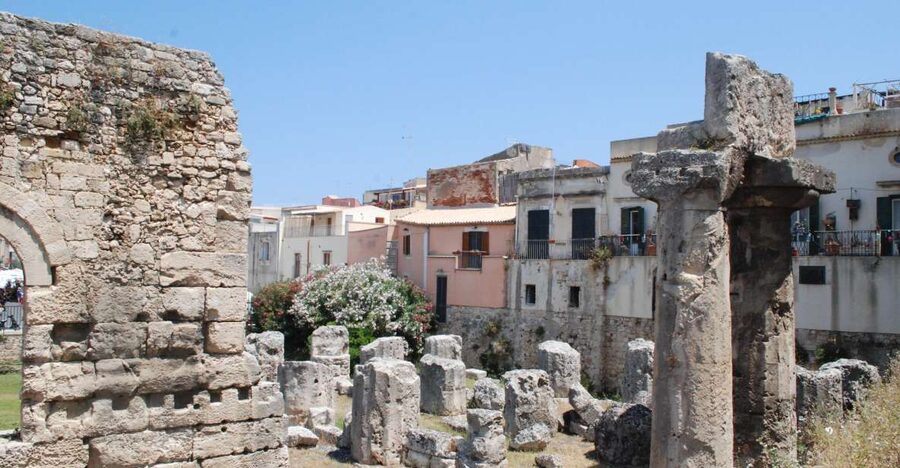
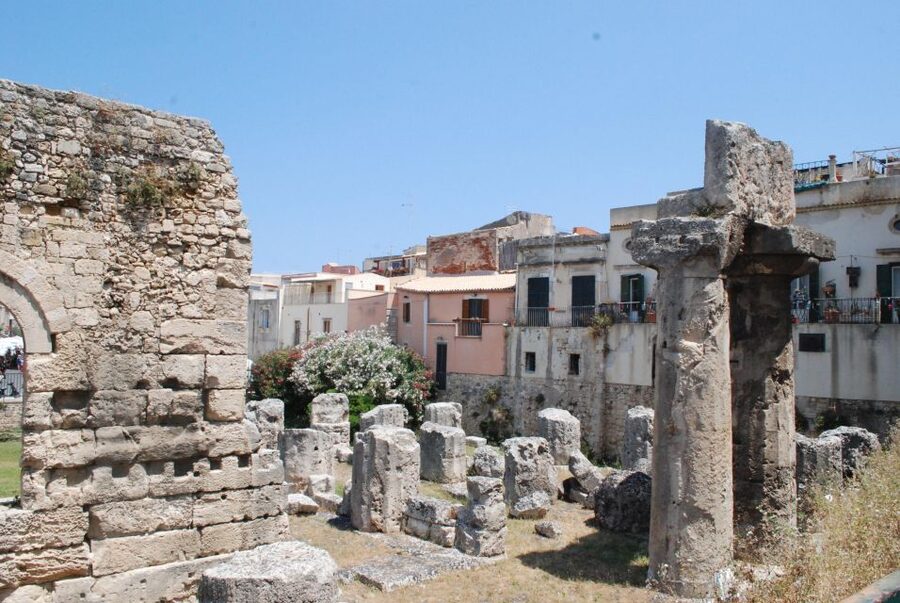
The walk begins at the Temple of Apollo, one of Ortigia’s defining ancient monuments. It is described as the oldest Doric temple in the western Greek world, which gives the opening stop real weight. You begin with the remains of a major Greek-era structure before moving into later layers of the city.
The planned visit here lasts about 15 minutes. That is enough time for an introduction and an explanation of why the temple matters, but it is not a full archaeological visit. You should expect to admire the monument from the outside rather than explore a large interior site.
This is a good starting point because the temple immediately shows how old Syracuse is. The rest of the walk makes more sense once you understand that Ortigia was not built in one period. It has been reshaped repeatedly, and the tour keeps returning to that idea.
If you want an extended archaeological discussion, this stop may feel brief. If you want a clear opening to the city’s story, it does the job well.
Piazza Archimede and the Diana Fountain
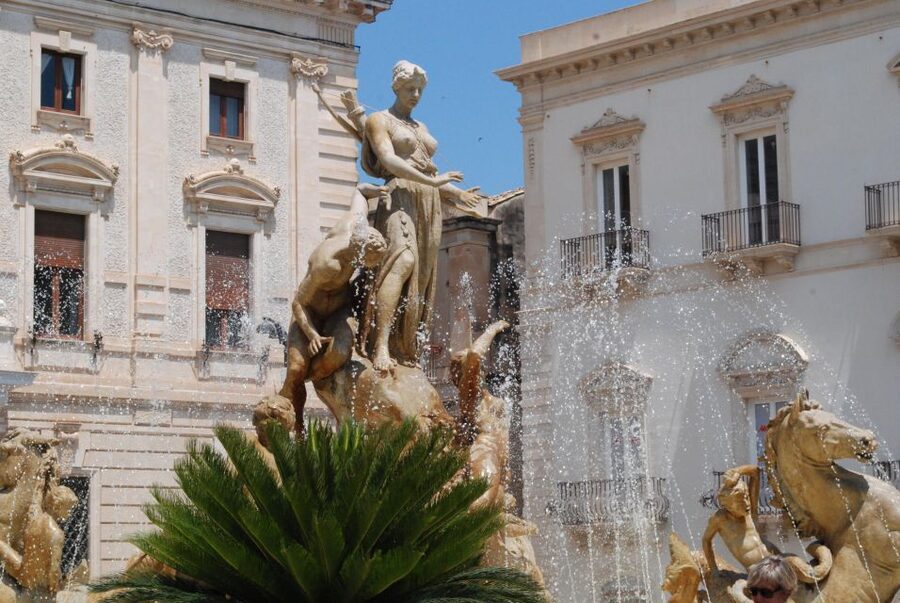
From the temple, the route continues to Piazza Archimede, where the Diana Fountain provides the visual focus. The fountain dates from 1907 and gives the square a different feel from the ancient remains at the first stop.
The visit here is scheduled for about 10 minutes. That makes it more of a guided orientation stop than a long pause. You will learn why the square matters, look at the fountain, and continue through the old island.
This change of subject is useful. Ortigia is not only about antiquity. The route moves between ancient, medieval, and more recent parts of the city, helping you see the town as a living place rather than an archaeological park.
Piazza Archimede also helps break up the longer historical story. After the Greek temple, you get a public square with a 20th-century fountain and a more everyday urban setting.
Piazza Duomo and Syracuse Cathedral
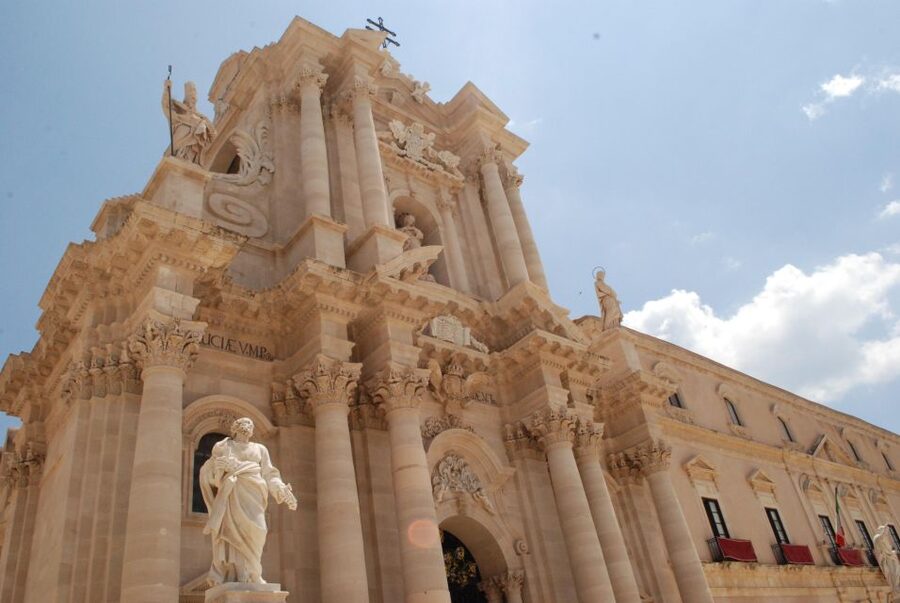
Piazza Duomo is likely to be one of the strongest stops on the walk. The square is home to Syracuse Cathedral, a major church shaped by several periods of construction and change.
The guide pauses here for about 25 minutes, giving this stop more time than most of the earlier points. That makes sense. The cathedral’s story is tied to the many powers that controlled Syracuse, and the building’s form reflects those changes.
You will hear about the church’s development and the transformations it underwent through successive periods. This is where a guide can add real value. A quick look at the cathedral may reveal columns, stonework, and different architectural elements, but the wider story helps you understand why they appear together.
There is one important restriction: the cathedral interior is not included. You should plan on an exterior explanation in the square. If entering the church is a priority, you will need to arrange that separately at another time.
Even without an interior visit, the piazza gives the tour a strong central moment. It is a spacious setting after the tighter lanes, and the evening lighting should make the cathedral and surrounding buildings especially striking.
A few more Syracuse days worth weighing up
- Syracuse: Boat Tour with Captain Mirko, Snorkeling & Caves
★ 4.7 · 746 reviews - Siracusa: Ortigia Boat Tour with Marine Grotto
★ 4.7 · 617 reviews - Siracusa: Ortigia & Sea Caves Speedboat Tour with Swim Stop
★ 4.9 · 499 reviews - Syracuse: Neapolis Archaeological Park Small Group Tour
★ 4.7 · 350 reviews
Palazzo Bellomo and the value of an outside view
The next stop is Palazzo Bellomo, visited for about 10 minutes. The building is associated with the regional gallery, but this evening walk does not include museum entry.
That distinction matters. The tour gives you a chance to see the palace and hear about its place in Ortigia, but it is not a museum tour. If you want to view the collection inside, you will need a separate visit.
For many people, that outside look will be enough within a two-hour route. You get a sense of the building’s position in the old city and continue toward the island’s edge. For art lovers, though, the omission may be a reason to return in daylight.
This is one of several stops where the tour focuses on context rather than admission. At $88 per person, you should understand that you are paying for a guided walking experience, not a package of entry tickets.
Walking toward Maniace Castle
The route then follows Via Castello Maniace toward Maniace Castle. This section receives about 25 minutes, making it one of the evening’s longer stops.
The castle sits at the tip of Ortigia and is one of the key monuments connected with the Swabian period. Its position gives the stop a clear sense of place. You are not just looking at a palace in a city square. You are reaching the far end of the island and seeing a fortified structure tied to Syracuse’s medieval past.
The atmosphere is especially important here. The tour description makes much of the castle at night, and that is easy to understand. Artificial light on old defensive stone, combined with the island’s edge, gives the stop a different mood from the cathedral or the fountain.
You should not expect a castle interior visit. The experience is built around seeing the exterior and hearing its story. That can be satisfying for a first look, but anyone wanting a detailed examination of the fortress will need more time elsewhere.
This is also the point where comfortable shoes matter. The walk is only two hours, but the route uses alleys and city streets, with no transport between stops mentioned.
Palazzo Montalto in the old lanes
Palazzo Montalto is visited for roughly 10 minutes. It is a historic palace tucked among Ortigia’s lanes, so the interest here comes partly from the way the building appears within the old street pattern.
This stop is shorter than Piazza Duomo or Maniace Castle. Think of it as a compact architectural pause. The guide can explain the palace’s place in the city while you take in the setting around it.
I like that the route includes a smaller palace rather than only the famous sights. It gives you a better feel for how Ortigia works as a historic quarter. The old city is made up of grand monuments, yes, but also buildings encountered almost by accident while walking between them.
Because the palace is presented as an exterior stop, your enjoyment will depend on how much you like urban detail and historical explanation. If you need every stop to be a major landmark, this may feel less important. If you enjoy noticing old buildings in their surroundings, it adds texture to the walk.
Arethusa Spring and its old legend
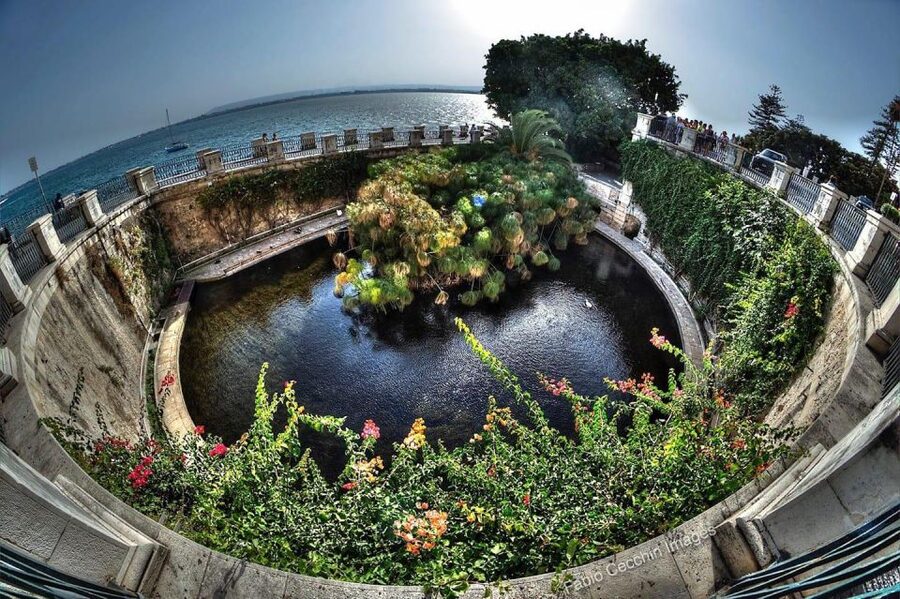
The final major stop is the Arethusa Spring, with about 25 minutes planned here. The spring is one of Ortigia’s most recognizable natural and cultural sights, and the guide introduces the legend connected with it.
This is a fitting end to the route. After temples, squares, churches, palaces, and a castle, you finish with a place shaped by both nature and myth. The spring gives the tour a softer closing note than Maniace Castle.
The appeal is not only the water itself. It is the story attached to the site and the way that story belongs to Syracuse’s long cultural memory. A guide can turn a short stop into something you remember, especially if you enjoy the blend of fact and legend found in old European cities.
The spring is also a good place to pause before returning to the Temple of Apollo. The walk forms a complete loop, so you are not left at an unfamiliar endpoint. The full itinerary returns to the starting location after this final stop.
What the two-hour schedule really gives you
The timing is tightly organized:
- Temple of Apollo: 15 minutes
- Piazza Archimede: 10 minutes
- Piazza Duomo: 25 minutes
- Palazzo Bellomo: 10 minutes
- Via Castello Maniace and the castle area: 25 minutes
- Palazzo Montalto: 10 minutes
- Arethusa Spring: 25 minutes
That adds up to two hours of guided sightseeing. The schedule favors steady movement and explanation over long free time at each site.
I would not choose this tour if you want to sit in cafés, enter several buildings, or linger for photographs at every stop. I would choose it if you want a clear introduction to Ortigia with a guide keeping the evening moving.
The format also suits people who find historical cities easier to understand with a route and a narrator. You do not have to decide which lane leads to which monument. The guide sets the order and supplies the background.
Guide quality and language choices
The guide is described as qualified and live, with tours offered in Italian, English, and Russian. The available feedback points to two qualities that matter most here: a well-prepared guide and a friendly manner.
One Italian booking from April 2024 praised the guide as very prepared and kind. Another booking from Puerto Rico in March 2024 highlighted the interesting history and the guide’s friendly, informed presentation.
Those comments fit the needs of this particular route. The tour depends less on complicated logistics than on clear storytelling. You want someone who can explain how Ortigia changed under different rulers without turning every stop into a lecture.
No guide names are provided, so you cannot request a particular person from the available information. You can, however, choose among Italian, English, and Russian when booking, subject to the available start times.
Is $88 per person good value?
At $88 per person, this is not a bargain-priced stroll. The value depends on what you want from the evening.
You are paying for a two-hour guided walk with a qualified guide and a carefully selected route through Ortigia’s major sights. The price includes interpretation, but not meals, drinks, or entry to the cathedral, Palazzo Bellomo, Maniace Castle, or any other interior.
I see the strongest value for a first-time visitor who wants historical context and a simple way to cover the island after dark. If you are already comfortable reading monuments on your own, $88 may feel high for an exterior-only walk.
The evening timing adds something that a daytime route cannot fully match. The lighting and quieter mood are central to the experience. Still, the tour does not promise a meal or a special tasting, so you should treat it as a history walk, not a dinner outing.
The overall rating is 4.8 from four published ratings, which suggests a strong early response, though the sample is small. I would give more weight to the repeated praise for the guide’s preparation, friendliness, and historical explanations than to the number alone.
Who should book this Ortigia night walk?
This tour suits you if:
- You are visiting Syracuse for the first time.
- You want to see the main Ortigia sights in one evening.
- You enjoy history, legends, and architectural details.
- You prefer a live guide to exploring without context.
- You want a compact two-hour activity rather than a full-day outing.
- You can appreciate monuments from the outside when interior entry is not included.
It may suit families and mixed-age groups because the duration is manageable, though the supplied information does not give a minimum age or a child-specific format. It is also listed as wheelchair accessible, an important practical point for anyone who needs that feature.
You may want another option if your main goal is entering the cathedral, visiting the regional gallery, touring Maniace Castle inside, or including food and drinks. Those are outside the stated package.
The tour offers free cancellation up to 24 hours before the start, and you can reserve now and pay later. Those terms are useful if your Syracuse plans are still shifting, but you should check the available starting times before committing.
Should you book it?
Book this Ortigia night tour if you want a guided introduction to Syracuse’s old island, with strong evening atmosphere and a route that covers the essential monuments. The best parts are the progression from the Temple of Apollo to Arethusa Spring, the explanations of Ortigia’s changing rulers, and the mood around Piazza Duomo and Maniace Castle after dark.
Skip it if you want extensive interior visits or a low-cost stroll without a guide. At $88, the tour makes sense when interpretation is the point. For a first night in Syracuse, it gives you a useful map, a coherent story, and several sights worth returning to in daylight.
FAQ
Where does the Ortigia night tour start?
The tour starts at the Temple of Apollo in Syracuse and returns there at the end.
How long does the tour last?
The guided walk lasts two hours.
Which sights are included?
The route includes the Temple of Apollo, Piazza Archimede, Piazza Duomo, Palazzo Bellomo, Maniace Castle, Palazzo Montalto, and Arethusa Spring.
Can I visit Syracuse Cathedral inside?
No. The cathedral is explained from the outside, but the interior visit is not included.
Is food or drink included?
No. Meals and drinks are not included in the tour price.
What languages are available?
The live guide can conduct the tour in Italian, English, or Russian.
Is the tour wheelchair accessible?
Yes. The activity is listed as wheelchair accessible.
How much does the tour cost?
The listed price is $88 per person.
Can I cancel for a full refund?
Yes. You can cancel up to 24 hours in advance for a full refund.
Just added around Syracuse
- Etna and Taormina tour from Syracuse with private driver★ 4.5 · 9 reviews
- Vendicari – Sicily’s best coast nature reserve ( Birdwatching & Archeology )★ 5.0 · 8 reviews
- Tour of Montalbano★ 4.5 · 7 reviews
- Etna tour from Syracuse with private driver★ 5.0 · 4 reviews
- Noto, Portopalo and Marzamemi tour from Syracuse with private driver★ 4.5 · 10 reviews
- Siracusa Walking Tour with Audio and Written Guide by a Local★ 5.0 · 59 reviews
- Syracuse Private Shore Excursion: Archaeological Park and Ortigia★ 5.0 · 5 reviews
- Syracuse Scavenger Hunt & Highlights Self Guided Audio Tour★ 4.5 · 4 reviews
Evening Experiences, compared.

Mount Etna Morning or Sunset Day Trip with Tasting
Read our review →
Sunset Jeep Tour of Mount Etna and Lava Flow Caves
Read our review →
Valley of the Temples Skip-the-Line Sunset Tour
Read our review →



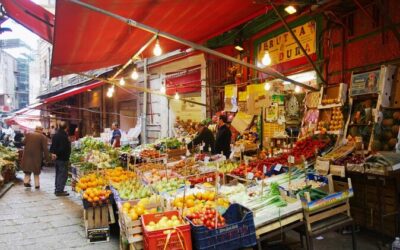
Night Street Food Tour of Palermo with a Local -For real foodies!
Read our review →Browse the lists this tour appears in