Reviewed · SICILY TOURS
CATANIA 1943: Husky operation
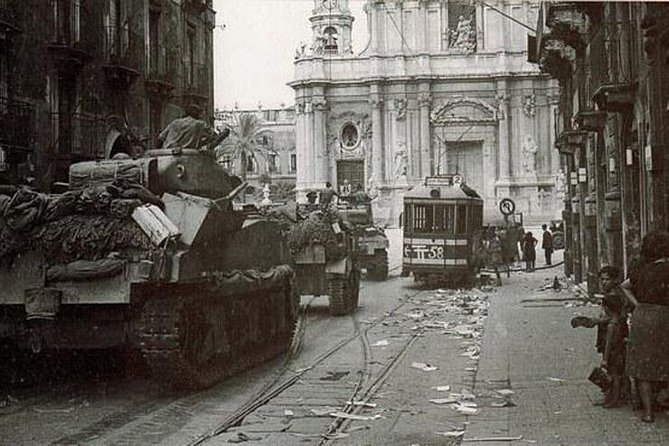
Catania’s WWII story is easiest to grasp when you connect the museum’s maps and documents with the bomb scars still visible in the city. This private tour does just that, beginning with Operation Husky and the battle of the Simeto before walking through central Catania.
I like the two-hour museum visit, which gives the military campaign proper context, and I like the way the tour links war damage to everyday landmarks such as the Roman amphitheater and the ruined church of Sant’Euplio. The main drawback is the schedule: the tour is offered Tuesday through Sunday from 10 a.m. to 1 p.m., so you have little flexibility if your sightseeing day is already packed.
Key points to know before booking
- Operation Husky takes center stage: Learn how the Allied invasion of Sicily affected Catania, with special attention to Operation Fustian and the battle of the Simeto.
- The museum visit lasts about two hours: Admission is included, and the displays provide the main historical foundation for the rest of the tour.
- War history meets Roman Catania: The Roman amphitheater became an air raid shelter during World War II.
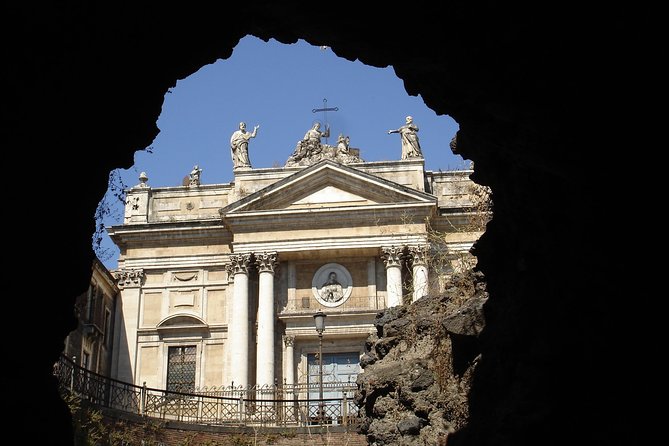
- Sant’Euplio gives the story a human scale: The church ruins preserve visible damage from the 1943 bombings and serve as a memorial to war victims.
- This is a private outing: Only your own group participates, and group discounts are available.
- The route ends at Piazza Duomo: You finish in central Catania, near one of the city’s main gathering places.
Why Catania’s 1943 story deserves your time
Many visits to Sicily focus on Greek temples, Baroque churches, Etna, and food. Those are good reasons to come, but Catania also carries a very clear World War II story. The Allied invasion of Sicily in 1943 changed the island’s military and political future, while the bombing campaign brought the war directly into city streets.
This tour helps you see that story in layers. You begin with the campaign itself, then move to the places where civilians sought shelter and where buildings were damaged. The result is more useful than a simple military lecture because you can connect the larger operation to real places in Catania.
I especially value the focus on Operation Fustian, a part of the Sicily campaign that can easily get lost in a broad account of Operation Husky. The battle of the Simeto receives particular attention, giving the tour a more precise local focus.
The tour is conducted in English. The guide named for the experience is Oreste, and the supplied details describe him as professional, accommodating, and especially strong on the troops, the war, and its effect on Sicilian people. Since this is a private activity, you have a better chance to ask questions and shape the conversation around your own interests.
A few more Sicily days worth weighing up
- Etna Morning Trip
★ 4.5 · 1,241 reviews - Syracuse: Boat Trip of Ortigia Island and Sea Caves
★ 4.7 · 937 reviews - Tour of the island of Ortigia and exploration of sea caves with baths.
★ 5.0 · 668 reviews
Starting at the Sicily 1943 museum
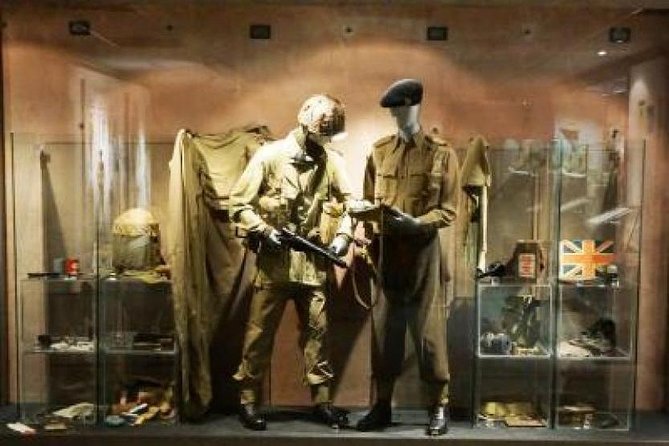
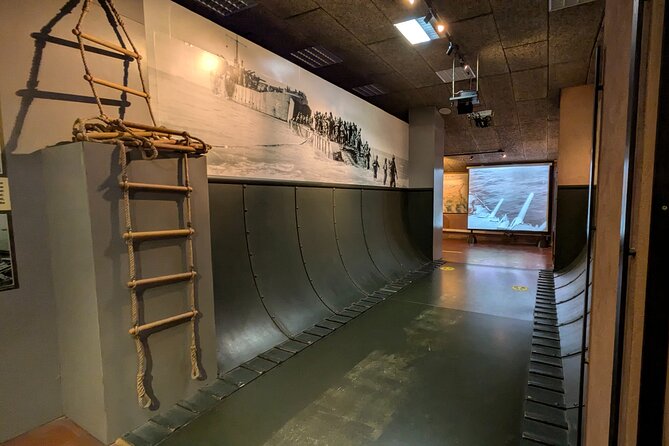
The meeting point is the Museo Storico dello Sbarco in Sicilia 1943 at Piazzale Rocco Chinnici. This is not a quick introductory stop. You spend about two hours inside, and the admission ticket is included.
That amount of time matters. A museum devoted to the Allied landing needs space for maps, documents, photographs, equipment, and explanations of the campaign. A shorter visit might give you a few dramatic images, but two hours lets the guide build a usable timeline.
Expect the museum to explain the Allied landing in Sicily and then narrow its attention to Catania, Operation Fustian, and the Simeto battle. The value here is the connection between military movement and local impact. You are not simply learning which army advanced where. You are also looking at what the fighting meant for the city and its people.
I would treat this as the essential part of the experience. The later stops make more sense after the museum has established the setting. If you already know a great deal about the 1943 campaign, you may find the two-hour visit more detailed than necessary. For most people, though, the museum provides the background that scattered wartime ruins cannot provide on their own.
Operation Fustian and the battle of the Simeto
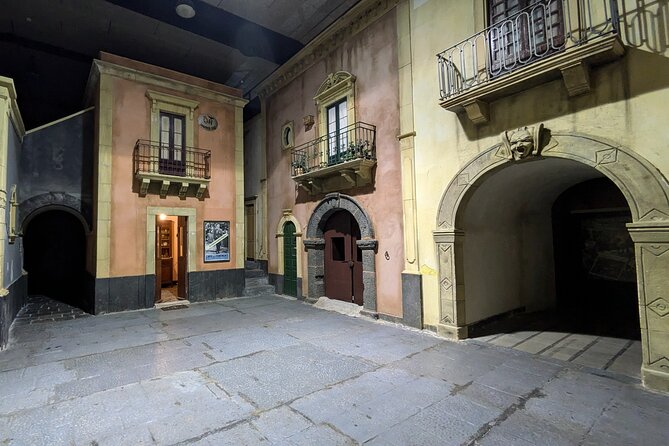
The tour gives special weight to Operation Fustian, which took place during the Allied campaign in Sicily. The supplied information identifies the battle of the Simeto as a central subject, so you can expect the guide to explain this episode rather than offering only a general account of the invasion.
This focus is one of the tour’s best features. Large wartime operations can feel abstract when presented only through dates and arrows on a map. A local guide can help you understand how a specific river area, road network, or defensive position fitted into the wider campaign.
The museum’s detailed reconstruction and documentation also give the guide something solid to work with. You are likely to spend much of this section looking at evidence and following the sequence of events rather than moving quickly from display to display.
I would ask questions about the civilian experience as well as troop movements. The guide’s role includes explaining the effect of the war on Sicily and its people, and that human side keeps the tour from becoming a narrow account of military tactics.
The Roman amphitheater as a wartime shelter
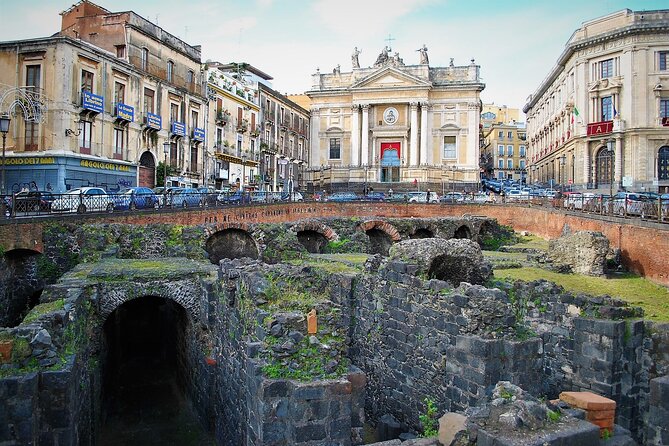
After the museum, the route continues toward the Roman Amphitheater of Catania. The amphitheater is one of the city’s major Roman monuments, but this tour adds a later chapter to its story: during World War II, it was used as an air raid shelter.
That detail changes the way you look at the monument. Ancient structures are often presented as if their history stopped when the Roman era ended. Here, the amphitheater also becomes part of the city’s wartime survival story.
You spend about 30 minutes at this stop, with admission included. That is enough time for the guide to explain the site and its wartime use without turning the tour into a full archaeological visit. If your main interest is Roman architecture, you may wish for more time. The purpose here is to connect the ancient monument to the events of 1943.
The amphitheater is also a useful bridge between the museum and the street-level evidence that follows. You move from maps and documents to a major public structure that was put to practical use during air raids. That gives the tour a strong sense of continuity.
Booked from the same base, and a completely different kind of day:
- Catania: Mount Etna Morning or Sunset Day Trip with Tasting
★ 4.8 · 4,028 reviews - Mount Etna: Guided Volcano Summit Hiking Tour with Cable Car
★ 4.7 · 3,784 reviews - Palermo: NO Mafia Walking Tour
★ 4.8 · 2,431 reviews - Palermo: Hop-on Hop-off Bus Tour 24-hour Ticket
★ 3.9 · 2,410 reviews
Sant’Euplio and the visible marks of bombing
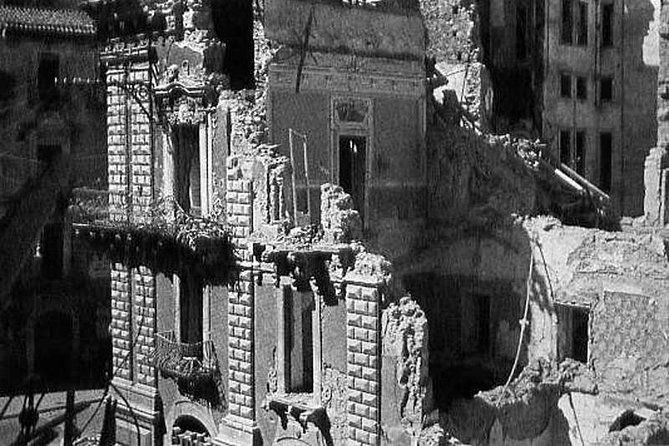
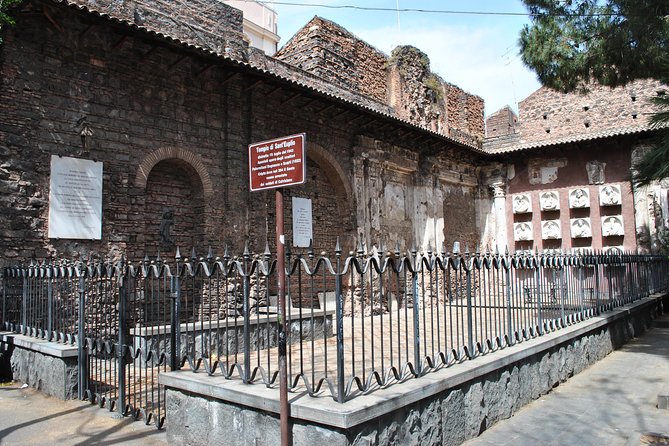
A short walk brings you to Via Sant’Euplio, where the remains of the ancient church of Catania’s patron saint still show damage from the July 1943 bombings. This is a brief stop, about 10 minutes, and there is no separate admission charge.
Do not expect a large church interior or a long museum-style presentation here. The point is the ruin itself. The broken remains make the wartime story physical and immediate, especially after the museum has explained the larger operation.
The church also carries a memorial role. Nearby, the remains of Sant’Euplio are linked with the memory of those killed by war and persecution. That gives the stop emotional weight without requiring a long visit.
I like the contrast between this small, damaged site and the monumental Roman amphitheater. One shows how a city adapted an ancient structure for protection. The other shows the lasting scars left on a religious building. Together, they help you understand that Catania’s wartime experience was not confined to a battlefield outside town.
Ending in Piazza Duomo
The tour ends in Piazza del Duomo, in the heart of Catania. You spend about 15 minutes here, looking at the city’s long history and pausing at an altar marked by bombing damage.
After the museum and the wartime ruins, Piazza Duomo adds a quieter closing note. The altar became a place of prayer for peace after the war, so the final stop shifts the focus from military action to remembrance.
This is a practical ending as well. Piazza Duomo is a central location, so you can continue sightseeing in the historic center after the tour. The official end point is listed as the Roman Amphitheater of Catania at Piazza Stesicoro, while the described route finishes at Piazza Duomo. Confirm the exact final meeting point when you book, since the two locations are close but not identical.
The city-center finish also means you do not end at an isolated museum or transport hub. You can continue toward other Catania sights, find a meal, or simply use the square as your next reference point.
The value of a private three-hour tour
The price is $94.68 per person. That is not a bargain walking tour, but the value depends heavily on your group size and your interest in wartime history.
You are paying for about three hours, museum admission, an English-speaking guide, and a private format in which only your group participates. Group discounts are available, so the price may work better for families or small parties booking together than for a solo visitor.
The museum portion alone would give you a serious introduction to the subject, but the guided city stops add the important local connection. You are not left to interpret the bomb damage on your own. The guide explains why the Roman amphitheater, Sant’Euplio, and the altar in Piazza Duomo matter to the 1943 story.
There is also a practical benefit for anyone who has difficulty walking between stops. One account of the experience describes Oreste driving an elderly mother from the museum to the next part of the tour, which made getting around easier. That should not be treated as a guaranteed feature for every booking, but it is worth asking about if mobility is a concern.
The tour is near public transportation, and service animals are allowed. The supplied participation information says most people can take part. Still, the experience includes movement between several central locations, so you should mention any specific needs when booking rather than assume arrangements will be identical for every group.
Timing, meeting point, and planning advice
The tour begins at the museum on Piazzale Rocco Chinnici. Its listed hours are Tuesday through Sunday, 10 a.m. to 1 p.m., with no Monday departure shown. The activity lasts about three hours, which fits the published morning window closely.
That narrow timing is the main planning issue. You should avoid scheduling another fixed activity immediately afterward, especially if your group wants to ask questions or needs extra time moving between stops.
A mobile ticket is available, and confirmation is sent when you book. Since the activity is private, your confirmation should be checked carefully for the exact start time and meeting instructions.
The route is offered in English. If your group wants a focused discussion about the Allied landing, the Italian civilian experience, or the Roman sites, decide that before you arrive. A private format gives you room to ask, but the time still passes quickly.
Free cancellation is available up to 24 hours before the start time. Cancellations made less than 24 hours before the experience are not refunded, and changes inside that period are not accepted. The cut-off follows local Catania time.
Who will get the most from this experience
I would choose this tour if you want WWII history tied to actual streets and buildings. It suits people who prefer a guided explanation to reading labels on their own, and it works well for anyone curious about how the 1943 invasion affected ordinary life in Sicily.
It is also a good fit for families with different interests. The Roman amphitheater gives the route an ancient-history anchor, while the museum and church ruins provide the wartime focus. A private group can ask questions at its own pace, which is useful when children or older relatives need a little more time.
History specialists may appreciate the attention to Operation Fustian and the battle of the Simeto. If your main goal is a broad introduction to Catania’s architecture, food, or ancient Greek sites, this is not the best use of three hours. Its subject is specific, and the museum occupies most of the visit.
I would also think carefully about the morning schedule. The limited Tuesday through Sunday hours make this easier to fit into a planned sightseeing day if you reserve early. It is not an all-day outing, but it is substantial enough to shape the rest of your morning.
Should you book Catania 1943: Husky Operation?
Book it if you want a serious, local account of the Allied landing and prefer seeing wartime evidence in the city rather than hearing only a general lecture. The two-hour museum visit, attention to Operation Fustian, and stops at the amphitheater and Sant’Euplio create a clear three-hour story.
The $94.68 price is easiest to justify for a private group that can use the group discount and values a guide’s attention. It is less compelling if you only have a passing interest in World War II or want a quick city walk.
For the right audience, this is a focused and thoughtful way to see Catania. You leave with more than a military timeline. You understand how an ancient city became a shelter, how bombing marked its churches, and how remembrance still appears in its public spaces.
FAQ
How long does the Catania 1943 tour last?
The experience lasts approximately three hours.
Where does the tour begin?
It begins at the Museo Storico dello Sbarco in Sicilia 1943, Piazzale Rocco Chinnici, 95129 Catania.
Where does the tour end?
The route is described as ending in Piazza del Duomo. The listed end point is the Roman Amphitheater of Catania at Piazza Stesicoro, so confirm the exact final location when booking.
What language is the tour offered in?
The tour is offered in English.
Is museum admission included?
Yes. Admission is included for the Museo Storico dello Sbarco in Sicilia 1943 and the Roman Amphitheater stop.
Is this a private tour?
Yes. Only your own group participates.
What are the main historical subjects?
The tour covers Operation Husky, Operation Fustian, the battle of the Simeto, the Allied landing in Sicily, and the effect of the war on Catania and its people.
When is the experience available?
It is listed from Tuesday through Sunday, between 10 a.m. and 1 p.m. The listed operating dates run from May 9, 2019, through March 18, 2027.
Are service animals allowed?
Yes, service animals are allowed.
Can I cancel for a full refund?
Yes, if you cancel at least 24 hours before the experience begins. Cancellations made less than 24 hours before the start time are not refunded.
Just added around Sicily
- Zafferana Etnea:Honey extraction workshop and honey tasting★ 4.7 · 3 reviews
- From Trapani: Favignana and Levanzo Yacht Tour with Stops★ 5.0 · 4 reviews
- Mt Etna: Winter Trekking Tour with Optional Catania Transfer★ 4.7 · 13 reviews
- Wine tour with wine tasting★ 4.7 · 18 reviews
- Sicilian Soul: Winery Tour, Wine & Food Tasting in Catania★ 5.0 · 4 reviews
- Wine tasting in Catania Historic center★ 4.4 · 15 reviews
- Valley Of The Temples By E-Bike With Picnic Included★ 4.7 · 7 reviews
- Valley of the Temples and Villa Romana Multi-Language Tour★ 4.8 · 5 reviews
Sicily Tours, compared.

Tour of the island of Ortigia and exploration of sea caves with baths.
Read our review →

SALT TOUR-all inclusive: salt tour: Trapani, Paceco, Nubia
Read our review →
Mt. Etna nature and flavors half day Tour from Catania
Read our review →
Boat tour Giardini Naxos Taormina Isola Bella Blue Grotto
Read our review →