
Reviewed · NOTO BAROQUE TOURS
|FROM CATANIA|Tour of Siracusa, Ortigia, Noto [PRIVATE TOUR]
Syracuse and Noto make a fine pair: one takes you into Sicily’s Greek and Roman past, the other into its grand Baroque present. This private day trip from Catania links both with a local guide and avoids the strain of driving, parking, and navigating unfamiliar streets.
I like the chance to see Ortigia at a walking pace, especially the Temple of Apollo, Fountain of Diana, Cathedral, and Arethusa Fountain. I also like the small-group format, which gives you more room to ask questions and adjust the pace, a real help for families. The main drawback is the long day and the tight schedule, with only 90 minutes at Syracuse’s archaeological park and roughly 90 minutes in Noto.
Key points to know
- The ancient heart of Syracuse: Spend about 90 minutes at the Archaeological Park of Neapolis, with its Greek theater, Roman amphitheater, and Ear of Dionysius.
- Ortigia is the walking highlight: Explore the market, Temple of Apollo, Fountain of Diana, cathedral, Church of St. Lucia, and Arethusa Fountain.
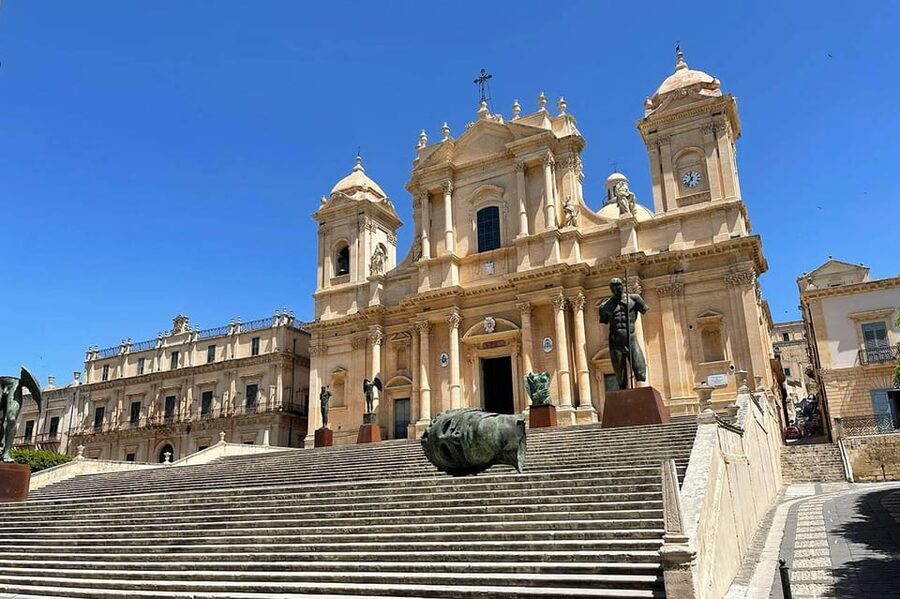
- Noto brings the Baroque drama: See Cathedral of San Nicola, Palazzo Ducezio, Palazzo Nicolaci, and other honey-colored stone buildings.
- Private transport keeps the day simple: Hotel pickup, chauffeur, fuel, and highway tolls are included.
- The archaeological park visit is independent: You buy your own personal entrance ticket and visit the site on your own.
- Best for a full sightseeing day: The advertised duration is 8 hours, while the detailed schedule says approximately 9 hours, so confirm the timing before booking.
Why this private route works from Catania
Syracuse and Noto are among eastern Sicily’s most rewarding stops, but combining them by rental car can be tiring. You must deal with city traffic, restricted driving areas, parking, and roads you may not know. This tour places you in a private Jeep or SUV with a chauffeur, so you can watch the countryside pass by instead of studying road signs.
The price is $686.57 for a group of up to seven people. That is not a cheap solo excursion, but the calculation changes when you fill the vehicle. Split among seven, it comes to about $98 per person. For a couple, it is a much bigger expense, but you are paying for private transport, a full-day route, a guide, fuel, and highway tolls rather than a basic transfer.
The private setup is especially useful if you are traveling with children or want to ask plenty of questions. One guide, Rustian, is specifically praised for explaining Sicily during the drives as well as at the sights. The guide also helped with plans for the rest of a Sicily visit, including transport suggestions and other places to see.
Pickup is scheduled for 8:30 AM from your Catania hotel. If your hotel sits inside a restricted traffic area, you meet at the nearest practical point instead. That detail matters in central Catania, so ask for the exact pickup arrangement before the morning of departure.
More baroque days around Noto:
- Catania: Syracuse, Ortigia, and Noto Tour with Brunch
★ 4.6 · 404 reviews - Syracuse, Ortigia and Noto walking tour from Catania
★ 5.0 · 273 reviews - From Catania: Neapolis of Syracuse, Ortygia, and Noto Tour
★ 4.7 · 234 reviews
Syracuse and the Archaeological Park of Neapolis
The first major stop is Syracuse, once the most important Greek colony in Sicily. The visit begins at the Archaeological Park of Neapolis, a protected area containing some of the island’s most important ancient monuments.
You have about 90 minutes here. That is enough for a strong introduction, but not enough for a slow, detailed examination of every corner. The visit inside the park is individual and autonomous, and you purchase your own entrance ticket. In other words, the guide takes you to the site, but the park portion is not presented as a fully escorted walk.
The main sights include:
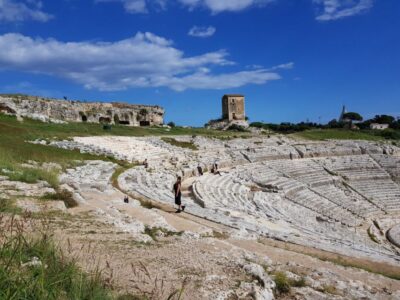
- The Ancient Theater, cut into the rock and linked to Syracuse’s Greek period.
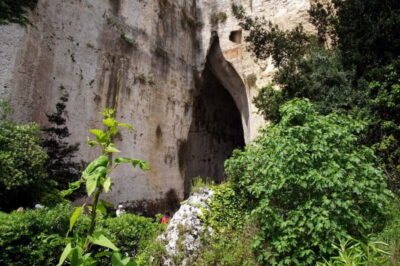
- The Ear of Dionysius, a famous limestone quarry known for its unusual shape.
- The Cordari Cave, another quarry space within the park.
- The Roman Amphitheater, a reminder that Syracuse continued to matter under Roman rule.
- The Altar of Hiero II, a large ancient structure connected with public ceremonies.
- The Paradise Quarry, part of the park’s dramatic stone setting.
I would use the 90 minutes to focus on the Ancient Theater, Ear of Dionysius, and Roman Amphitheater first. If you stop often for photographs or read every sign, the time will pass quickly. Comfortable walking shoes are sensible because this is an outdoor archaeological site with several monuments spread across a sizable area.
This arrangement has both an advantage and a limitation. You can move at your own pace rather than follow a rigid explanation at every stone, but you should not expect the guide to provide a detailed talk inside each monument. If ancient Greek architecture is your main reason for booking, ask in advance how the guide handles the park visit and whether there is flexibility in the timing.
Ortigia, where Syracuse becomes a walking city
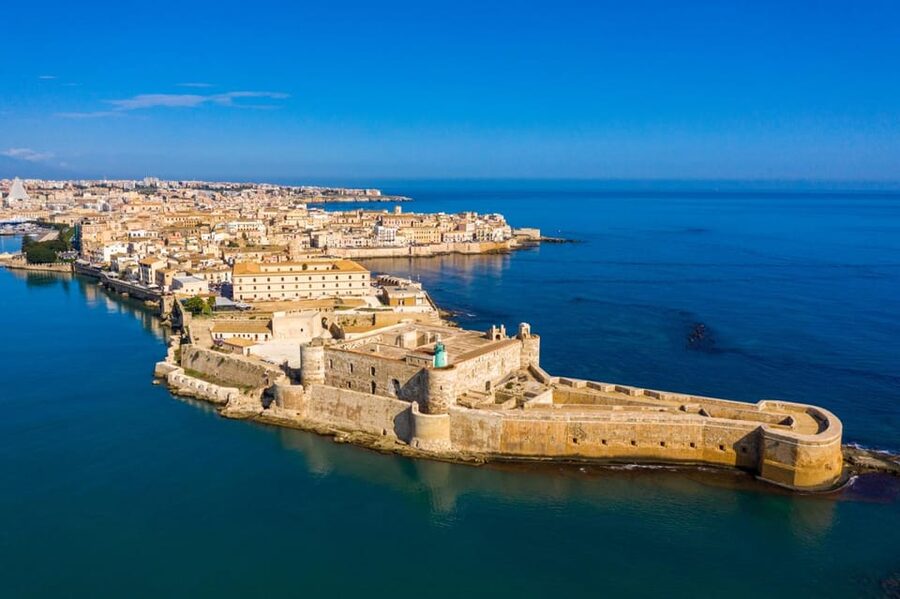
After the archaeological park, the tour moves into Ortigia, the small island that forms the historic center of Syracuse. This is where the day becomes more intimate. Instead of large ruins spread through an open park, you walk through lanes, squares, market streets, and buildings that still shape daily life.
The historic market is a good early stop. Its scents and colors give you a more ordinary view of Syracuse than the monumental ruins do. The market is also a natural place to notice local food traditions, though the exact vendors and products can vary.
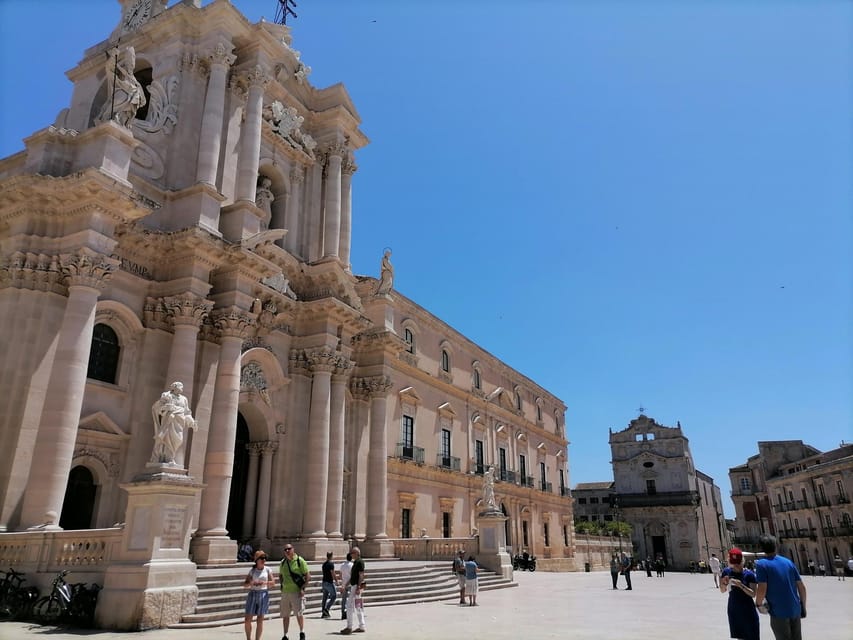
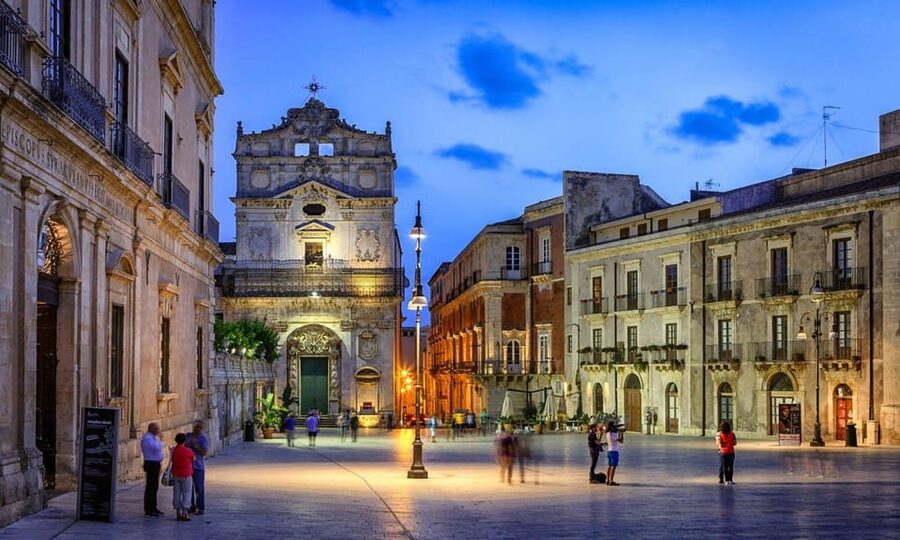
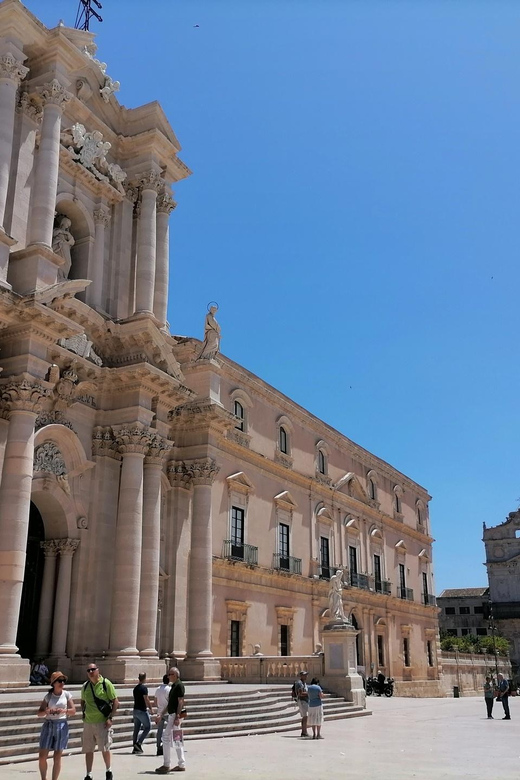
From there, the route includes the Temple of Apollo, one of the oldest landmarks on Ortigia. You then reach the Fountain of Diana, a central feature of Piazza Archimede, before continuing to the Cathedral of Maria Santissima. The cathedral is particularly interesting because it incorporates the structure of an ancient Greek temple into a later Christian building. That blend of old and new is one of the clearest ways to understand Sicily’s layered past.
The Church of St. Lucia is also included. After the main sights, you wander through Ortigia’s narrow lanes toward the Arethusa Fountain. The fountain is a freshwater pool beside the sea, famous for the papyrus plant growing in its waters. The story of Arethusa belongs to Greek mythology, while the papyrus gives the place a living, botanical detail that makes it more than a stone monument.
You have about two hours for Ortigia. That is a useful amount of time for the principal sights and a short food stop, but it is not enough to explore every lane or linger over lunch. The schedule includes a brief break for local street food. Treat this as a chance to taste something simple rather than a full restaurant meal.
I like this section because it balances explanation with free movement. The guide can point out the main monuments, then you get a little time to look around and absorb the setting. If you prefer long café stops, extensive shopping, or museum visits, the pace may feel brisk.
Noto and the best of Sicilian Baroque
The final major stop is Noto, a UNESCO World Heritage site and one of Sicily’s clearest showcases of Baroque architecture. After the ancient world of Syracuse, Noto offers a sharp change in mood. Here, the emphasis is on grand facades, carved stone, broad streets, and theatrical church and palace design.
The route includes the Palazzo dei Frati Francescani and the Benedictine Friars’ Palace, followed by the Cathedral of San Nicola. You also see Palazzo Ducezio, a major civic building, before finishing at Palazzo Nicolaci.
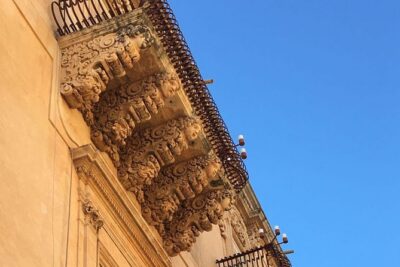
Palazzo Nicolaci is presented as the finest example of Sicilian Baroque on the route. Look closely at its decorative details, particularly the expressive stone carving that gives Baroque buildings their playful, dramatic character. Noto rewards slow looking, but the planned stop is about 90 minutes, so you will need to keep moving between the main buildings.
The cathedral and Palazzo Ducezio help explain Noto’s public face, while Palazzo Nicolaci gives you a more decorative palace view. Together, they make the town more than a quick photo stop. Still, the visit is a broad introduction rather than a detailed architectural study.
If you love ornate churches and historic town centers, Noto may be your favorite stop. If ancient ruins are your priority, Syracuse will likely make the stronger impression. Having both in one day gives you a useful comparison between Greek and Roman Syracuse and the later Baroque style that defines southeastern Sicily.
A few more Catania days worth weighing up
- Catania: Mount Etna Morning or Sunset Day Trip with Tasting
★ 4.8 · 4,028 reviews - Catania: Sunset Jeep Tour of Mount Etna and Lava Flow Caves
★ 4.8 · 2,113 reviews - Sicily: Etna and Alcantara Gorges Full-Day Tour with Lunch
★ 4.8 · 1,766 reviews - Catania: Etna Sunset Tour with Pickup and Drop-off
★ 4.8 · 1,348 reviews
What the private vehicle adds
The transport element is one of the strongest practical reasons to choose this experience. A private Jeep or SUV is used for the day, with a chauffeur, fuel, and highway tolls included. The vehicle is described as clean, spacious, and safe, and the private setup means you are not sharing the day with a large coach group.
That matters most on a route with three different stops. You can leave your bags in the vehicle, avoid figuring out local connections, and return to Catania without changing trains or buses. Driving between Catania, Syracuse, Ortigia, and Noto would also leave you responsible for parking and restricted traffic areas.
The tradeoff is that driving time still takes a meaningful part of the day. The schedule lists about one hour in the vehicle early on and another 30-minute transfer later, while the complete excursion is described elsewhere as approximately nine hours. The activity information also gives an 8-hour duration. This mismatch is worth clarifying before you pay, especially if you have an evening flight, dinner reservation, or other fixed plan in Catania.
The route is not designed as a leisurely stay in one place. It is a high-value sightseeing circuit. You cover a lot, but you accept short visits and several hours on the road.
Languages, group size, and pace
Guiding is available in English, Italian, and Spanish. Choose the language that lets you ask questions easily, since the drive between locations is part of the experience. The guide can provide context on the road, not just point out buildings after you arrive.
A private group can include up to seven people. That makes this a good choice for a family, two couples, or a small group of friends who want to divide the price. It is also a sensible option for families with children because the guide may be able to adjust the order or pace within reason. One family found the guide flexible with two children, which is useful evidence for parents considering a full day of sightseeing.
Do not expect unlimited flexibility. The tour still has fixed destinations and a planned return to Catania. The archaeological park, Ortigia, and Noto each receive a set amount of time, so major changes could affect the rest of the day.
Who gets the best value from this outing
I would recommend this tour most strongly to you if:
- You are staying in Catania and want to see southeastern Sicily without renting a car.
- You prefer a private guide to a large bus group.
- You want ancient ruins, a historic island center, and Baroque architecture in one day.
- You are traveling with family or a small group that can share the cost.
- You value practical help with transport and the rest of your Sicily plans.
- You are comfortable with a full schedule and limited time at each stop.
I would think twice if you want a slow holiday day with long meals and unplanned wandering. You might also prefer separate excursions if Syracuse’s archaeology or Noto’s architecture deserves your full attention.
The $686.57 price makes the most sense for a larger group. With seven people, it becomes a reasonable private-day cost for transport and guiding. With one or two people, the same route is more of a splurge. The benefit is control, comfort, and the ability to ask questions throughout the day, not just transportation from one town to another.
Free cancellation up to 24 hours before departure and the reserve-now, pay-later option make planning less risky. Those policies are useful if your Catania schedule is still shifting, though the day itself remains long and tightly timed.
Should you book this Syracuse, Ortigia, and Noto tour?
Book it if you want to cover three major Sicilian sights from Catania without driving. The best parts are the private vehicle, the walking visit through Ortigia, and the contrast between Syracuse’s ancient monuments and Noto’s Baroque streets.
Before booking, confirm two points: the exact total duration, since the details give both eight hours and approximately nine, and how much guidance you receive inside the Archaeological Park of Neapolis, where the visit is independent and the entrance ticket is purchased separately.
For a small group, family, or anyone who dislikes bus tours, this is a strong choice. For a couple seeking the lowest possible price or a traveler wanting long, unhurried visits, the cost and pace may not suit you. Choose it for convenience, local explanation, and a lot of Sicily in one carefully packed day.
FAQ
Where does the tour begin?
The tour begins with pickup in Catania, normally from your hotel at 8:30 AM. If the hotel is inside a restricted traffic area, pickup takes place at the nearest meeting point.
Which destinations are included?
The route includes Syracuse, the Archaeological Park of Neapolis, the island of Ortigia, and Noto.
Is the tour private?
Yes. It is a private group experience for up to seven people.
What languages are available?
The live guide is available in English, Italian, and Spanish.
Is the Archaeological Park entrance ticket included?
No. You purchase a personal entrance ticket for the Archaeological Park of Neapolis. The park visit is individual and autonomous.
What is included in the price?
The price includes the chauffeur, vehicle transport, fuel, highway tolls, and guiding in English, Italian, or Spanish.
Just added around Catania
- Mt Etna: Winter Trekking Tour with Optional Catania Transfer★ 4.7 · 13 reviews
- Wine tour with wine tasting★ 4.7 · 18 reviews
- Sicilian Soul: Winery Tour, Wine & Food Tasting in Catania★ 5.0 · 4 reviews
- Wine tasting in Catania Historic center★ 4.4 · 15 reviews
- Trekking at 3000 meters on Etna★ 3.8 · 7 reviews
- Catania: Underground and Street Food Walking Tour★ 4.7 · 56 reviews
- Private Tour from Catania to Etna Naxos and Taormina★ 4.5 · 7 reviews
- Catania AIRPORT transfer From / To Taormina★ 5.0 · 3 reviews
Noto Baroque Tours, compared.
Syracuse, Ortigia and Noto walking tour from Catania
Read our review →
Noto, Modica and Ragusa: The Baroque Tour from Catania
Read our review →
Syracuse, Ortygia & Noto small group Tour from Catania with lunch
Read our review →Browse the lists this tour appears in