
Reviewed · WALKING TOURS
Discover the Charm of Palermo: A 3-Hour UNESCO Sites Walking Tour
Palermo’s best sights are packed into a walkable but confusing center, where Norman churches, Arab details, Baroque squares, noisy markets, and modern street life all collide. This three-hour UNESCO walking tour gives you a useful first look, from Teatro Massimo to the Palace of the Normans.
I like the route’s variety: you get major monuments plus market streets and lesser-known corners such as the Galleria delle Vittorie. I also like the included Cathedral entry and Sicilian cannolo or granita, small extras that add real value. The catch is pace. You cover a lot of ground, and the Palatine Chapel is discussed from outside rather than visited inside.
Key points to know before booking
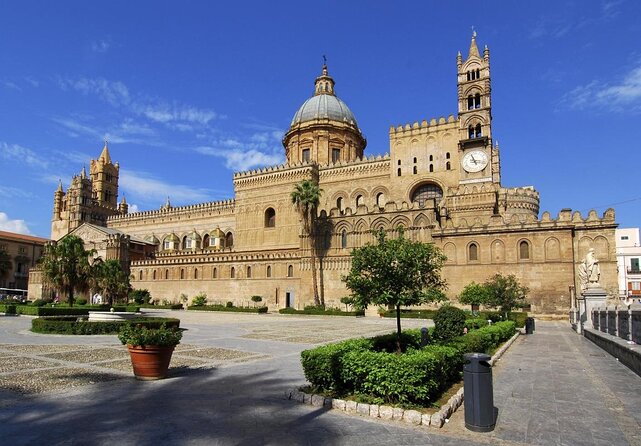
- See Palermo’s main center in three hours: The route links Teatro Massimo, San Domenico, Piazza Pretoria, Quattro Canti, the Cathedral, and the Palace of the Normans.
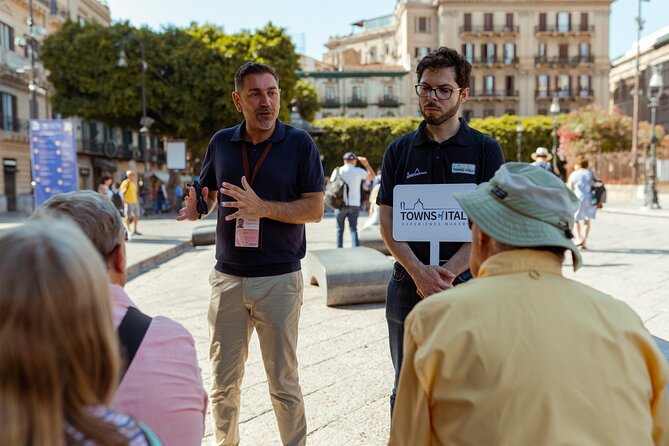
- Expect history with local context: Guides such as Valeria, Renata, Fabio, Giada, and Lara have been praised for clear English and personal stories about Palermo.
- The markets are part of the route: You pass an open-air market on Via Bandiera and the food-filled lanes around Piazza Caracciolo.
- Cathedral entry is included: The Palatine Chapel is explained from outside, but its interior admission is not included.
- A treat finishes the outing: You receive a typical Sicilian cannolo or granita.
- Plan for a brisk walk: The group can include up to 20 people, and some parts of the route are crowded, hot, or uneven.
Why this is a smart first look at Palermo
I would put this walk near the start of a Palermo visit. The city can feel scattered at first, even though its principal sights sit fairly close together. A guide helps you understand how the Norman, Arab, Byzantine, Spanish, and Baroque influences overlap instead of treating each building as an isolated stop.
The route also gives you a practical map in your head. After the walk, you know where Via Maqueda, Quattro Canti, the Cathedral, Piazza Pretoria, and the markets sit in relation to one another. That makes it easier to return later for lunch, shopping, photographs, or a slower look inside a church.
The guides are a major part of the experience. Valeria has been noted for lively explanations and useful food suggestions. Renata is praised for her command of Palermo’s UNESCO sights, while Fabio has a clear, conversational way of explaining the city. Giada has also been attentive to heat, using shade when possible and offering pastry recommendations.
You should not expect a quiet museum tour. Palermo’s streets remain active, with cars and scooters sometimes pushing through areas that feel pedestrian-only. The markets can be loud and crowded. That street life is part of the appeal, but it also means you need to listen carefully and keep moving with the group.
More Walking Tours in Palermo
- Palermo: NO Mafia Walking Tour
★ 4.8 · 2,431 reviews - Palermo Original Street Food Walking Tour by Streaty
★ 5.0 · 2,105 reviews - Palermo: Street Food and History Walking Tour
★ 4.9 · 1,294 reviews
From Teatro Massimo to Palermo’s market lanes
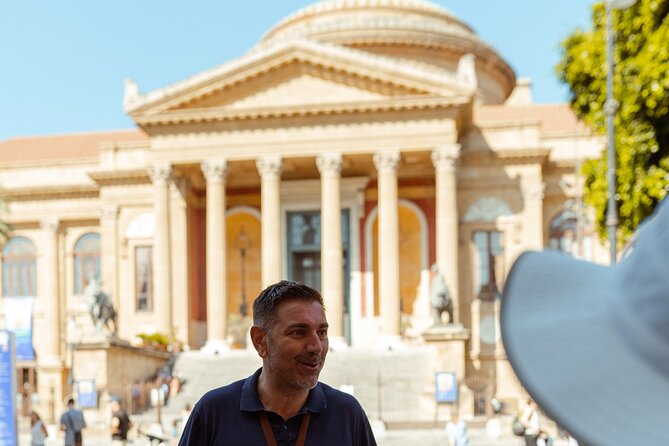
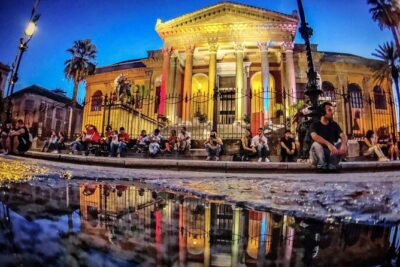
The meeting point is on Via Volturno, near Teatro Massimo. The opera house is an impressive opening sight. Built in the late 19th century and dedicated to Victor Emmanuel II, it is Italy’s largest opera house and one of Europe’s largest. It is also famous for its acoustics.
The stop here is brief, about five minutes, so think of it as an introduction rather than an architectural study. You will have time to appreciate the monumental facade and learn why the building matters, but not enough time for a performance or interior visit.
From there, the walk moves toward the Galleria delle Vittorie on Via Maqueda. This former commercial arcade once represented a more polished side of central Palermo. Its five-story structure has deteriorated over time, despite restoration efforts, which makes it interesting in a different way from the city’s restored churches. It shows how Palermo’s buildings carry both pride and neglect.
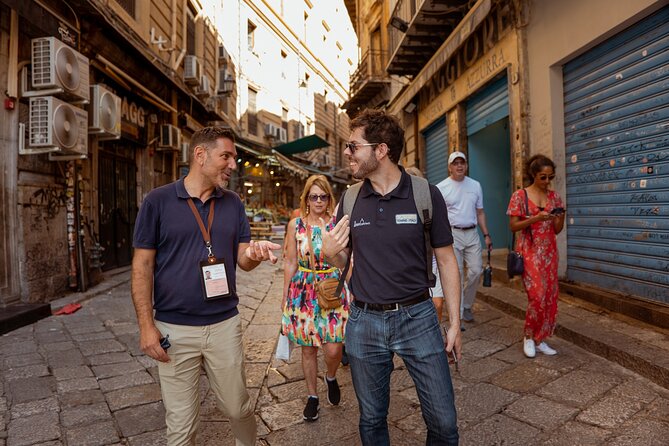
The route then crosses Via Bandiera, where an open-air market offers a first look at everyday street commerce. This is a good moment to pay attention to the sounds, smells, and narrow lanes rather than simply waiting for the next monument. You will not have a long shopping break, so plan to return independently if you want to browse.
San Domenico and the city’s public life
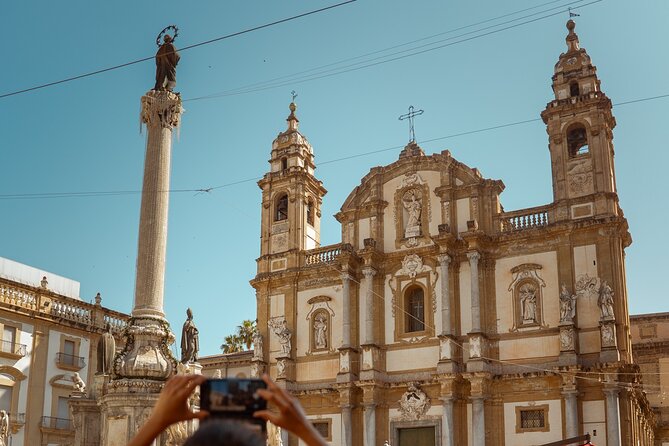
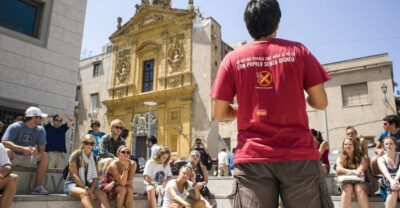
Chiesa di San Domenico is one of Palermo’s most important churches. It follows the Cathedral in size and public importance, and it is known as a pantheon of notable Sicilians. The church is also linked with Palermo’s anti-mafia movement.
The visit here lasts about ten minutes. That is enough for the guide to explain the church’s role and point out major features, but it is not a long religious art tour. If church interiors are your main interest, you will want separate time later.
The route continues through the market around Piazza Caracciolo. This area reflects Palermo’s food culture and street life more directly than the grand squares do. The market was once called La Bucceria, a name linked to the French word for butcher shop, because meat was originally sold here.
The important thing is the contrast. Within a short walk, you move from a formal church to tight alleys filled with food stalls and local business. The tour does not reduce Palermo to polished monuments. It shows you a city that still uses its historic center as a working neighborhood.
Garraffo Fountain and forgotten institutions
The Garraffo Fountain is a Baroque work in Piazza Marina, near the old Cassaro, now Via Vittorio Emanuele. It is a smaller stop, but it helps explain how Palermo’s public spaces were decorated during the Baroque period.
The route also points out the former Palermo Stock Exchange. Palermo’s exchange opened in 1845 and remained active until the Italian financial institutions were unified in 1997. It was based in the Palazzo delle Finanze and was once the most important exchange in Sicily.
You may not recognize this building as a major sight, and that is exactly why the stop is useful. A city tour should explain more than churches and palaces. Palermo’s commercial life, government, and financial past also shaped the city you see today.
The Descent of the Judges leads from Piazza Sant’Anna toward Piazza Bellini. Its name refers to judges of the old Praetorian Court, who once lived nearby in the monastery of Santa Caterina. The lane is a reminder that Palermo’s streets often preserve the jobs and institutions of earlier centuries in their names.
Booked from the same base, and a completely different kind of day:
- Palermo: Hop-on Hop-off Bus Tour 24-hour Ticket
★ 3.9 · 2,410 reviews - Segesta, Erice and Salt Pans Full-Day Excursion from Palermo
★ 4.2 · 1,791 reviews - Palermo: Teatro Massimo Opera House Guided Tour
★ 4.5 · 1,573 reviews - From Palermo: Monreale and Cefalù Half-Day Trip
★ 4.2 · 1,354 reviews
La Martorana and the Baroque heart of Palermo
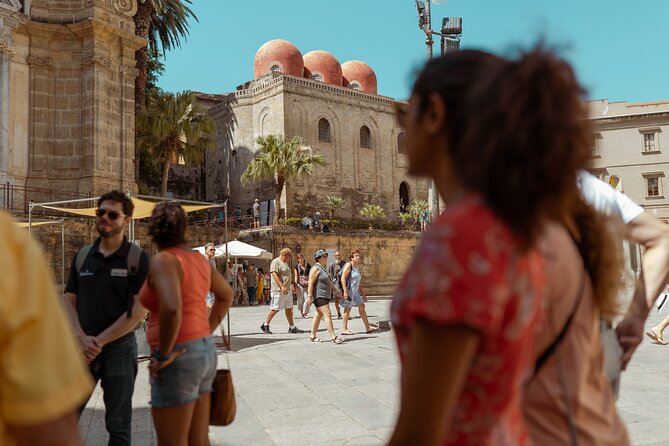
Near Piazza Bellini, Santa Maria dell’Ammiraglio is better known as La Martorana. The church was founded in the 12th century by George of Antioch, a Greek admiral, and still belongs to the Italo-Albanian Catholic tradition. Ceremonies may be held in Greek or Albanian.
This is one of the most revealing stops for understanding Palermo’s cultural mix. The city was not shaped by one ruling group alone. Greek-Byzantine traditions, Arab influence, Norman power, and later Italian styles all appear in its buildings and religious life.
The tour then reaches Piazza Pretoria, a dramatic square dominated by its fountain. The fountain was made in Florence for a private garden before being brought to Palermo. The square itself was created after land belonging to Dominican nuns was obtained in the 16th century.
You have about 20 minutes here. That is enough time to hear the story of the fountain, examine the surrounding buildings, and take photographs. The square is close to Quattro Canti, so it is easy to continue on foot afterward if you want to revisit it at a quieter hour.
Quattro Canti is Palermo’s famous four-cornered Baroque junction. The surrounding buildings were constructed between 1608 and 1620, with the sculptural decoration completed later. Each corner presents a carefully staged facade, making this one of the city’s best places to see how architecture was used to shape public space.
The tour allows about 20 minutes here. Your guide can explain the symbolism and the city’s old four-quarter layout, while you take in the traffic and people moving through the intersection. Keep your attention on the group, since this is one of Palermo’s busiest central points.
Palermo Cathedral and the included Sicilian treat
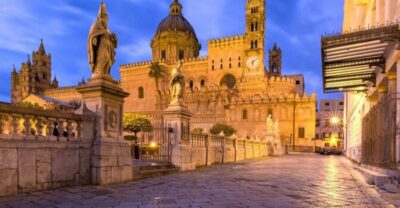
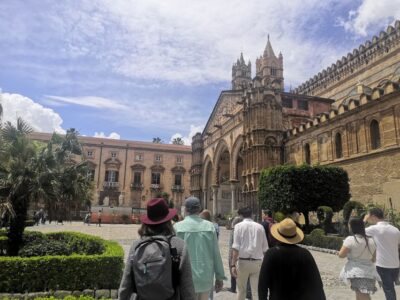
The Cathedral is the route’s longest major monument stop, with about 30 minutes allotted. It began in 1184 under the Normans on a site that had previously held a Muslim mosque and an earlier Christian basilica.
Its appearance reflects centuries of additions. You can find Norman, Gothic, Arabic, medieval, and Neoclassical elements, including an Arabic inscription from the Quran on one of the columns. The building was also part of a rivalry with Monreale, whose cathedral pushed Palermo’s leaders to create something even more impressive.
Cathedral admission is included, which makes the $31.88 price easier to justify. The allotted time is still limited, so you will receive an orientation rather than a complete examination of every chapel, tomb, and architectural detail.
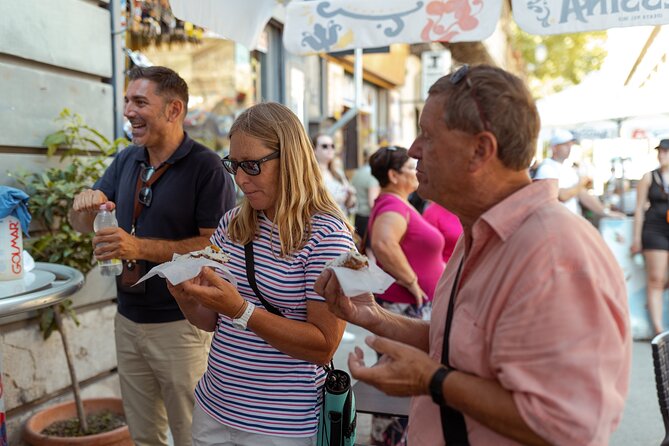
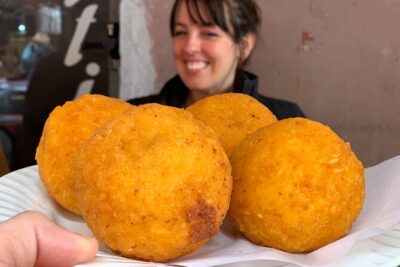
A cannolo or lemon granita is included during the experience. This is not just a sweet bonus. It gives the walk a distinctly Sicilian finish and creates a relaxed moment after several hours on foot. If you receive the option of a granita, it may be especially welcome on a hot day.
Villa Bonanno and the Palace of the Normans
Villa Bonanno is a palm-filled garden behind the Palace of the Normans. It was created in 1905 and contains statues and busts of notable Palermo figures. Roman house remains with mosaics were found in the area, including scenes of the seasons and Orpheus. Those mosaics are now held in the National Archaeological Museum.
The stop lasts about ten minutes, and entry is not included. You should treat the garden as a short pause and an exterior orientation, not as a museum visit.
The final major sight is Palazzo dei Normanni, also called the Royal Palace. It records Palermo’s long political past and contains the Palatine Chapel, whose Arab-Norman decoration is a UNESCO World Heritage feature.
Here is the main limitation to understand before you book: you learn about the Palatine Chapel from outside, but the chapel admission is not included. The palace itself is also listed as an outside stop, with entry not included. If seeing the famous mosaics inside is your main reason for coming, reserve separate admission and time for a dedicated visit.
The supplied timing gives about 30 minutes at the palace area. That works well for a final explanation and photographs, but not for an interior tour. The stated activity ends back at the meeting point, so confirm the exact return arrangement with the operator on the day.
Pace, group size, and comfort
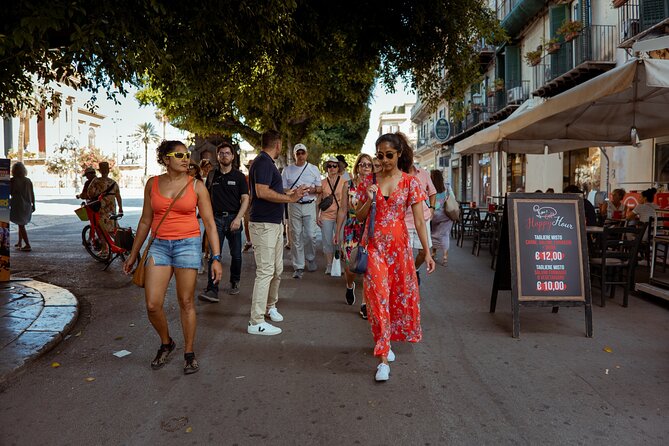
The tour lasts about three hours and accepts a maximum of 20 people. That is a manageable size for an urban walk, though a group of 20 can be difficult to keep together in market lanes and at busy intersections.
Some experiences have included an amplification system or headsets, which helps when traffic and street noise rise. Ask at the start if you have trouble hearing. Guides have been praised for answering questions, but a larger group may limit one-on-one conversation.
The walk takes place in all weather. Bring water, wear practical shoes, and use sun protection in warm months. One guide was praised for keeping the group in shade during a hot day, but you should still prepare for heat. Another walk took place in rain and cold, and the route continued.
Most people can take part, and service animals are allowed. Pets are not permitted. Tell the operator in advance about mobility needs or other special requirements so they can try to help.
Restrooms can be hard to find in central Palermo. Use one before the tour if possible, since the walk moves through public streets rather than a series of facilities with convenient toilets.
Is $31.88 a fair price?
At $31.88 per person, the price is reasonable for a guided three-hour orientation that includes an English-speaking licensed guide, Cathedral entry, and a cannolo or granita. You are paying mainly for structure and interpretation, not for a long list of paid admissions.
The value is strongest if this is your first time in Palermo. You see the principal center, learn how the neighborhoods connect, and receive restaurant and pastry suggestions that can shape the rest of your visit. Several guides have been praised for recommending places to eat and helping people decide what to return to later.
The value is weaker if you want extended time inside monuments. The Palatine Chapel is not included, the Palace entry is not included, and market stops are too brief for serious shopping. You are buying an overview, not an all-day cultural tour.
The experience is often booked well ahead, with an average booking lead time of about 36 days. That is worth noting if your dates are fixed. Free cancellation is available up to 24 hours before the start time, while later cancellations and changes are not accepted.
Who should book this Palermo walk?
I would choose this tour for a first morning or first afternoon in Palermo. It suits you if you want the city’s main sights explained in plain English, prefer a local guide to a phone map, and enjoy seeing ordinary street life alongside major monuments.
It is also a good fit for visitors with only a short stay, including people using Palermo as a port stop. You can cover a lot without giving up a full day.
I would choose something else if you move slowly, dislike busy markets, or want to spend serious time inside the Palatine Chapel and Palace of the Normans. The pace is described as quick, though there are rest stops, and one group finished around ten minutes early after a last-minute change to the final admission schedule.
Final verdict
Book this walk if you want a clear first picture of Palermo, especially early in your stay. Its strongest features are the route, the local storytelling, the included Cathedral admission, and the Sicilian treat at the end.
Just set your expectations correctly. You will see the Palace of the Normans and learn about the Palatine Chapel, but you will not tour those interiors as part of the price. Save time afterward for the places that catch your eye, especially the markets, La Martorana, and the Cathedral.
FAQ
How long does the Palermo UNESCO walking tour last?
The tour lasts approximately three hours.
What language is the tour offered in?
The tour is offered in English with a licensed English-speaking guide.
Where does the tour begin?
It begins at Via Volturno, 44, 90138 Palermo, Italy.
Where does the tour end?
The activity is scheduled to end back at the meeting point.
Is admission to Palermo Cathedral included?
Yes. Entrance to the Cathedral is included.
Is the Palatine Chapel included?
No. The Palatine Chapel is explained from outside, and admission to the Palace of the Normans and its interiors is not included.
Is a food or drink included?
Yes. The tour includes a typical Sicilian cannolo or granita.
How many people can join the tour?
The maximum group size is 20 people.
Does the tour operate in bad weather?
Yes. The tour takes place regardless of the weather.
Can I cancel for a full refund?
Yes, if you cancel at least 24 hours before the experience start time. Cancellations made less than 24 hours before the start time are not refunded.
More 3-Hour Experiences in Palermo
- Discover Palermo in 3 hours. Art, history, markets and street food
★ 5.0 · 352 reviews - Palermo: three-hour private city tour
★ 4.9 · 8 reviews - Boat excursion in Cefalù and snorkeling 3 hours fruit and drink
★ 4.5 · 85 reviews - 3-Hour Dolphin watching at sunset with aperitif
★ 5.0 · 67 reviews
Just added around Palermo
- Valley of the Temples and Villa Romana Multi-Language Tour★ 4.8 · 5 reviews
- Valley of the Temples★ 5.0 · 43 reviews
- Sicilian Winery Tour with Wine Tasting from Palermo★ 5.0 · 12 reviews
- Palermo: Medieval castles of Caccamo & Cefalù. Small Group Tour★ 5.0 · 24 reviews
- Traditional Sicilian Recipes in Palermo★ 5.0 · 4 reviews
- Private Transfer from/to Castellammare del Golfo★ 5.0 · 24 reviews
- UNESCO Day Trip – Monreale & Cefalù★ 5.0 · 6 reviews
- Palermo on a plate: Traditional Food & Wine tour (by Streaty)★ 5.0 · 119 reviews
Walking Tours, compared.
Palermo Original Street Food Walking Tour by Streaty
Read our review →
Palermo No Mafia walking tour: discover the Anti-mafia culture in Sicily
Read our review →
Street Food Walking Tour with Local Guide & Tasting
Read our review →Browse the lists this tour appears in