
Reviewed · SYRACUSE ARCHAEOLOGICAL PARK TOURS
Private Taormina Walking Tour & Greek Theatre
Taormina’s best sights come with a side of hills, stone steps, and ancient stories. This private walk begins at the Greek Theatre and threads through Palazzo Corvaja, the Roman Odeon, Corso Umberto, medieval lanes, and Piazza Duomo, with Mt. Etna often taking the star turn from the overlooks.
I like the small private format, which gives you room to ask about Sicilian food, architecture, and local life. I also like the route’s mix of famous monuments and quieter corners, including the San Domenico cloister and streets many visitors might miss on their own.
The main caution is simple: Greek Theatre admission is not included, and the visit has not always worked as clearly as the title suggests. Some departures have entered the theater, while others have viewed the area without a proper visit because of timing, closing hours, or special events.
Key points to know before booking
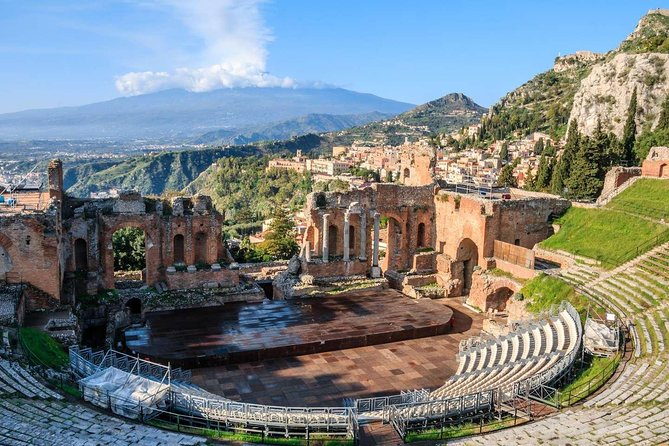
- A private walk through Taormina’s historic center: Only your group takes part, so the guide can answer questions and adjust the pace.
- The Greek Theatre is the starting point, not a guaranteed included admission: You meet at its entrance, but the ticket costs extra and access can change for events.
- A strong introduction to Taormina’s many ruling cultures: Greek, Roman, Arab, Byzantine, and Norman influences appear in the town’s buildings and stories.
- Excellent views from Corso Umberto: Belvedere Square offers coastal scenery and a clear look toward Mt. Etna when conditions cooperate.
- Expect uneven surfaces and steep sections: Taormina is built on a hillside, and parts of the walk use rough stone steps.
- A useful pre-dinner orientation: The tour ends at Piazza Duomo, close to restaurants, cafés, and the evening life of the old town.
A smart starting point at the Greek Theatre
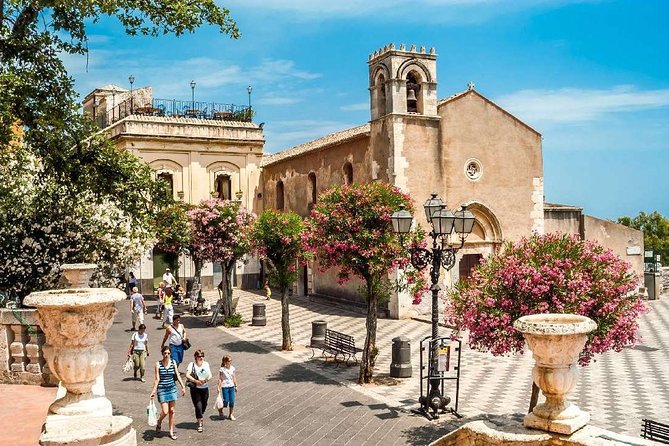
The walk begins at the entrance to Taormina’s famous Greek Theatre on Corso Umberto. This is a sensible meeting place because the theater is one of the town’s essential sights and gives your guide an immediate way to explain Taormina’s long story.
The name can cause confusion. The theater is Greek in origin, but much of what you see today reflects later Roman changes. Its setting is the real showstopper: the stage area frames the sea and, on a clear day, Mt. Etna. Admission is extra, and the operator warns that access can be restricted suddenly for special events.
You should also clarify at the start if the theater entry is part of your particular departure. The route description includes a visit, but several accounts describe seeing the theater only briefly or not entering at all. A late start can be a problem if the site is close to closing time. If the theater matters most to you, ask about entry and remaining visit time before the walk moves into town.
The theater itself deserves more than a rushed glance. You will want time to take in the view, inspect the stonework, and hear how Greek, Roman, and later uses shaped the site. The listed tour lasts about 1.5 hours, though the full experience is described as roughly two hours. That difference may reflect the pace of a private group, extra questions, or time spent at the theater.
More Walking Tours in Taormina
- Taormina Food and Wine Walking Tour (Small Group or Private)
★ 4.5 · 180 reviews - The Pearl of Sicily: Private Taormina Walking Tour
★ 5.0 · 179 reviews - Taormina: Shared or Private Food & Wine Walking Tour
★ 4.6 · 167 reviews
Palazzo Corvaja and the Roman Odeon
From the theater, the walk continues toward Palazzo Corvaja, one of Taormina’s most recognizable buildings. Its appearance reflects the town’s layered past, with medieval forms and earlier artistic influences meeting in one structure. This is where a good guide can help you read Taormina as more than a pretty Sicilian resort.
The nearby Odeon provides a smaller and more intimate ancient site. This Roman theater dates from the second century, yet it was not uncovered until 1892. That detail gives the stop a useful lesson in archaeology: Taormina’s old remains were not always obvious beneath the modern town.
The Odeon is not a replacement for the large Greek Theatre. It is much smaller, and you should not expect the same grand coastal view. Its value lies in the contrast. One site shows a major public theater shaped by its dramatic setting, while the other offers a glimpse of Roman urban life tucked into the present-day center.
Guide quality matters here. Strong guides such as Alfredo, Margaret or Margherita, Martina, Martine, and Alberto have been singled out for clear explanations, friendly conversation, and local insight. Since guides change by date, you cannot count on a specific person. The best version of this tour depends heavily on whether your guide brings the stones to life with stories instead of reciting dates.
Corso Umberto, music, food, and the everyday town
After the ancient sites, the walk shifts into Taormina’s main social space. Corso Umberto cuts through the old center and carries you past cafés, shops, churches, and side lanes. It can be busy, especially in the evening, so staying close to your guide matters.
This portion is less about checking off monuments and more about sensing how Taormina works after sunset. You might hear musicians among the café chatter, catch the smell of Sicilian dishes from restaurant kitchens, and see flowers, lemon trees, and olive trees tucked into the town’s stone corners.
I like this change of pace. Ancient theaters can feel remote, but Corso Umberto shows you the town as a living place. Your guide may also point out restaurants and local areas worth returning to later. Several visitors found the dining suggestions useful, especially because the tour ends at a convenient time for dinner.
There is one practical issue: sound. On a busy shopping street, it can be hard to hear a guide, especially if the guide has a strong accent or speaks softly. In a private group, stay near the guide and ask for a repeat when needed. You paid for the explanation, so do not let street noise turn an interesting stop into a silent march.
The view toward the coast and Mt. Etna
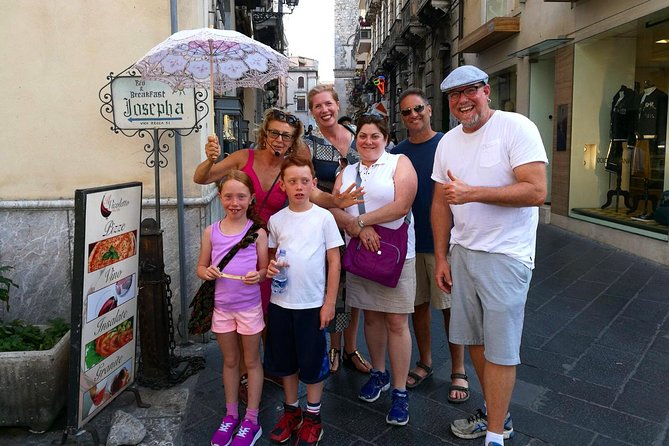
One of the route’s best pauses comes at Belvedere Square along Corso Umberto. Here you get a wider view of the coast, with Taormina’s hillside setting opening toward the sea. Mt. Etna may dominate the horizon, though visibility depends on weather and cloud cover.
This is a good place to understand Taormina’s appeal. The town is not simply a collection of old buildings. It sits above a dramatic stretch of Sicilian coast, and the views explain why people have valued this location for centuries.
Bring your camera, but do not treat this as a quick photo stop only. Ask your guide about the volcano, the coastline, and how the natural setting influenced Taormina’s growth. The views are also a reason to consider an afternoon or early evening departure, when the strongest heat may have eased and the light can be softer.
One account describes the walk beginning as the sun started to fade, followed by time in gardens to watch the sunset over Etna. That exact addition may not be part of every departure, so treat it as a possibility rather than a promise. Weather also matters. High winds have made the walk harder for some groups, and poor weather can lead to a cancellation or a new date.
More visits to the Neapolis park:
- Syracuse: Neapolis Archaeological Park Small Group Tour
★ 4.7 · 350 reviews - From Catania: Neapolis of Syracuse, Ortygia, and Noto Tour
★ 4.7 · 234 reviews - Syracuse: Ortigia and Neapolis Guided Walking Tour
★ 4.7 · 205 reviews - Syracuse: Neapolis and Greek Theater guided tour
★ 4.5 · 160 reviews
Medieval Taormina and the quieter corners
The route then turns toward monuments linked with Taormina’s medieval period. You may see Palazzo Duchi di Santo Stefano, Porta Catania, the Church of the Carmine, and the Duomo Stairs. These stops help shift your attention from classical antiquity to the town’s later political and religious life.
Porta Catania marks one of the old approaches into the center. The nearby Church of the Carmine adds another layer to the streetscape, while the Duomo Stairs guide you toward the main square. Palazzo Duchi di Santo Stefano is especially useful for understanding how Taormina’s buildings combine defensive shapes, decorative details, and local stone.
The guide is also meant to take you down small lanes and less obvious corners. This is where a private walk can earn its price. You might walk past a place you would otherwise ignore, then return later in daylight to explore it properly.
Do not expect a completely flat stroll. Taormina’s center rises and falls, and some sections use steep, uneven rock stairways. Healthy and reasonably agile walkers should still take care, but sturdy shoes are a sensible choice. The route is not a good fit if you need smooth, level pavement throughout.
Piazza Duomo and the final story
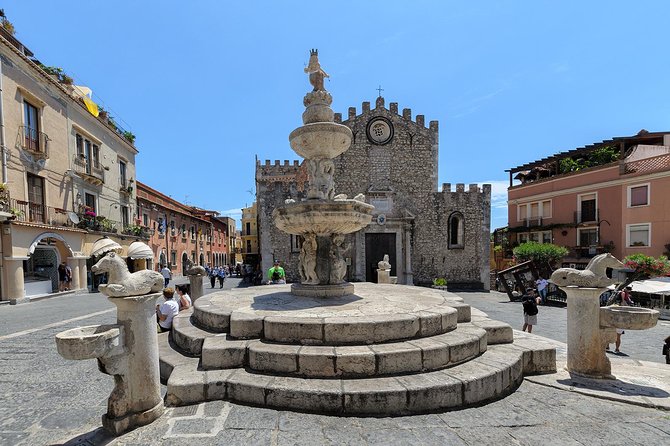
The walk ends in Piazza Duomo, one of Taormina’s most attractive public spaces. The square gives you a useful finish because it leaves you in the heart of town, with the rest of the evening open for dinner, drinks, or another wander.
Your guide closes with a story about Taormina’s symbol. This final anecdote is a small touch, but it gives the route a proper ending instead of simply stopping on a random street corner. From here, you can continue along Corso Umberto or use the square as a reference point for later exploring.
Some people prefer a tour that finishes inside the Greek Theatre so they can stay and look around. This one generally ends in Piazza Duomo instead. That is convenient for the evening, but less useful if your main goal is extra theater time. Plan to visit the theater separately if you want a slow, detailed look.
What the private format adds
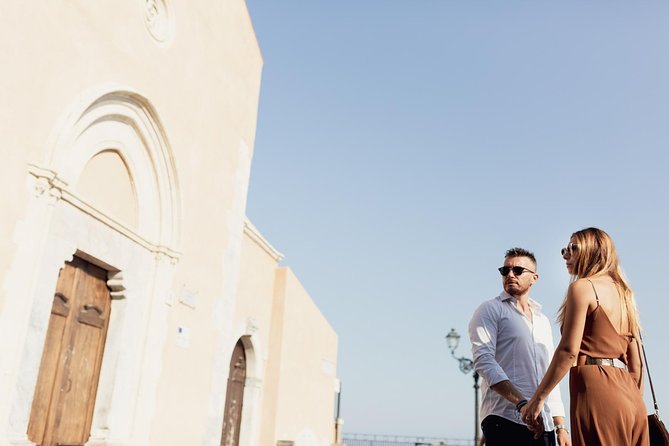
The activity is private, so only your party takes part. That can mean two people, a family, or a small group of friends. Group discounts are available, though the exact saving depends on the booking.
The format is valuable because Taormina’s streets are not always easy for a large group. A guide can stop without holding up dozens of people, answer questions about Sicilian customs, and adjust the walking speed. A small party also makes it easier to hear on Corso Umberto.
The experience is offered in English. Past departures have included guides with very different styles. Some have been warm, patient, and lively, while others have delivered a more formal lecture or repeated information. The tour’s subject matter is strong, but the person leading it will shape your experience.
If you care about legends, local stories, and practical food advice, say so at the start. If you prefer dates, architecture, and archaeology, say that too. A private format works best when you tell the guide what interests you.
Is $167.47 per person good value?
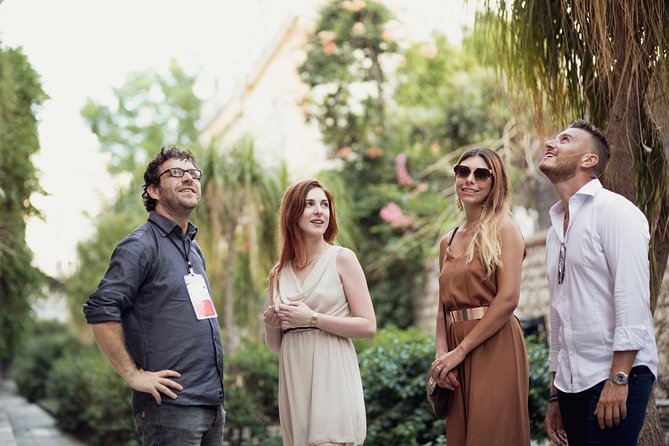
At $167.47 per person, this is not a bargain walking tour. The price makes the most sense for a private group that values flexibility, personal questions, and a local guide’s help getting oriented. It is harder to justify for one person or for anyone mainly seeking entry to the Greek Theatre, since admission is extra.
The tour covers several useful pieces of Taormina in a short time: the theater area, Palazzo Corvaja, the Odeon, Corso Umberto, viewpoints, medieval monuments, and Piazza Duomo. You also receive restaurant suggestions and historical context that can improve the rest of your stay.
The value drops if the theater is not open, if you expect a long guided visit inside it, or if you are paying a premium only for a basic stroll. Check the current theater arrangements and ask exactly what entry is planned. With that point clear, the private format can be worth the cost for a first evening in town.
Timing, weather, and practical planning
The listed walk is about 1.5 hours, while the overall activity is described as approximately two hours. Allow a little flexibility for questions, photographs, and a slower pace on the hills.
The meeting point is at the Greek Theatre entrance on Corso Umberto. The ending is in or near Piazza Duomo. Hotel pickup and drop-off are not included, so you need to make your own way to the start and arrange your onward plans from the square.
The tour requires good weather. If rain or another weather problem cancels it, you can receive a full refund or move to another date. You can also cancel for a full refund up to 24 hours before the start time. Late cancellations and changes are not accepted.
The activity is near public transportation, and most people can participate. Still, the uneven paving, hills, and steep steps deserve attention. Wear shoes with a firm grip, keep your hands free, and avoid bringing luggage.
Who should book this Taormina walk?
I would choose this for a first visit, especially if you have only one evening in Taormina and want a quick sense of the town before dinner. It also suits anyone who enjoys combining major sights with small lanes, local stories, and views.
It is a good match for couples, families, and small groups willing to pay more for a private guide. History fans should get plenty to work with, provided the guide explains the ancient sites with more than a string of dates.
I would hesitate if you need a fully accessible route, dislike hills, or want a guaranteed, unhurried Greek Theatre visit. I would also ask careful questions if the theater is your sole reason for booking.
Should you book it?
Book this tour if you want a compact private introduction to Taormina and value a guide who can connect Greek, Roman, Arab, Byzantine, Norman, and modern Sicilian influences. The strongest parts are the small-group attention, the coastal and Mt. Etna views, and the detour into lanes you might skip alone.
Book with realistic expectations. The price is high, the theater ticket costs extra, and the quality depends on the guide assigned. Confirm theater entry, check the start time against closing hours, and wear shoes for rough stone streets. If those details suit your plans, this is a useful way to get your bearings before Taormina’s evening begins.
FAQ
How long does the Taormina walking tour last?
The walking portion is listed as 1.5 hours, while the overall experience is described as approximately two hours.
Where does the tour begin?
You meet your licensed local guide at the entrance to the Greek Theatre on Corso Umberto in Taormina.
Where does the tour end?
The tour ends in Piazza Duomo, near the Duomo and the central evening activity of Taormina.
Is admission to the Greek Theatre included?
No. Entrance fees to the Greek Theatre are not included in the price.
Is entry to the Greek Theatre guaranteed?
No. Access may be restricted for special events, and the amount of time available inside can depend on opening and closing conditions. Confirm the plan with your guide at the start.
Is this a private tour?
Yes. Only your group participates in the activity.
What language is the tour offered in?
The tour is offered in English.
Does the tour include hotel pickup and drop-off?
No. Hotel pickup and drop-off are not included.
Can I cancel for a full refund?
Yes. You can cancel at least 24 hours before the local start time for a full refund. Poor weather or failure to meet the minimum number of participants may also result in a new date or a full refund.
Just added around Taormina
- Private Airport Transfer From Taormina to Catania Fontanarossa★ 5.0 · 5 reviews
- Tour of the Etna cellars, typical lunch and wine tasting★ 5.0 · 7 reviews
- 8 Days Small Group Sicily Highlights (Max 8 Guests)★ 5.0 · 83 reviews
- Taormina Sunset Aperitif on-Board★ 4.5 · 83 reviews
- TASTE OF SICILY: Taormina, Messina + sicilian street food tasting★ 5.0 · 13 reviews
- Taormina International Music Festival★ 3.5 · 7 reviews
- 8 Days Small Group Food & Wine Tour of Sicily (Max 8 Guests)★ 5.0 · 26 reviews
- Sea, Volcano and History: Giardini Naxos, Isolabella, Etna and Taormina★ 4.5 · 3 reviews
Syracuse Archaeological Park Tours, compared.
Ancient Syracuse: private guided tour of the Neapolis archaeological park
Read our review →
Group guided tour of the archaeological park of Neapolis
Read our review →
Private tour Syracuse -Archaeological Park and Ortigia with lunch
Read our review →Browse the lists this tour appears in