
Reviewed · SYRACUSE ARCHAEOLOGICAL PARK TOURS
Syracuse: Greek Theater and Neapolis Guided Private Tour
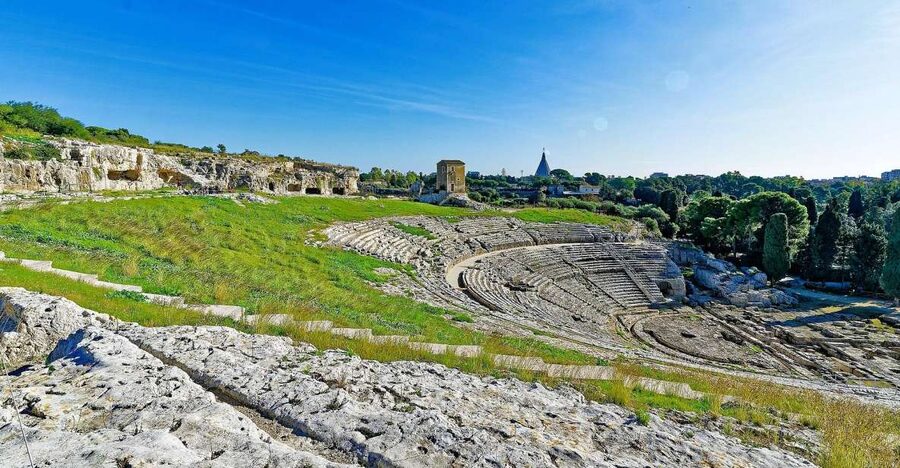
Syracuse’s ancient world comes into focus in the Neapolis Archaeological Park, where Greek theater, stone quarries, Roman ruins, and old myths sit within a compact two-hour visit. The Ear of Dionysus adds a memorable touch: its shape and acoustics give a dark cave a story you will remember.
I like the private format, which gives your group of up to 15 a guide’s full attention instead of leaving you to decode a huge archaeological site alone. I also like the mix of major monuments and smaller details, from the harbor view above the Greek Theater to the old Cordari Cave. Guides named Rita and Cristina have been singled out for clear history, careful explanations, and an appreciation of the park’s plant life.
The main consideration is time. Two hours covers the essential monuments, but it leaves little room for a slow visit or long photography stops. Admission and anything beyond the certified guide are not listed as included, so check the booking option carefully before you pay.
Key points to know before booking
- The Greek Theater is the star: You visit one of the largest Greek theaters in the Mediterranean, with views toward the port from the upper terrace.
- The Ear of Dionysus adds atmosphere: Your guide explains its connection to the tyrant Dionysius and points out its unusual acoustics.
- You see three periods of Syracuse: Greek, Roman, and later phases of the city appear in one concentrated park visit.
- The tour is private: One price covers a group of up to 15, making it more attractive for families and small groups.
- Italian adds a possible extra: If you choose the Italian-language option, you may attend Il mito di Aretusa.
- Weather can affect plans: Bad conditions may lead to a change or cancellation of the reservation.
Why Neapolis is the right place to begin Syracuse
Syracuse is not just a town with a few ancient stones scattered around. In Neapolis, you can trace how the city worked, changed, and entertained itself. The route takes you from quarries cut into the rock to a Greek performance space, then on to a monumental altar and a Roman arena.
That range gives the tour its value. You are not spending two hours looking at one ruin from every angle. You are moving through different chapters of Syracuse, with a guide explaining why each place mattered.
The short briefing at the entrance is useful. Before you enter, your guide explains the origins of the city and gives you a basic sense of the ancient polis of Syracuse. That context helps you read the ruins as part of an urban center, not as isolated monuments.
The private setup is especially helpful here. A certified guide can adjust the explanation to your group and answer questions as you go. With a maximum of 15 people, this is still intimate enough for a family or group of friends, though a larger party may feel less personal than a small couple or family booking.
More visits to the Neapolis park:
- Syracuse: Neapolis Archaeological Park Small Group Tour
★ 4.7 · 350 reviews - Syracuse: Ortigia and Neapolis Guided Walking Tour
★ 4.7 · 205 reviews - Syracuse: Neapolis and Greek Theater guided tour
★ 4.5 · 160 reviews
The Latomie: from hard labor to shaded gardens
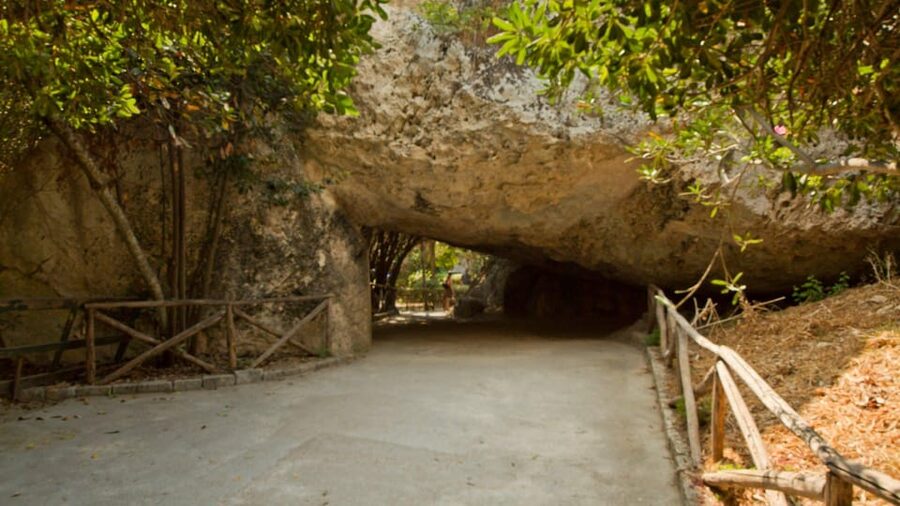
The first major area is the Latomie, the ancient stone quarries used for centuries to extract building material. These cuts in the rock tell you something practical about Syracuse: the city’s grand buildings depended on heavy work below ground.
The quarries also had a grim second role. They were used as places of imprisonment, so this is not simply a pleasant walk through old gardens. Your guide connects the physical space with the people who labored and suffered there.
Today, greenery covers much of the Latomie. That change can soften the first impression, but it also makes the area pleasant to walk through. You see how nature has reclaimed the stone rather than finding a bare excavation site.
I would pay attention to the contrast here. The quarries began as an industrial part of the ancient city, yet now their greenery can make them seem calm. A guide helps you keep both sides in view.
The Ear of Dionysus and its famous acoustics
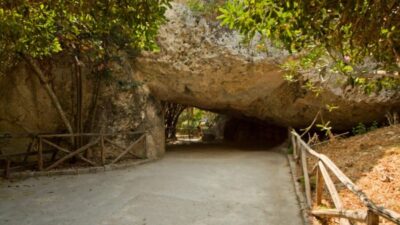
Inside the Latomie, you reach the Ear of Dionysus, one of the park’s most memorable features. Its name comes from its ear-like shape, and its acoustics are part of its appeal.
Your guide also explains the story linked to Dionysius, the tyrant of Syracuse. The cave’s legend has helped make it famous, but the stone itself is the real attraction. Its narrow, towering form feels different from the open theater you see later.
This is the point where a guided visit earns its keep. Without explanation, you might notice the shape and echo, take a photograph, and move on. With a guide, you get the story, the political context, and the reason this cave has remained tied to Syracuse’s myths.
Do not expect a long scientific demonstration. The tour has a fixed two-hour schedule, so the Ear of Dionysus is one stop within a larger route. Still, it gives the visit a strong sensory moment that the other monuments cannot quite match.
Cordari Cave and the park’s quieter corners
The route continues to the Grotta dei Cordari, or Cordari Cave. It is a smaller stop than the Greek Theater, but it helps show how much activity took place within these stone-cut spaces.
The supplied details do not specify how long you spend inside or what demonstrations take place, so I would treat this as a brief guided visit rather than a separate attraction with a full program. Its value lies in the way it adds another layer to the quarry district.
This is also a good place to notice the park’s natural side. Cristina, one of the guides named in feedback about the tour, was praised for explaining details while drawing attention to the beautiful plant life. That balance matters in Neapolis, where the vegetation can be as noticeable as the archaeology.
If you prefer ruins presented in a clean, bare setting, the greenery may occasionally obscure parts of the stone. If you like old sites that still feel connected to the outdoors, it adds character.
A few more Syracuse days worth weighing up
- Syracuse: Boat Tour with Captain Mirko, Snorkeling & Caves
★ 4.7 · 746 reviews - Siracusa: Ortigia Boat Tour with Marine Grotto
★ 4.7 · 617 reviews - Siracusa: Ortigia & Sea Caves Speedboat Tour with Swim Stop
★ 4.9 · 499 reviews - Syracuse: Pillirina, Ortigia, and Sea Caves Tour by Boat
★ 4.6 · 348 reviews
The Greek Theater: the tour’s main event
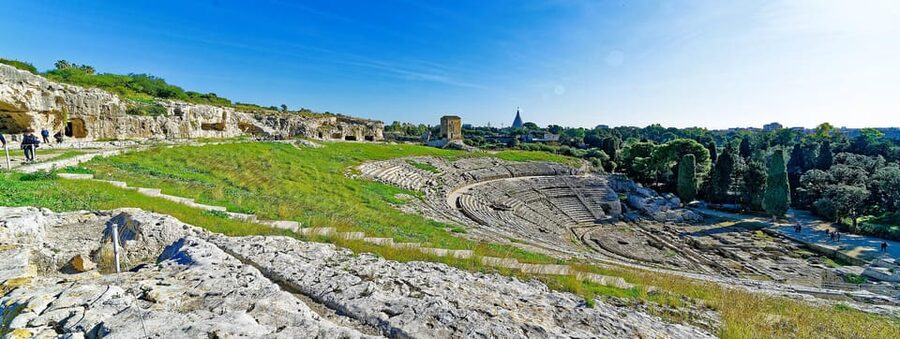
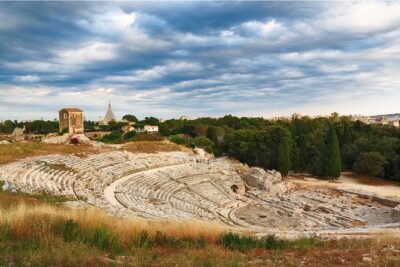
The Greek Theater is the major stop, and rightly so. It is one of the largest Greek theaters in the Mediterranean, giving the tour a clear centerpiece.
Your guide helps you understand the structure rather than simply pointing out rows of seats. The theater shows how performance, public life, and civic identity were tied together in ancient Syracuse. You can picture a large audience gathering here, even though the present-day setting is far quieter.
From the upper terrace, you can look toward the Fountain of the Nymphaeum and across a panorama toward the large port. This view is one of the tour’s best rewards because it connects the theater to the city around it.
The terrace also helps explain why the site was chosen. The theater was not an isolated building. It was part of a city with water, harbor access, quarries, and public monuments close by.
The drawback is that the theater may not provide the same sense of performance as a modern venue. The tour focuses on history and monuments, not on a live reconstruction. If your Italian-language option includes Il mito di Aretusa, however, you may get an added theatrical element connected to Syracuse’s myths.
Ask about that option when comparing language choices. It is specifically associated with the Italian tour, so do not assume it is part of every departure.
The Fountain of the Nymphaeum and harbor views
The Fountain of the Nymphaeum appears from the upper terrace as part of the theater visit. It gives you another way to read the ancient site, since water and views were important parts of the setting.
You also get a panorama toward Syracuse’s large port. This is more than a pleasant photograph. It shows the relationship between the ancient city and the water that helped make Syracuse an important center of the Mediterranean.
The view is a useful pause in the route. After the enclosed quarries and the steep presence of the theater, the open outlook lets you see the city as a whole. I would save a few minutes for it instead of rushing straight to the next monument.
Because this is a guided two-hour tour, the exact amount of viewing time depends on your guide and group. A private party can ask for a brief pause, but you should not expect an extended sightseeing session at every viewpoint.
The Altar of Hieron II and the scale of Greek Syracuse
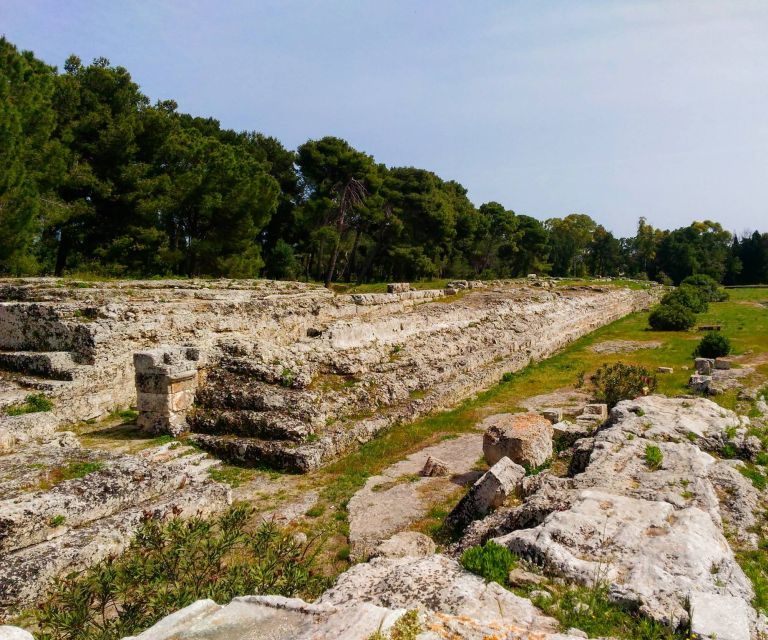
After the theater, the route moves to the Altar of Hieron II. The site is described as the largest stone altar built in the Greek world, so its importance comes from scale as much as detail.
This stop helps you think about public ceremonies and the power of the Syracusan state. A theater shows civic culture through performance. An altar shows how ritual and government could occupy a monumental place in the city.
You may find the remains less visually complete than the theater. That is part of the challenge with ancient archaeology: the importance of a structure is not always matched by what survives above ground. Your guide’s explanation gives the fragments meaning.
For visitors with limited time in Syracuse, this is a worthwhile inclusion. You do not have to choose between the city’s famous theater and a wider look at its public architecture. The route includes both.
The Roman Amphitheater and the city’s later chapter
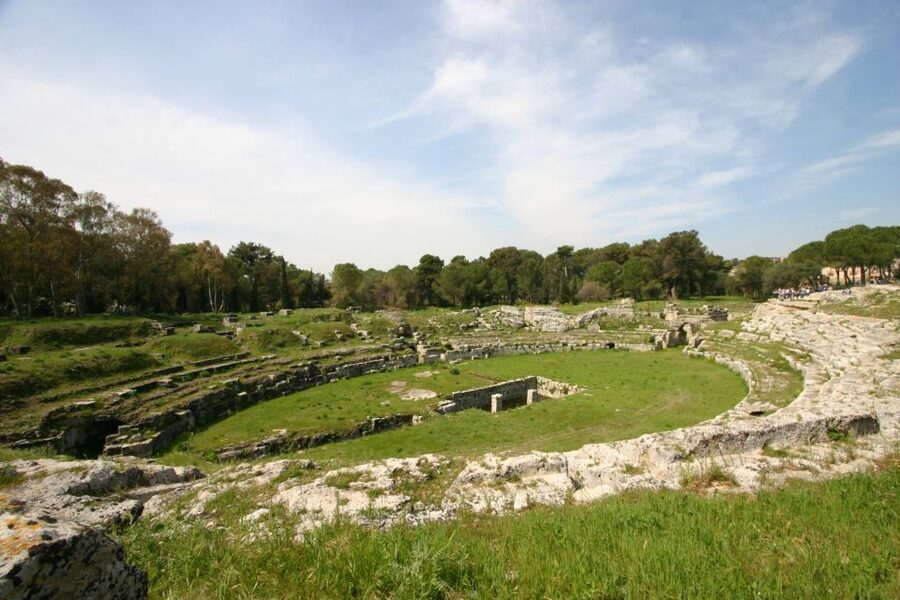
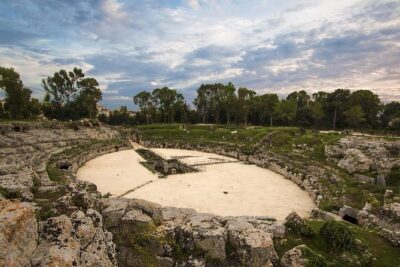
The final monument is the Roman Amphitheater. Here, your guide shifts the story from Greek Syracuse to the Roman phase of the city.
The building’s design and the nature of gladiatorial games give you a different way to understand public entertainment. The theater and amphitheater were both places for crowds, but they served different purposes and reflected different traditions.
This contrast is one of the tour’s strongest teaching points. You can compare the Greek theater’s performance setting with the Roman arena’s gladiatorial spectacles while the structures are still fresh in your mind.
The amphitheater also prevents the visit from treating Syracuse as purely Greek. The city continued to develop under Roman rule, and the final stop makes that later period part of the story.
As with the altar, you may need to use your imagination. Ancient buildings rarely survive with their original decoration and activity intact. A good guide fills in the missing pieces without turning the visit into a lecture disconnected from what you can see.
What the two-hour private format is worth
The price is $283.21 per group of up to 15 people. That is a different calculation from a per-person group tour. A couple may find it expensive, while a family or larger party can spread the cost across several people and get a private guide for the entire group.
For 10 people, the guide portion works out to about $28 per person. For 15, it is less than $19 per person. For only two people, the cost is much higher per head, so you should decide how much you value privacy and direct questions.
The tour is also efficient. In two hours, you cover the Latomie, Ear of Dionysus, Cordari Cave, Greek Theater, Fountain of the Nymphaeum viewpoint, Altar of Hieron II, and Roman Amphitheater. That is a lot for a short visit, and it suits a day when you want the main archaeological sights without spending half a day in the park.
The tradeoff is depth. You will receive explanations at each stop, but you will not have unlimited time to linger. If you want detailed photography, long pauses, or a slow study of every ruin, plan extra independent time if your schedule allows.
Only a certified guide is listed as included. Since anything not included is your responsibility, check whether entrance arrangements are covered by the option you select. This is worth confirming before booking, particularly because the listed price may not represent every cost connected with entering the park.
Guide languages and the feel of the visit
Live guiding is available in English, German, Italian, Spanish, and French. That range makes the tour practical for mixed-language groups, but the exact language must match the option you choose.
Rita and Cristina are two guide names associated with particularly strong feedback. Rita was praised for her command of history and for making the group enjoy the visit. Cristina was praised for explaining details and drawing attention to the park’s natural beauty.
You should not assume one of them will lead every departure. Guide assignment can vary. Still, those examples show the kind of guide you want here: someone who can connect political history, myths, architecture, and the living setting without burying you in dates.
A private tour also means you can ask for clarification at the moment you need it. That helps if you are visiting with children, if ancient Greek terms are unfamiliar, or if you want more attention on the Roman remains than on the myths.
Who should book this Syracuse tour?
I would recommend it most to:
- Families and small groups that can share the private price
- First-time visitors who want the major Neapolis monuments explained
- History-minded visitors who enjoy comparing Greek and Roman sites
- People with only two hours for Syracuse’s archaeological park
- Visitors who prefer a live guide in English, German, Italian, Spanish, or French
- Anyone who wants a focused route rather than an unstructured walk through a large site
It may be less suitable if you want to explore independently, spend a long time photographing the theater, or avoid paying for a private guide. It is also not ideal to treat as a flexible full-day visit. The schedule is built around a concentrated two-hour route.
The overall rating is 4.6 from eight reviews, which fits the tour’s strengths: a strong route, personal guiding, and guides who can make the history readable. The smaller number of reviews means I would focus less on the number itself and more on the clear pattern in the comments about guide quality.
Bad weather can lead to a modified or canceled reservation. Keep that in mind when building a tightly timed Syracuse itinerary, especially if this is your only planned visit to Neapolis. Free cancellation is available up to 24 hours in advance for a full refund, and you can reserve now and pay later, which gives you some flexibility.
Should you book the Neapolis private tour?
Book it if you want the essential ancient Syracuse route explained by a certified guide and you can divide the private price among several people. The combination of the Ear of Dionysus, Greek Theater, harbor view, Altar of Hieron II, and Roman Amphitheater gives you a strong two-hour introduction.
For a couple, compare the private cost with your interest in personal guiding. For a larger group, the value improves quickly. Choose the Italian option only if Il mito di Aretusa appeals to you, since that show is tied to the Italian-language tour.
I would book this for a first visit, a short stay, or a family group that wants clear context without spending an entire day on archaeology. If you already know Syracuse well and prefer to move at your own pace, visiting independently may suit you better.
FAQ
How long does the Syracuse Neapolis tour last?
The tour lasts two hours.
How much does the private tour cost?
The listed price is $283.21 per group of up to 15 people.
Which monuments are included in the route?
You visit the Latomie, Ear of Dionysus, Cordari Cave, Greek Theater, Fountain of the Nymphaeum viewpoint, Altar of Hieron II, and Roman Amphitheater.
Which languages are available?
Live guiding is available in English, German, Italian, Spanish, and French.
Is the tour private?
Yes. The activity is offered for a private group, with up to 15 people per group.
Does the tour include a certified guide?
Yes, a certified guide is included. Anything not listed under the included items is not included.
What happens if the weather is bad?
In bad weather, the reservation may be modified or canceled. You can cancel up to 24 hours in advance for a full refund.
Just added around Syracuse
- Etna and Taormina tour from Syracuse with private driver★ 4.5 · 9 reviews
- Vendicari – Sicily’s best coast nature reserve ( Birdwatching & Archeology )★ 5.0 · 8 reviews
- Tour of Montalbano★ 4.5 · 7 reviews
- Etna tour from Syracuse with private driver★ 5.0 · 4 reviews
- Noto, Portopalo and Marzamemi tour from Syracuse with private driver★ 4.5 · 10 reviews
- Siracusa Walking Tour with Audio and Written Guide by a Local★ 5.0 · 59 reviews
- Syracuse Private Shore Excursion: Archaeological Park and Ortigia★ 5.0 · 5 reviews
- Syracuse Scavenger Hunt & Highlights Self Guided Audio Tour★ 4.5 · 4 reviews
Syracuse Archaeological Park Tours, compared.
Ancient Syracuse: private guided tour of the Neapolis archaeological park
Read our review →
Group guided tour of the archaeological park of Neapolis
Read our review →Browse the lists this tour appears in