
Reviewed · SYRACUSE ARCHAEOLOGICAL PARK TOURS
Guided tour of the Greek Theater and the Neapolis of Syracuse
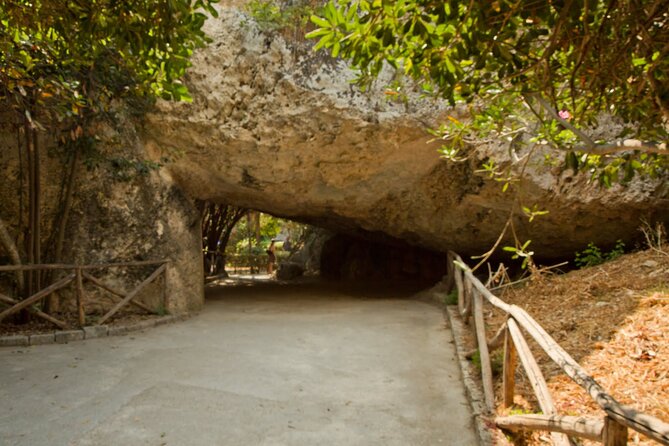
Syracuse’s Neapolis Archaeological Park packs a remarkable slice of ancient Sicily into one open-air visit. You’ll see one of the Mediterranean’s largest Greek theaters, the famous Ear of Dionysus, old stone quarries called latomie, and the Cordari Cave while a guide explains the site’s history and myths.
I like the early 9:00 am start, especially in warm weather, and I like that the entrance ticket is included rather than left for you to arrange. The main drawback is the group size, which can reach 25 people, and some uphill and downhill walking is involved.
Key points to know before booking
- The 9:00 am start matters: Morning brings cooler temperatures and fewer people at the park.
- Four major sights are included: You visit the Greek Theater, Ear of Dionysus, Latomie and Cordari Cave.
- Guide Rita has received special praise: Her clear explanations add useful context to a large, sometimes confusing site.
- The ticket is handed to you at the meeting point: Arrive 20 minutes early at the Neapolis ticket office.
- Expect outdoor walking: Much of the park is open to the sun, with some climbing up and down.
- The group may include up to 25 people: That keeps the cost reasonable, but it can make intimate guiding harder.
Why the Neapolis Park deserves your morning
Syracuse was founded in the eighth century BC and became one of the major Greek centers of the ancient Mediterranean. The Neapolis Archaeological Park lets you see how much of that old city survives, not in a neat museum display, but across a broad site shaped by stone cutting, theater building and centuries of use.
I like this tour because it gives you a framework for the park. Without a guide, the Greek Theater is impressive but easy to treat as a photo stop. A good explanation helps you understand why the theater mattered, how it was used, and how the surrounding quarries fit into the city’s story.
The guide also connects physical places with old myths. That matters at the Ear of Dionysus and the latomie, where the stone walls can feel dramatic but do not explain themselves. Your guide turns separate sights into one story about Syracuse.
The visit lasts about two hours. That is enough time to cover the main attractions without making this an all-day archaeological outing. You will still need to keep moving, especially with a group of up to 25 people, but the pace should suit most people who can manage ordinary walking with some inclines.
More visits to the Neapolis park:
- Syracuse: Neapolis Archaeological Park Small Group Tour
★ 4.7 · 350 reviews - From Catania: Neapolis of Syracuse, Ortygia, and Noto Tour
★ 4.7 · 234 reviews - Syracuse: Ortigia and Neapolis Guided Walking Tour
★ 4.7 · 205 reviews
Starting at the Neapolis ticket office
The meeting point is the ticket office on Via Luigi Bernabò Brea in Syracuse. You should arrive 20 minutes before the 9:00 am start. The guide provides your entrance ticket directly, so do not expect to collect it from a separate counter after the group has formed.
That arrangement is simple, but the early arrival still matters. A large archaeological park is not the place to arrive at the last second and search for the right entrance. You’ll want time to locate the ticket office, check your mobile ticket and meet the guide without rushing.
The park is near public transportation, which helps if you are staying elsewhere in Syracuse. The activity ends back at the same meeting point, so you are not left to work out a new pickup location at the end.
The tour is offered in English, though it may sometimes be conducted in English and Italian at the same time. If you need a fully English-only visit, this is worth confirming when you book. A bilingual tour can mean the guide repeats explanations, which may affect the pace.
The Greek Theater: Syracuse’s great outdoor stage
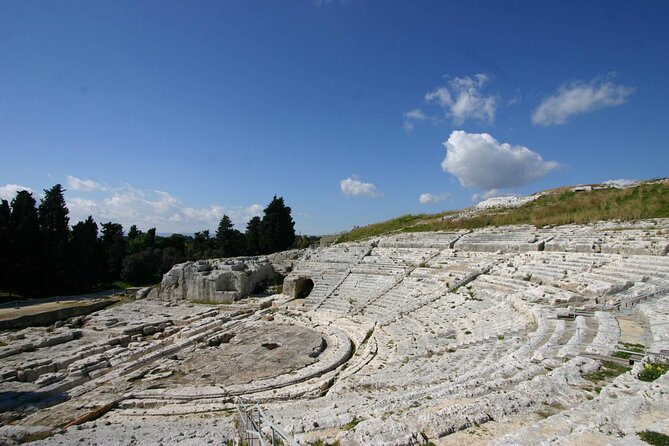
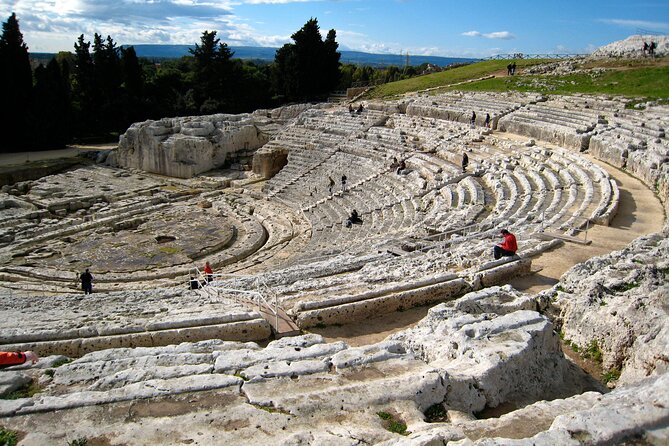
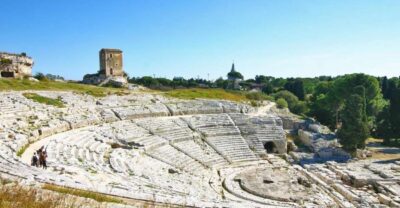
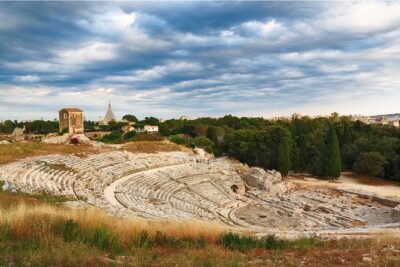
The Greek Theater is the main event for many people. It is one of the largest Greek theaters in the Mediterranean, and its scale gives you an immediate sense of Syracuse’s importance in the ancient world.
A guide is especially useful here because the theater’s size can be hard to grasp from a quick look. From the seating area, you can take in the curved arrangement and the broad open setting. The stone itself is the attraction, but the human story makes the visit more memorable: this was a place designed for public performance and shared civic life.
The tour allows about an hour and a half for the park portion, with the entire experience lasting roughly two hours. That means the Greek Theater receives proper attention, but you should not expect a long, free period to wander every corner at your own speed.
This is also where the walking conditions become important. The site includes some up and down climbing, and much of the park is open to the sun. Wear shoes suited to uneven archaeological paths and bring protection from the heat. The early start is one of the best features of the schedule. The morning can be cooler, and one guide-led visit at 9:00 am was especially valued for the lack of crowds.
The Ear of Dionysus and the old quarries
The Ear of Dionysus is one of the park’s most distinctive sights. It is a tall, curved space cut into the stone, with a name tied to its unusual shape and the myths surrounding it.
This is the sort of place where a guide adds real value. The physical space catches your eye at once, but the stories connected to it give you something to listen for beyond its shape. Your guide explains the legends and history linked to the site, rather than leaving you with a quick photograph and a name.
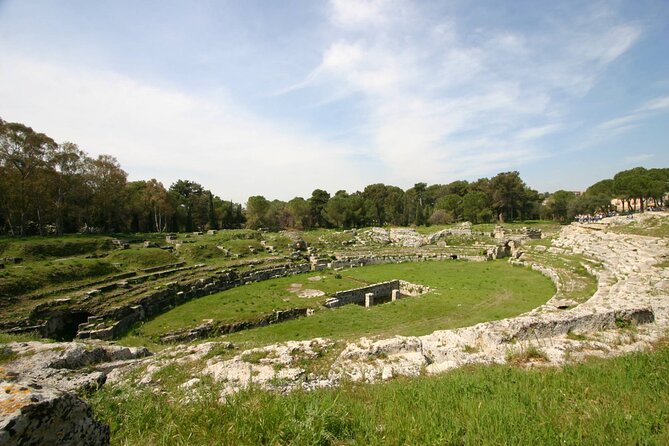
The surrounding latomie are former stone quarries. They show the less polished side of ancient Syracuse. The city’s grand buildings required huge amounts of stone, and these excavated spaces reveal the work behind that architecture.
I like the contrast between the theater and the quarries. One was built for public life and performance. The other reflects extraction, labor and the practical demands of construction. Seeing both in one visit helps you understand the city as a working place, not only as an ancient monument.
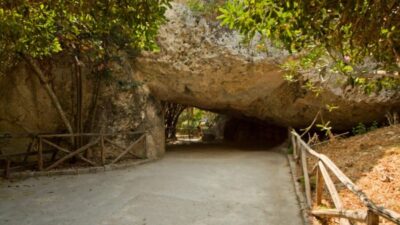
The Cordari Cave adds another layer to the visit. It is part of the park’s network of cut-stone spaces and caves, and it helps show how the site changed over time. The guide links these places to the longer story of Neapolis, including the myths associated with them.
A few more Sicily days worth weighing up
- Etna Morning Trip
★ 4.5 · 1,241 reviews - Syracuse: Boat Trip of Ortigia Island and Sea Caves
★ 4.7 · 937 reviews - Tour of the island of Ortigia and exploration of sea caves with baths.
★ 5.0 · 668 reviews - Pub Crawl Palermo
★ 5.0 · 595 reviews
What the guide adds to a large archaeological site
This is not a tour built around entertainment or fast sightseeing. Its success depends on the guide’s ability to explain a complicated place in a clear order.
Rita has received especially strong praise for her explanations and her command of the site. That is useful here because Syracuse’s story stretches from its Greek beginnings through later periods, and the park contains several kinds of remains. You need someone who can tell you what you are looking at without turning every stop into a long lecture.
The best parts of a guided visit are the connections. You learn not only what the Greek Theater is, but why it belongs beside the quarries. You hear not only the name Ear of Dionysus, but the myths that made the place famous. You get a sense of Syracuse from its first Greek period onward.
The group limit is 25 people. That is not a tiny walking tour, so you may be near the back during explanations or need to stay close to hear clearly. One person found the group a little large, while still finding the walking manageable. If you prefer a private guide or a quiet, unhurried pace, this format may feel too social.
The tour can also be conducted in English and Italian at the same time. That may be practical for the operator, but it can make the presentation longer. If your priority is detailed English commentary at every stop, ask about the language arrangement before booking.
Heat, walking and the best time to go
Sicilian sun can change the feel of an archaeological visit. Much of Neapolis is outdoors, and there is limited reason to count on shade throughout the route. A morning visit is the practical choice.
The 9:00 am start gives you a better chance of cooler air and fewer crowds. It also lets you see the park before the day becomes tiring. By late morning, the open stone areas can feel hot, especially if you are walking at a steady group pace.
The route includes some climbing up and down. Most people can take part, but you should be comfortable walking over an archaeological site for around two hours. The walking was described as manageable, yet the presence of slopes means this is not a flat, effortless stroll.
Bring water and dress for sun, though the supplied information does not specify any equipment or refreshments provided by the operator. The entrance ticket is included, but anything else not listed as included is your responsibility.
Is the $51.66 price good value?
At $51.66 per person, this is not the cheapest way to enter an archaeological park. The value comes from combining the admission ticket with a two-hour guided explanation in English.
If you would otherwise visit the park alone, the tour saves you from arranging the entrance and trying to identify the most important features without help. The Greek Theater, Ear of Dionysus, latomie and Cordari Cave are all included in one organized route.
I think the price makes the most sense for a first visit to Syracuse, especially if you want historical context rather than a quick look around. It is also useful when your time is limited and you want to cover the principal sights in a set morning slot.
The value is less clear if you already know the site well, prefer to read at your own pace, or want to spend a full day exploring every corner. The group size and possible bilingual format also mean you are paying for a shared tour, not a private experience.
The ticket is directly provided by the guide at the meeting point, which removes one small source of confusion. Just remember that the advertised price does not include anything outside the stated inclusions.
Who should book this Syracuse tour?
I would choose this tour if you want a clear introduction to ancient Syracuse and prefer a guide to explain the site as you walk. It suits first-time visitors, people with about two hours to spare, and anyone who wants the main sights organized into one morning visit.
It is a good match for you if you enjoy history, myths and large archaeological remains but do not want to spend time planning your own route. The guide’s explanations are the main reason to book, with Rita offering a particularly strong example of the kind of guide you might have.
Families and older adults may find the length manageable, but everyone should be ready for some climbing. The information says most people can participate, though it does not promise a fully step-free route.
You may want another option if you need a private group, a guaranteed English-only presentation, or plenty of time alone at each sight. A group of up to 25 can be practical and affordable, but it will not feel personal at every moment.
The experience requires good weather and a minimum number of participants. If poor weather or low enrollment cancels the tour, you are offered another date or experience, or a full refund. You can cancel for a full refund up to 24 hours before the start time. Changes or cancellations inside that window are not accepted.
My booking advice
Book this tour for the 9:00 am departure, arrive at least 20 minutes early, and plan for sun and uneven walking. The morning timing is a real advantage, not just a small scheduling detail.
At $51.66, you are paying for structure, admission and historical explanation rather than luxury. For a first look at Neapolis, that is a fair trade. The Greek Theater, Ear of Dionysus, latomie and Cordari Cave make a strong set of sights, and a good guide helps you see how they belong together.
I would book it if you want the ancient Syracuse story in a compact, guided format. I would skip it only if you prefer complete independence or need a tour with a very small group.
FAQ
How long does the guided Neapolis tour last?
The experience lasts approximately two hours. The visit to the Neapolis Archaeological Park is listed as about one hour and 30 minutes.
What sights are included?
The tour includes the Greek Theater, Ear of Dionysus, Latomie and Cordari Cave within the Neapolis Archaeological Park.
Is the entrance ticket included?
Yes. Admission to the Neapolis Archaeological Park is included, and the guide provides the ticket directly at the meeting point.
Where and when does the tour start?
The tour starts at 9:00 am at the ticket office on Via Luigi Bernabò Brea, 96100 Siracusa SR, Italy. You should arrive 20 minutes before the start.
Is the tour offered in English?
Yes, the tour is offered in English. It may also be conducted in English and Italian at the same time.
What happens if I need to cancel?
You can cancel up to 24 hours before the start time for a full refund. Cancellations or changes made less than 24 hours before the experience are not accepted.
Just added around Sicily
- Zafferana Etnea:Honey extraction workshop and honey tasting★ 4.7 · 3 reviews
- From Trapani: Favignana and Levanzo Yacht Tour with Stops★ 5.0 · 4 reviews
- Mt Etna: Winter Trekking Tour with Optional Catania Transfer★ 4.7 · 13 reviews
- Wine tour with wine tasting★ 4.7 · 18 reviews
- Sicilian Soul: Winery Tour, Wine & Food Tasting in Catania★ 5.0 · 4 reviews
- Wine tasting in Catania Historic center★ 4.4 · 15 reviews
- Valley Of The Temples By E-Bike With Picnic Included★ 4.7 · 7 reviews
- Valley of the Temples and Villa Romana Multi-Language Tour★ 4.8 · 5 reviews
Syracuse Archaeological Park Tours, compared.
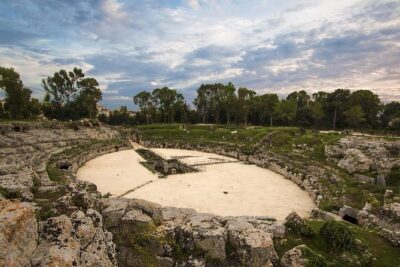
Ancient Syracuse: private guided tour of the Neapolis archaeological park
Read our review →
Group guided tour of the archaeological park of Neapolis
Read our review →Browse the lists this tour appears in