
Reviewed · SYRACUSE ARCHAEOLOGICAL PARK TOURS
Syracuse: Ortygia & Neapolis Archaeological Park Guided Tour
Syracuse comes in two striking parts: the elegant island center of Ortygia and the great ancient monuments of Neapolis. This private tour connects both, taking you from a 2,500-year-old Doric temple to a Greek theater carved into stone, with a guide to explain what you are seeing along the way.
I like the excellent range of sights, especially the chance to enter Syracuse Cathedral and see the columns of its former Greek temple still built into the church. I also like the contrast between Fonte Aretusa, with its freshwater and papyrus, and the huge Ear of Dionysus in Neapolis. The main concern is time: two hours is tight for Ortygia, the cathedral, and the archaeological park, particularly since transport between the two areas is not included.
I also like that the tour is private, with a group limit of 30, and that the guide can lead the visit in English, Italian, French, German, or Spanish. Giuseppe is specifically praised for making the tour entertaining for younger members of a group. At $369.31 for the group, the value depends on how many people join you and whether you are comfortable paying separately for admission and transportation.
Key points at a glance
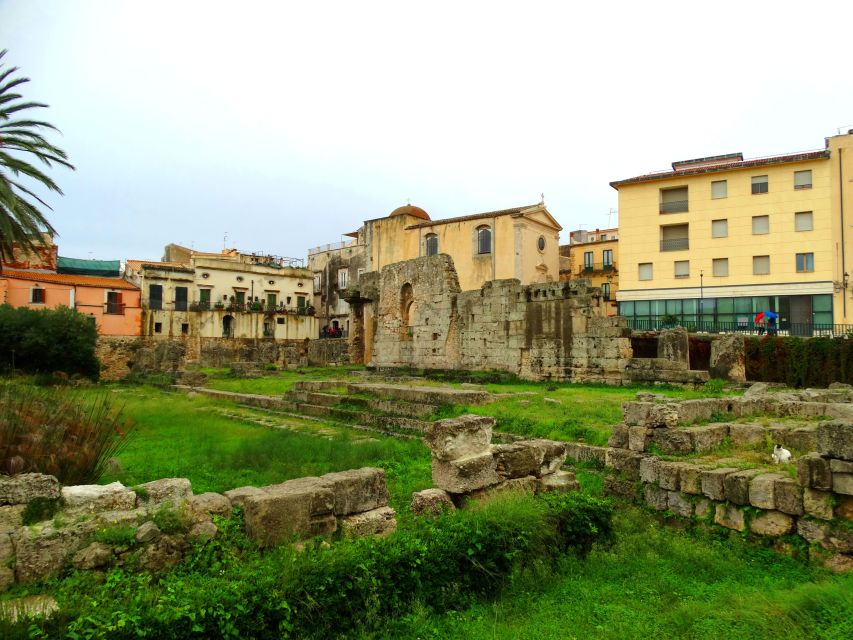
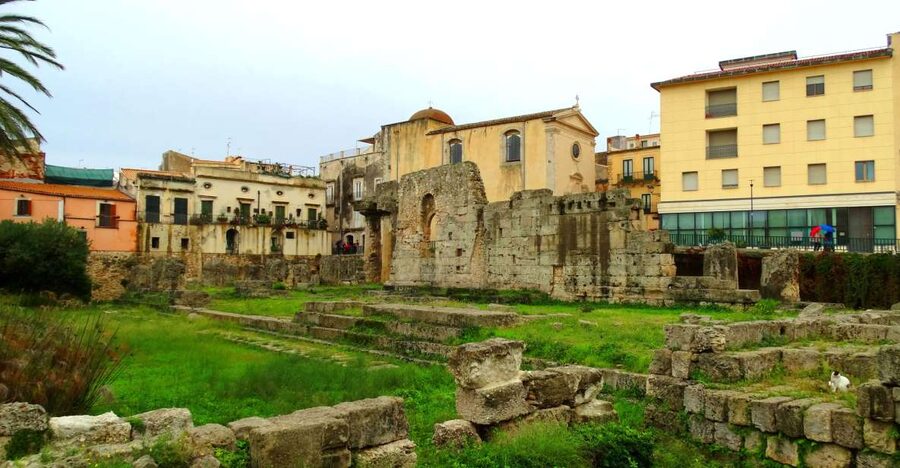
- Temple of Apollo: Begin near the Umbertino Bridge at Sicily’s oldest Doric temple, dating to about 580 BC.
- Syracuse Cathedral: Enter a Baroque and Rococo church built around columns from the ancient Temple of Athena.
- Caravaggio in Ortygia: See The Burial of Saint Lucia inside Santa Lucia alla Badia.
- Fonte Aretusa: Visit the unusual freshwater spring beside the sea, known for fish, ducks, and papyrus plants.
- Neapolis Archaeological Park: See the Roman amphitheater, Hieron’s altar, the Ear of Dionysus, and the Greek theater.
- Private guiding: Choose from five tour languages, with a licensed guide and a group size of up to 30.
Starting on Ortygia at the Temple of Apollo
Your meeting point is on the Umbertino Bridge, beside the statue of Archimedes. Look for the guide’s clearly visible license badge. From here, the route moves onto Ortygia, the historic island center of Syracuse.
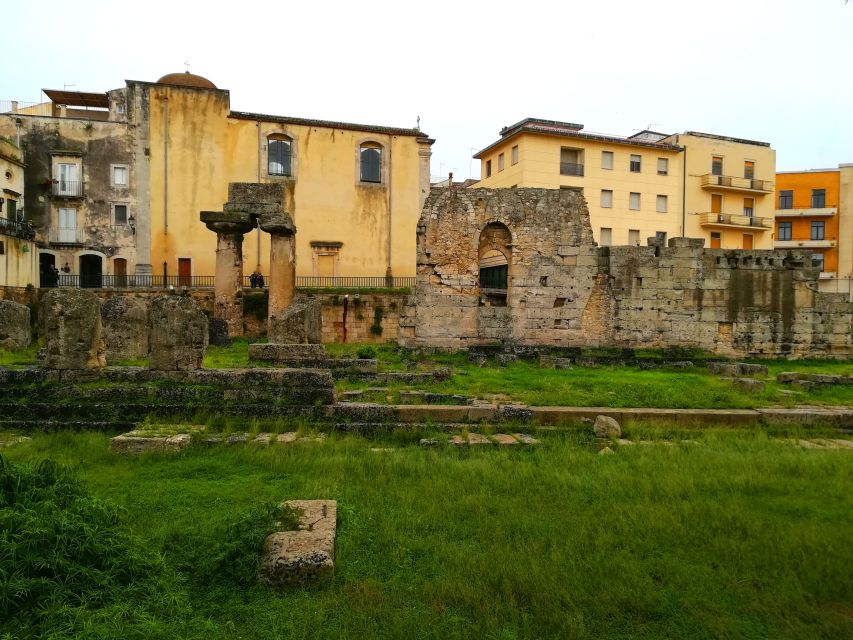
The first major stop is the Temple of Apollo, dating from around 580 BC. It is described as the oldest Doric temple in Sicily, so it gives you an immediate sense of Syracuse’s place in the Greek world. You will not simply be looking at another pile of ancient stones. The remains mark the beginning of a city whose religious and civic buildings were later reused, altered, and built over.
This is a good opening stop because it puts the rest of Ortygia in context. The modern streets and elegant squares come later, but here you begin with the oldest layer of the city. I would pay close attention to the guide’s explanation of how the temple fits into Syracuse’s development, since the value of a guided visit is strongest when the ruins are connected to the city around them.
More visits to the Neapolis park:
- Syracuse: Neapolis Archaeological Park Small Group Tour
★ 4.7 · 350 reviews - Syracuse: Ortigia and Neapolis Guided Walking Tour
★ 4.7 · 205 reviews - Syracuse: Neapolis and Greek Theater guided tour
★ 4.5 · 160 reviews
Piazza Archimede and the Fountain of Diana
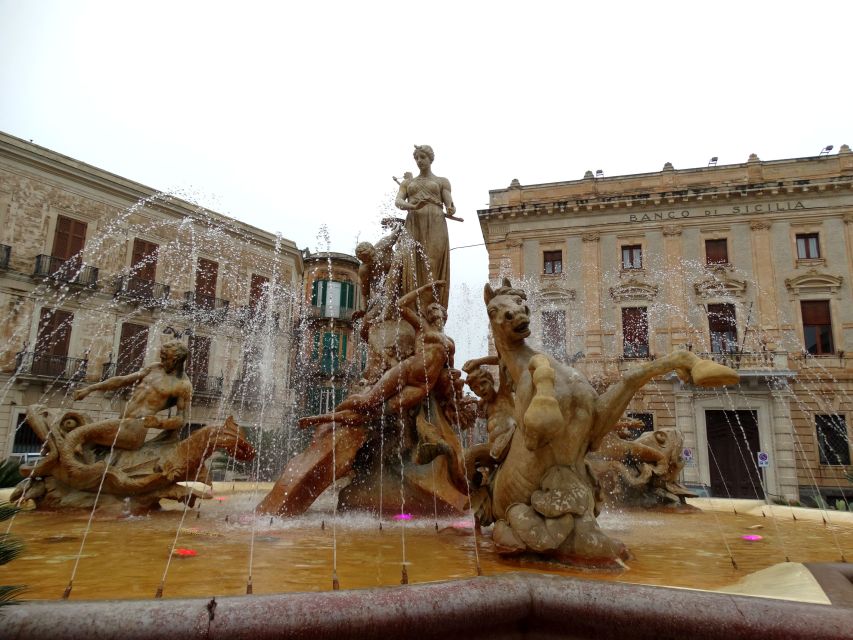
The walk continues to Piazza Archimede, named for the famous Syracusan mathematician. Its centerpiece is the Fountain of Diana, a decorative focal point in the square surrounded by buildings and daily city life.
This part of the tour is less about entering a single monument and more about seeing how Ortygia is arranged. The route through the lanes leads you from the bridge toward the island’s main civic and religious spaces. The short walking sections also give the guide a chance to point out the white limestone buildings and explain the setting without packing every moment with formal sightseeing.
You should expect a walking tour rather than a series of long indoor visits. Comfortable shoes are sensible, and you will want to keep the two-hour schedule in mind. The tour covers a lot, so the guide will need to keep moving.
Syracuse Cathedral and its ancient Greek columns
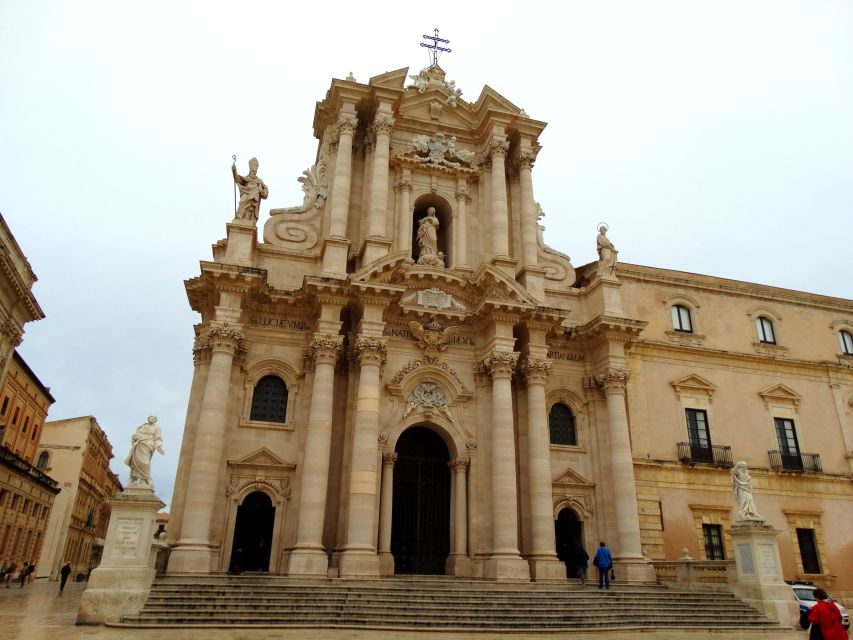
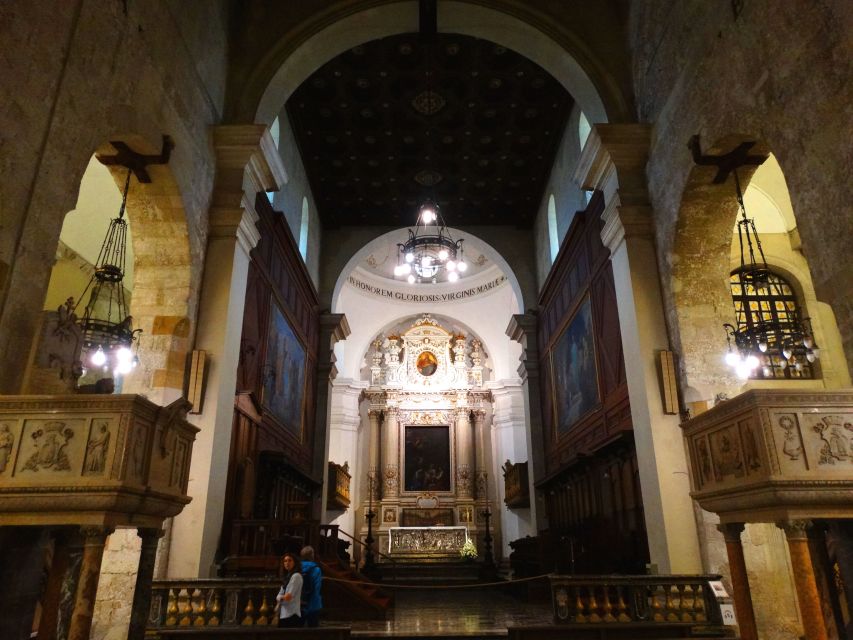
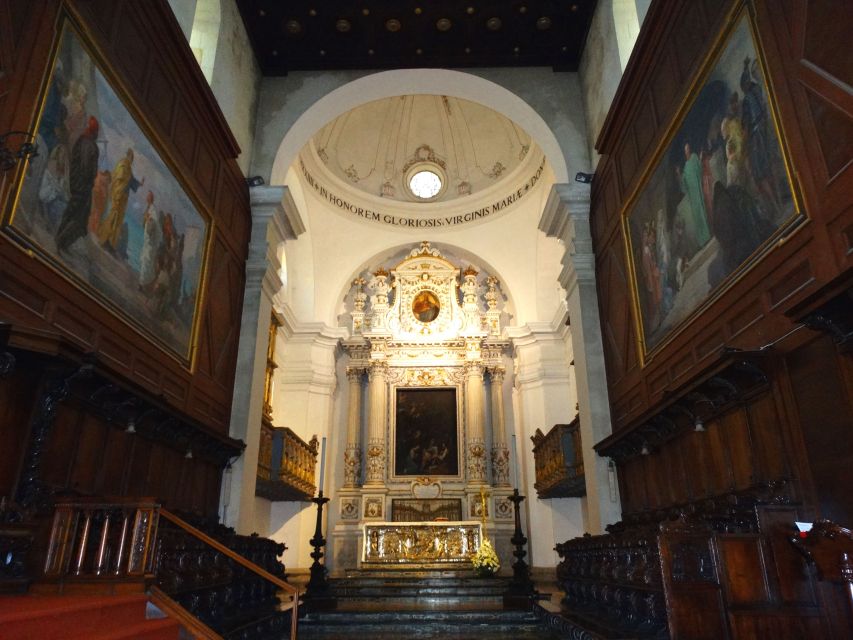
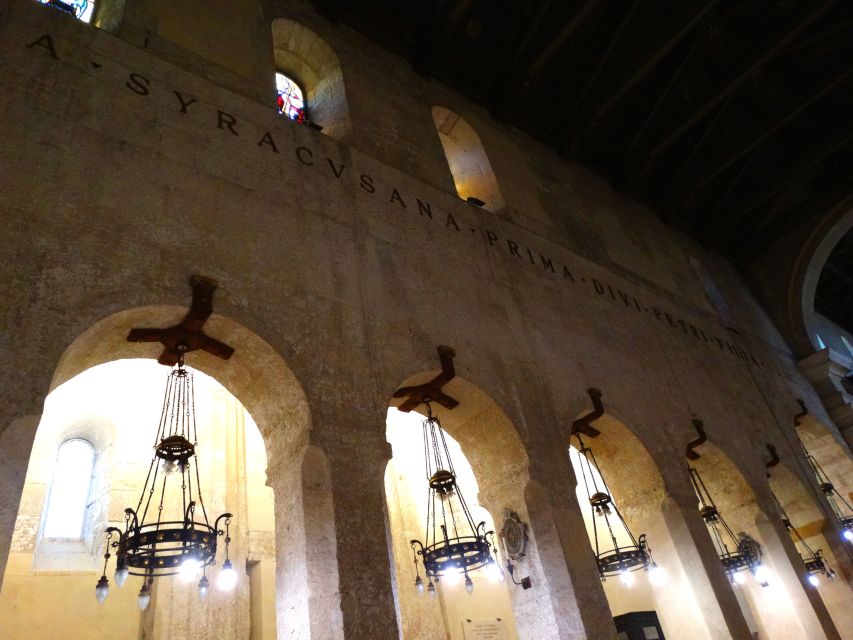
Piazza della Minerva brings you to Syracuse Cathedral, dedicated to the Nativity of Mary Most Holy. The church’s exterior is Baroque and Rococo, with an imposing façade facing a square lined by important buildings, including the Town Hall in Palazzo del Vermexio and Palazzo Beneventano.
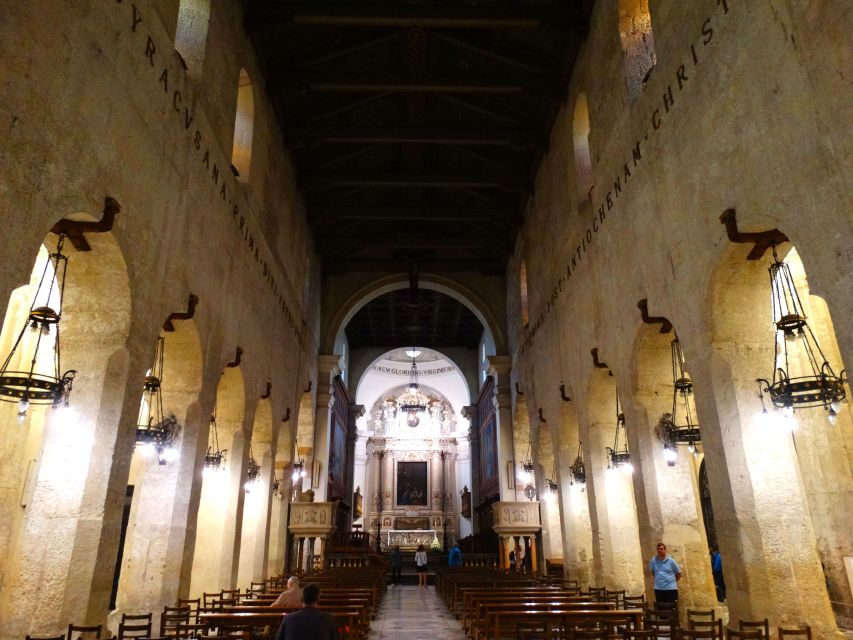
The most unusual feature is inside. The cathedral was founded on the remains of the ancient Temple of Athena, and some of the original Greek columns are still visible within the church. Other portions can be seen from outside, but entering is the key reason to include this stop.
I find this kind of building especially rewarding because it shows how Syracuse’s history is layered in one place. You can see an ancient Greek structure, a Christian church, and later Baroque decoration occupying the same site. It is far more revealing than viewing a detached ruin with no connection to the living city.
The Duomo admission is not included, so budget for a separate ticket. That extra cost is worth considering when comparing this tour with a simple walk around Ortygia. If you want to see the interior and the Greek columns, confirm the current admission arrangements before you go.
Santa Lucia alla Badia and Caravaggio
Near the cathedral is the Church of Santa Lucia alla Badia, another important stop in Piazza della Minerva. Inside is Caravaggio’s The Burial of Saint Lucia.
This gives the Ortygia portion a strong artistic focus. The cathedral shows the city’s ancient foundation and elaborate later decoration, while Santa Lucia alla Badia adds a major painting to the route. The contrast keeps the visit from becoming a parade of similar churches.
The church visit may be brief, especially with only two hours for the full program. Still, the Caravaggio is a worthwhile reason to enter. If this painting is a priority for you, tell the guide at the start so you can make sure the stop receives enough attention within the available time.
A few more Syracuse days worth weighing up
- Syracuse: Boat Tour with Captain Mirko, Snorkeling & Caves
★ 4.7 · 746 reviews - Siracusa: Ortigia Boat Tour with Marine Grotto
★ 4.7 · 617 reviews - Siracusa: Ortigia & Sea Caves Speedboat Tour with Swim Stop
★ 4.9 · 499 reviews - Syracuse: Pillirina, Ortigia, and Sea Caves Tour by Boat
★ 4.6 · 348 reviews
Fonte Aretusa and the Alfeo waterfront
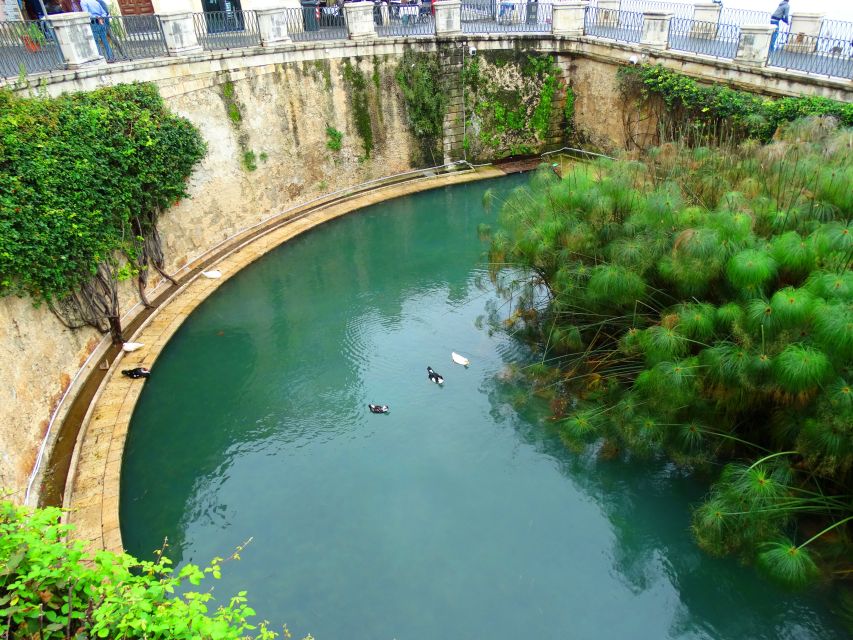
From the square, the route heads toward the sea and Fonte Aretusa. This is an unusual freshwater spring beside the Mediterranean. Fish and ducks live in the water, and papyrus plants grow there.
Fonte Aretusa is one of the tour’s most distinctive stops because it combines nature, city history, and sea views in one small setting. It is not another grand monument. Its interest comes from the odd sight of fresh water and papyrus on an island surrounded by the sea.
A short distance away, the tour reaches the Alfeo waterfront, described as the oldest stretch of seafront on Ortygia. From here, you can look across the water toward the imposing Castle of Maniace, a fortress from the Swabian period. The castle later served as a prison and military barracks, which adds another layer to the view.
This is where the first part of the visit ends. The waterfront is a natural pause before changing locations, but the tour does not include transport to Neapolis. You must arrange the transfer by your own vehicle or public transportation, then return to the stated meeting point when the activity finishes.
Moving from Ortygia to Neapolis
The two parts of Syracuse are not next door. Since transportation is excluded, this tour works best when you have a practical plan for getting from Ortygia to the Neapolis Archaeological Park.
That detail matters more than it may seem. A two-hour guided visit is already compact, and an unplanned transfer can reduce the time available at the archaeological park. Ask about the recommended order and timing when you meet the guide. The activity description says the tour begins and ends at the meeting point on the Umbertino Bridge, so do not assume the guide will provide a ride.
The private format gives you some flexibility to discuss the pace, but the total time remains limited. If your main goal is a relaxed visit to every major monument, you may find the schedule brisk. If your goal is a guided overview of the city’s most important places, the route offers a great deal in a short period.
San Nicolò ai Cordari and the Roman water tanks
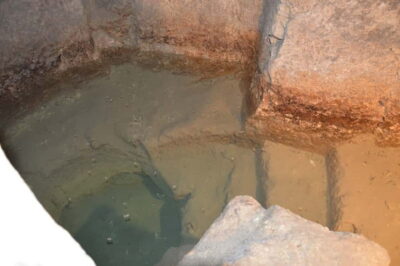
The Neapolis section begins at the Church of San Nicolò ai Cordari, an 11th-century church. In the lower area are the Roman Pool, large water tanks cut into the rock.
Pipes carried water to the Roman amphitheater for nautical games and water fights. That detail helps explain why the tanks matter. They were not just ordinary reservoirs. They formed part of the practical system that supported public shows in the amphitheater.
This is a good example of why a guide adds value at Neapolis. Without an explanation, the carved tanks could look like a minor stop beside the larger monuments. With the connection to Roman spectacles, they become part of the park’s story.
The Roman amphitheater and Hieron’s altar
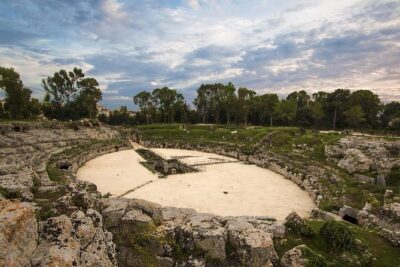
The Roman amphitheater dates from the era of Augustus and was used for several types of shows, including gladiator fights. Its elliptical shape is cut into the rock and arranged over three levels.
The monument gives you a clear change of scale from Ortygia’s squares and churches. Here, the focus is on mass entertainment and the physical organization of a large public venue. The guide can help you understand how the carved structure worked and why the water supply mattered.
Next comes the Altar of Hieron, an immense altar dedicated to Zeus. Bulls were sacrificed here, and the size of the remains hints at the scale of the ceremonies once held at the site.
The altar is less complete than some of the park’s other sights, so this is another place where interpretation matters. You are looking at a large remnant, not a fully restored building. The guide’s explanation gives the stonework a purpose and helps you picture the ceremonies that took place here.
The Ear of Dionysus in the Latomie del Paradiso
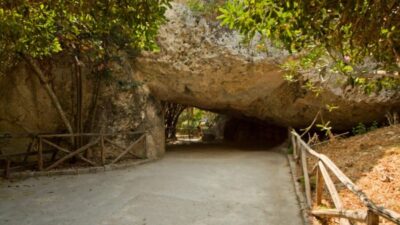
The route continues into the Latomie del Paradiso, quarries that were used to extract stone. The best-known cavern here is the Ear of Dionysus.
The cave is about 23 meters high and famous for its remarkable echo. Its name comes from its ear-like form, while the enclosed shape makes sound the main attraction. This is one of the stops that can engage younger members of a group, since the effect is easy to experience rather than simply observe.
The cave is also a reminder that the park was a working stone site as well as a place of monuments. The rock was removed to build the city, leaving dramatic cuts and chambers behind. I like this stop because it connects construction, geology, and legend in a single space.
Ending at the Greek theater
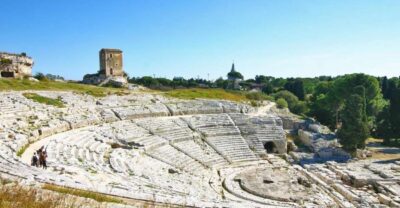
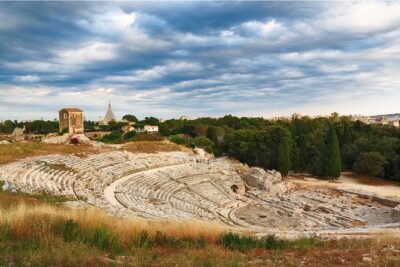
The final major stop is the Greek theater, carved into the stone and regarded as the most important monument in Neapolis. Built by the Greeks and later renovated by the Romans, it brings several periods of Syracuse’s past together.
Ending here makes sense. The theater is the park’s grandest sight on this route, and its location in the rock gives it a strong visual finish. The guide can explain how Greek construction and Roman changes shaped the monument, helping you read the layers rather than seeing only a semicircle of stone seats.
The theater is also where you may most feel the limits of a two-hour visit. It deserves time to look, listen, and take in the scale of the setting. If the earlier stops or the transfer take longer than expected, the final visit could feel rushed. The tour is best treated as a focused introduction, not a slow, all-day examination of every corner of Neapolis.
What the $369.31 group price really means
The listed price is $369.31 for a private group of up to 30 people. That can be fair value for a large family, wedding group, school group, or party traveling together. Split among several people, the per-person cost drops quickly.
For one or two people, the price is harder to justify unless you place a high value on having your own guide and seeing both Ortygia and Neapolis in one organized visit. Admission to Syracuse Cathedral and Neapolis Archaeological Park is extra, and transport between the two areas is also your responsibility.
The price includes the licensed guide, not a complete package of entrance fees and transfers. I would compare the total cost, not just the headline figure. The five language choices and private format add practical value, especially for a mixed-language group or a family that wants to ask questions at its own pace.
The score is 4.7 from three ratings, and Giuseppe is named as a guide who gave an entertaining visit that worked well for younger members of a group. That is useful if you are booking for a family, though it is still a small number of ratings and should not be treated as a guarantee of who will lead your tour.
Who should book this Syracuse tour?
I would choose this experience if you want a single guided overview of Syracuse’s two main historic areas and prefer a private group to a large scheduled crowd. It suits families, friends, and groups who want a guide to connect Greek, Roman, medieval, Baroque, and modern Syracuse.
It is also a good match if you are particularly interested in contrasts: a church built around Greek columns, a freshwater spring by the sea, a Roman amphitheater supplied for water spectacles, and a Greek theater carved from rock.
I would hesitate if you want a slow visit, dislike arranging your own transport, or plan to spend substantial time inside both paid sites. Two hours is ambitious, and the ticket costs are separate. For a larger group, the price becomes more attractive. For a couple, you should decide if the private guide and broad coverage outweigh the total expense.
You can cancel up to 24 hours before the activity for a full refund, and reserve now while paying later. Those policies make the booking less rigid, but they do not change the need to plan the transfer between Ortygia and Neapolis.
FAQ
Where does the tour begin?
The tour begins on Umbertino Bridge at the statue of Archimedes. The guide will have a clearly visible license badge around the neck.
Where does the tour end?
The activity ends back at the meeting point on Umbertino Bridge.
How long does the tour last?
The tour lasts two hours. Starting times depend on availability.
Is transportation between Ortygia and Neapolis included?
No. You must arrange transport by your own vehicle or public transportation from Ortygia to Neapolis and back.
Are entrance tickets included?
No. Tickets for Syracuse Cathedral and the Neapolis Archaeological Park are not included.
Which languages are available?
The live guide is available in English, Italian, French, German, and Spanish.
How many people can join the private group?
The private group can include up to 30 people.
The final call
Book this tour if you want a guide-led introduction to Syracuse that links Ortygia’s churches and waterfront with Neapolis’ major Greek and Roman monuments. The route is ambitious but well chosen, and the private format can make the $369.31 group price sensible for a larger party.
Skip it if you want an unhurried archaeological visit or a package with tickets and transfers included. In that case, plan more time and handle the two areas separately.
Just added around Syracuse
- Etna and Taormina tour from Syracuse with private driver★ 4.5 · 9 reviews
- Vendicari – Sicily’s best coast nature reserve ( Birdwatching & Archeology )★ 5.0 · 8 reviews
- Tour of Montalbano★ 4.5 · 7 reviews
- Etna tour from Syracuse with private driver★ 5.0 · 4 reviews
- Noto, Portopalo and Marzamemi tour from Syracuse with private driver★ 4.5 · 10 reviews
- Syracuse Private Shore Excursion: Archaeological Park and Ortigia★ 5.0 · 5 reviews
- Siracusa Walking Tour with Audio and Written Guide by a Local★ 5.0 · 59 reviews
- Syracuse Scavenger Hunt & Highlights Self Guided Audio Tour★ 4.5 · 4 reviews
Syracuse Archaeological Park Tours, compared.
Ancient Syracuse: private guided tour of the Neapolis archaeological park
Read our review →
Group guided tour of the archaeological park of Neapolis
Read our review →Browse the lists this tour appears in